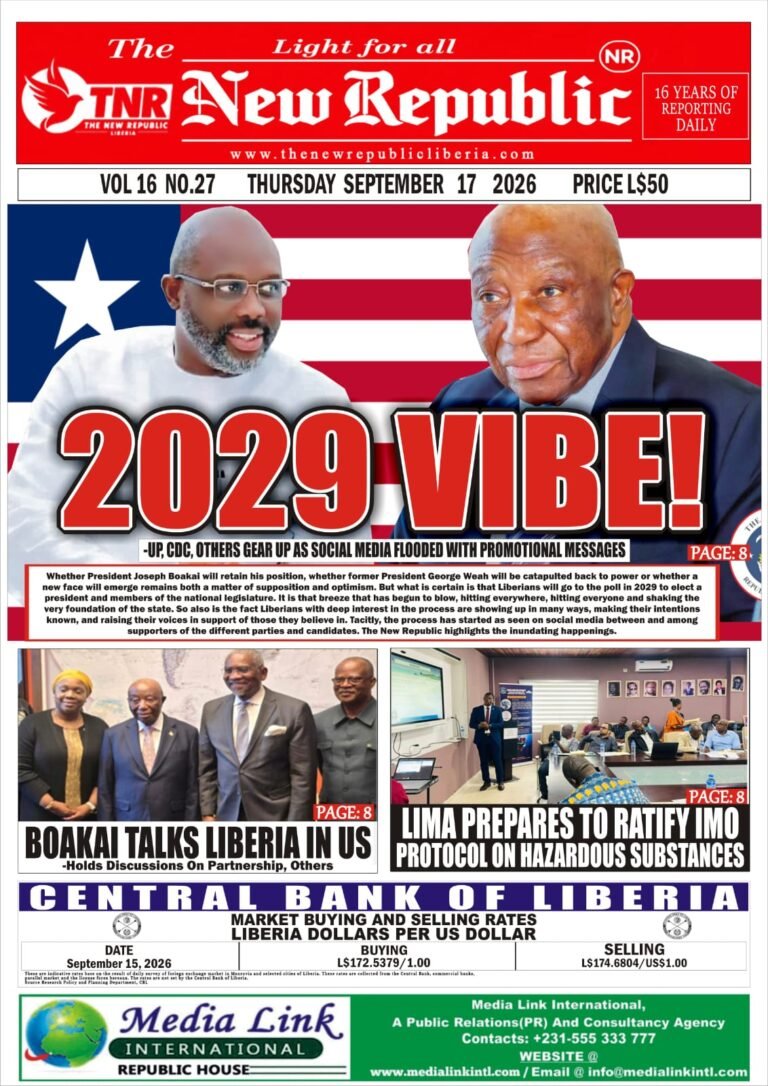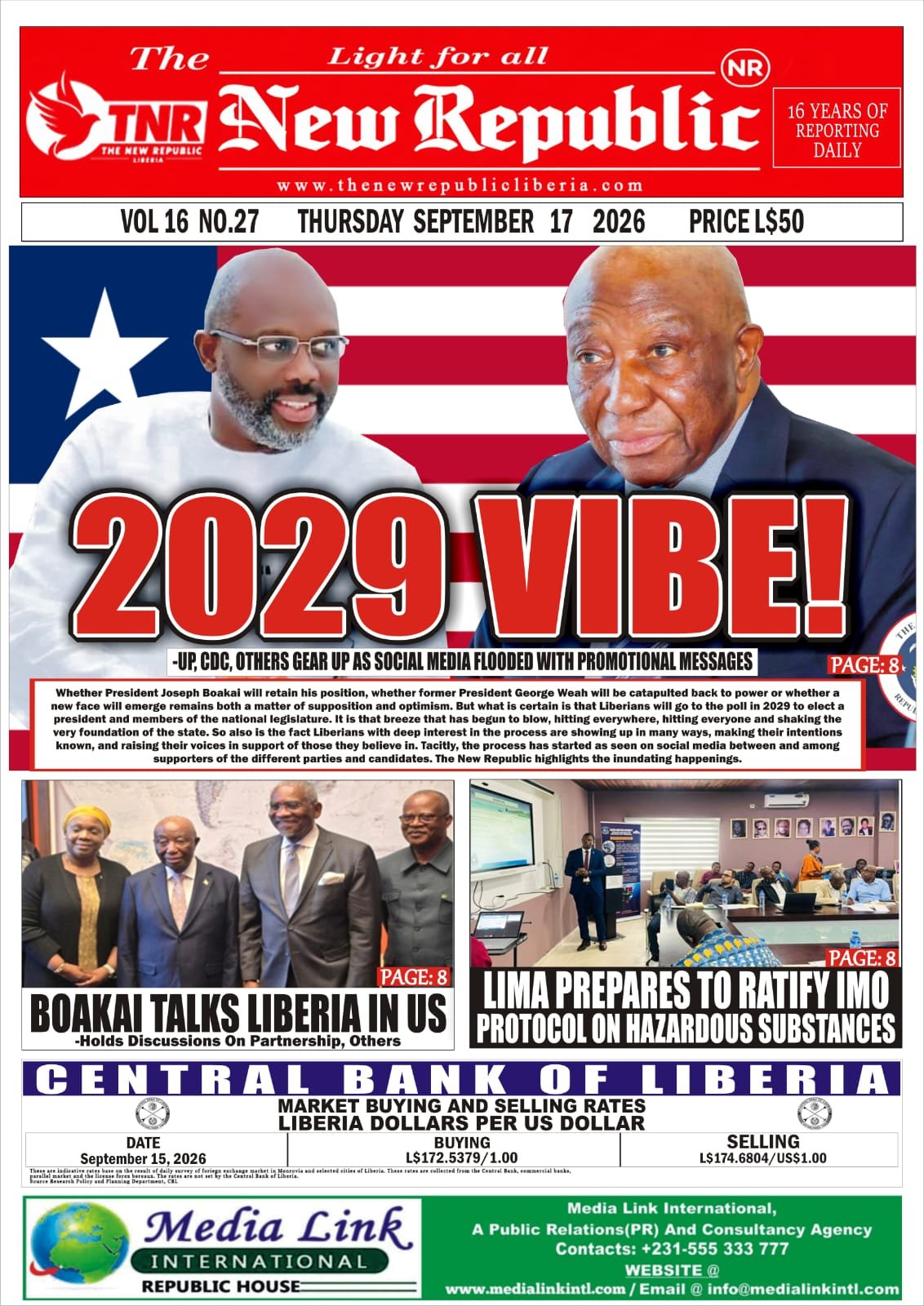
Monrovia-Whether President Joseph Boakai will retain his position, whether former President George Weah will be catapulted back to power or whether a new face will emerge remains both a matter of supposition and optimism. But what is certain is that Liberians will go to the poll in 2029 to elect a president and members of the national legislature. It is that breeze that has begun to blow, hitting everywhere, hitting everyone and shaking the very foundation of the state. So also is the fact Liberians with deep interest in the process are showing up in many ways, making their intentions known, and raising their voices in support of those they believe in. Tacitly, the process has started as seen on social media between and among supporters of the different parties and candidates. The New Republic highlights the inundating happenings.
Although the next presidential election is more than three years away, Liberia is already gripped by 2029 election vibe throughout the length and breadth of the country.
Except for former President George Manneh Weah who has made public his intentions to contest the 2029 electoral showdown, other political leaders, including President Joseph Boakai are yet to make known their interests, though supporters are cascading the political theatre with propaganda – messages of hope and inspiration.
Liberians are witnessing social media platforms being flooded daily with promotional graphics, jingles, videos, and carefully crafted slogans from supporters of the ruling Unity Party, the opposition Coalition for Democratic Change, and other emerging political movements — a sign that early campaigning for 2029 has effectively begun.
For example, platforms like Facebook, TikTok, WhatsApp, and X, timelines are filled with content like “Boakai will finish what he started,” “CDC will take Liberia back,” and “New Liberia is coming.”
Supporters of President Joseph Nyuma Boakai have been sharing videos highlighting road projects, agriculture initiatives, youth programs, and claims of improved revenue under the ARREST Agenda for Inclusive Development, framing them as reasons for continuity beyond 2026.
Pro-Boakai songs such as “that Boakai we want” are blasting on social media along with caricature of president Weah domed in black T-shirt with “I support JNB-JNK for 2029” message – something attributed the UP propaganda.
At the same time, backers of former President George Weah and the CDC are pushing back with their own materials, touting the former government’s infrastructure legacy, youth empowerment programs, and what they describe as the current administration’s slow pace on delivering promises.
Beyond the two major parties, other actors including Alternative National Congress, Liberty Party, and some new political movements are also circulating exploratory messages and testing slogans, keeping their names in public view.
Alexander Cummings of the ANC and Musa Bility of Citizens Movement for Change (CMC) are making their voices heard near and far, signaling to Liberians the need to reset the political landscape, trying a new breed of leaders other than the UP and CDC.
Bility has been making slew of nationwide tour in an effort to identify with the people (electorate), and also popularize himself before 2029.
The opposition community is weighing number of options evident by the two-day consultative discussions held recently under the auspices of former President Weah.
A special committee is said to have been set up to draft a workable plan as opposition parties seek to form a “formidable force” against the UP-Alliance.
Political observers say four factors are driving the early surge, including the 2026 midterm elections where parties see the upcoming senatorial and representative by-elections as a test run for 2029.
They noted that building online energy now helps mobilize structures on the ground, insisting that the 2029 contest will be shaped by who defines success and failure of the current government, and that social media has become the primary battlefield for that narrative.
For others, another factor would be that with over 2 million Liberians active online, Facebook pages and TikTok accounts have become low-cost campaign headquarters because a single viral video can reach more people than a week-long county tour.
Questions about potential candidates, possible alliances, and whether President Boakai will seek a second term are fueling speculation, and supporters are preemptively declaring their positions.
But governance advocates warn that while early political activity is part of democracy, it risks distracting from governance. “Instead of focusing on service delivery, we are already in campaign mode,” said a civil society leader in Monrovia.
“Ministers and lawmakers are spending time responding to political jabs online rather than implementing policies.”
He called on the National Elections Commission (NEC) to provide clarity on what constitutes premature campaigning under the elections law.
Reactions are mixed among ordinary Liberians, with some welcoming the debate as healthy and democratic while others say it is too early and only heightens political tensions.
“We just finished elections in 2023. Now again we are talking 2029? Let the government work first,” said a market seller in Duala, while a university student in Congo Town countered “Politics never stops. Social media is where we talk politics. If you are not there, you are already losing.”
As of now, no political party has officially submitted a notice of intent to contest or held a national convention to select a standard bearer for 2029.
Moreover, the NEC is yet to release its official electoral calendar, but for anyone scrolling through Liberian social media today, one thing is clear that the road to 2029 is already crowded, noisy, and gaining speed by the day.
Above, political analysts claimed the UP is already dominating political conversations online, with a wave of pro- Boakai advertisements flooding social media and fueling early talk about the 2029 presidential election.
Officials of government are members of the UP are pushing the message further by highlighting of lifting pro-government programs – signaling their determination to ensure UP victory in 2029.
The posts feature photos of President Boakai with captions such as “finish what you started,” “AAID working for the people,” and “2029 consolidate the gains.”
Some videos highlight road projects, school interventions, and health sector support attributed to the administration. According to party loyalists, the online push is aimed at countering opposition narratives and showcasing achievements ahead of the 2026 midterm elections. Critics, however, argue it is an early campaign in disguise.
A UP stalwart who spoke on condition of anonymity said: “The people are seeing results. It’s natural that they want continuity. 2029 starts with defending the record today.”
Political analysts note that social media has become the first arena for 2029 positioning. Pro-Boakai content has been shared widely by youth groups, women’s organizations, and county-based support teams aligned to the President.
At the same time, opposition voices have responded with counter-messaging, questioning the pace of delivery under the ARREST Agenda and warning against “campaigning while the people are still suffering.”
“The frenzy shows that 2029 politics has already begun,” a Monrovia-based analyst said. “The battle for narrative, for who defines success and failure, is happening now on your phone.”
Unity Party officials have not officially declared a 2029 campaign, but say the President deserves to be appreciated for his leadership. They maintain the ads are expressions of support from citizens, not a party directive.
President Boakai once told the nation he was not focusing on the next election but the next generation of Liberians, ensuring they have a sustainable foundation of infrastructure development, education, good health facilities, service delivery among others.
With the NEC yet to release a political calendar, the early surge has nonetheless set the tone for what could be a long and heated run-up to 2029.
For now, the message across timelines is clear that the Unity Party is not waiting.
About The Author