
Monrovia-Liberia has outlined five key priorities to guide its engagement at the United Nations Security Council (UNSC) as the country prepares to assume the Council’s Presidency in December 2026.
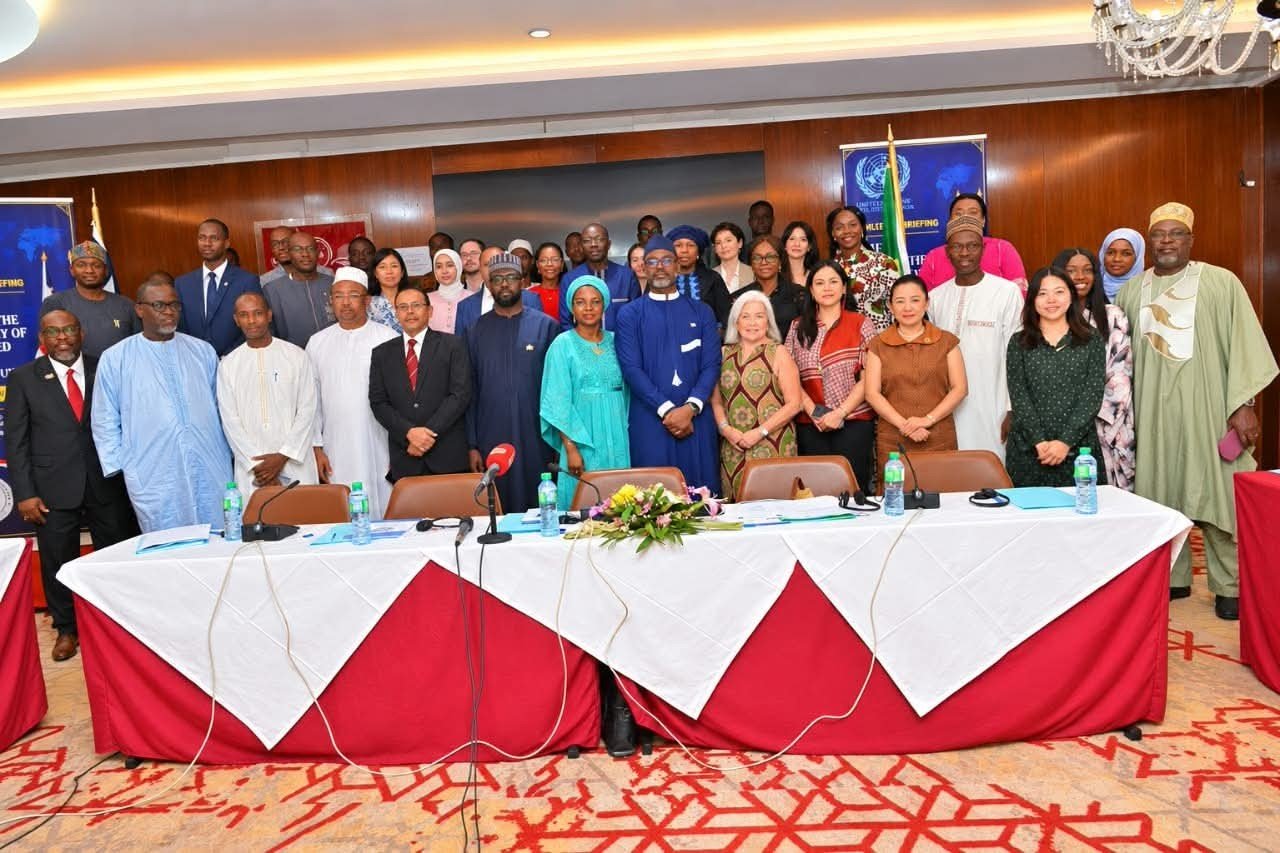
The priorities were announced during a high-level diplomatic briefing convened in Dakar, Senegal, by Liberia’s Ambassador to Senegal, the Gambia, Guinea-Bissau, Cabo Verde, and Mauritania, H.E. Ambassador Ali Sylla.
The briefing brought together members of the diplomatic corps, representatives of international organizations, and other distinguished guests to discuss Liberia’s upcoming leadership role and its commitment to promoting international peace and security.
Speaking at the event, Ambassador Sylla highlighted the importance of Liberia’s return to the Security Council after more than six decades, describing the achievement as a major milestone in the country’s diplomatic history.
He said Liberia’s renewed presence on the Council was made possible through the collective efforts of successive administrations, generations of Liberian diplomats, international partners, and the resilience of the Liberian people.
Under the theme, “Advancing International Peace and Security, African Priorities and Partnerships for Sustainable Development,” Ambassador Sylla outlined five priority areas that will guide Liberia’s engagement at the Security Council.
These include Women, Peace and Security; Youth, Peace and Security; Climate Change, Conflict and Natural Resources; Regional and Subregional Security; and Security Council Reform and Peacekeeping.
The Liberian Ambassador also commended President Joseph Nyuma Boakai Sr. for his leadership in strengthening the country’s international engagement and diplomatic partnerships.
According to Ambassador Sylla, Liberia’s upcoming presidency presents an opportunity for the country to contribute meaningfully to discussions and decisions affecting global peace and security.
The diplomatic briefing also featured remarks from representatives of regional and international institutions, who welcomed Liberia’s upcoming leadership role and encouraged the country to draw on its experience in peacebuilding and post-conflict recovery.
ECOWAS Resident Representative in Senegal, Zelma Nobre Fassinou, encouraged Liberia to advocate for stronger United Nations peacekeeping operations, drawing from its own experience of conflict, recovery, and reconciliation.
Similarly, United Nations Resident Coordinator in Senegal, Aminata Maiga, expressed hope that Liberia would use its position to contribute to building a more inclusive and effective international security system.
For his part, Sudan’s Ambassador to Senegal, Abdelghani Al-Naeem Awad Al-Karim, recognized Liberia’s transformation from years of conflict to lasting peace.
He noted that Liberia’s experience offers valuable lessons for addressing global security challenges and strengthening international efforts toward peace.
Liberia’s upcoming Security Council presidency is expected to provide the country with an important platform to advance its diplomatic priorities, strengthen international partnerships, and contribute to discussions on pressing global security issues.
The development also represents a significant shift in Liberia’s international role, from a country that once depended on international peacekeeping support to one preparing to help shape decisions on global peace and security.
Meanwhile, Liberia’s diplomatic missions around the world are intensifying outreach efforts to raise awareness of the country’s 2026–2027 Security Council membership, promote its priority areas, and mobilize international support ahead of its December presidency.
Through these coordinated diplomatic engagements, Liberia is seeking to strengthen its position as an active contributor to international peace, security, and sustainable development.
….…………………….
The November 4, 2026 MIDA lists 22 public infrastructure projects. Eight are Primary Projects with a combined base cost of US$4.4513 billion, including land acquisition and resettlement compensation. The other 14 require separate signed Project Proposal Agreements. Article 3.4 also provides for a separate 60 MW biomass plant and transmission line for BMMC’s mining operations.
- Eight Primary Projects
| # | Project | Scope | Base cost |
| 1 | VIA Hydropower Plant | 100 MW on the VIA River. Reservoir of 8.7 billion m³ at a water level of 255 m. | US$2,070.60 million |
| 2 | SP-4 Hydropower Plant | 10 MW on the St. Paul River. Reservoir of 1.2 billion m³ at 256 m. The works include a water transfer channel and tunnel. | US$634.44 million |
| 3 | SP-3 Hydropower Plant | 100 MW on the St. Paul River. Reservoir of 46 million m³ at 195 m. | US$1,170.96 million |
| 4 | Public Biomass Power Plant | 60 MW near the VIA Dam, connected to the national grid for public electricity supply. Includes equipment for cutting, sizing and transporting feedstock. | US$147.90 million |
| 5 | Main Transmission Line | 150 km, 300 MVA, connecting the four public power plants to the existing Mount Coffee substation. | US$76.50 million |
| 6 | Nimba Transmission Line | 150 km, 100 MVA, from the VIA Power Plant to Nimba County, including an endpoint substation. | US$53.04 million |
| 7 | Bong Transmission Line | 5 km, 60 MVA, branching from the VIA–Mount Coffee line to Bong County, including an endpoint substation. | US$13.26 million |
| 8 | Liberia Development Road | 146 km. The agreement gives the length and a minimum 40 m right-of-way. It leaves the route and endpoints unspecified. | US$234.60 million |
| Eight-project subtotal | Includes design fees. | US$4,401.30 million | |
| Expropriation and resettlement compensation | Primary Projects only. | US$50.00 million | |
| Total Base Cost | Before applicable taxes and adjustments. | US$4,451.30 million |
The three hydropower plants provide 210 MW and have a combined stated reservoir capacity of 9.946 billion m³. The public biomass plant brings total installed generation for public supply to 270 MW, supported by 305 km of primary transmission lines. Annex B gives a combined base cost of US$3.876 billion for the three hydropower projects and gives no separate reservoir-only prices.
The 146 km Liberia Development Road averages US$1.61 million per km at base cost, including design and before indexation. Annex D indexes the road cost and fixes the base costs of the seven primary power and transmission projects.
Source: Article 3.1 and Annexes A, B and D.
- Fourteen projects requiring further approval
| # | Project | Scope |
| 9 | National Grid Reinforcement | Upgrade substations, transformers and the 66 kV network serving Monrovia. The detailed scope is subject to one or more Project Proposal Agreements. |
| 10 | Bomi to Gbarpolu Road | Tubmanburg to Compoundzu. |
| 11 | Brewerville–Bopolu Road | Brewerville to Bopolu. |
| 12 | Cestos Road | Cestos Junction to Cestos City, one lane in each direction. |
| 13 | Coastal Road | Cestos Junction to Greenville City and Greenville Port. |
| 14 | Gbarnga–Kokoyah–Compound 3–Buchanan Road | Gbarnga through Kokoyah and Compound 3 to Buchanan, across Bong and Grand Bassa counties. |
| 15 | Greenville–Klowne Town Road | Coastal road from Greenville to Klowne Town, one lane in each direction. |
| 16 | Kesselly Boulevard Bridge | Road from 12th Street via the new bridge to Bardnesville Junction. |
| 17 | Lofa Road | Konia to Voinjama. |
| 18 | Monrovia Paved Road | Concrete-paved road in Monrovia. The agreement leaves the alignment unspecified. |
| 19 | Nimba Road | Connects Saclepea, Boutuo, Bahn and Karnplay. |
| 20 | Pleebo–Big Suehn Junction Road | Covers two stated sections, Pleebo to Barclayville and Grandcess to Big Suehn Junction, with one lane in each direction. |
| 21 | Sengeh–Mbaloma–Gongu–Kinjor–Bandela Road | Connects the five communities in Grand Cape Mount County. |
| 22 | Tubman Boulevard Road and Bridge | Road works on Tubman Boulevard and a new bridge with two lanes in each direction. |
The 13 additional road and bridge projects share a US$1 billion base-cost cap. The Government and BMMC must agree on their priority order, and proposals proceed one at a time. A project can be skipped if its proposed base cost exceeds the remaining allocation or the Government misses the decision deadline. Once the allocation is fully committed, further road works require a separate written agreement. This version gives no individual lengths or prices for these 13 projects.
The National Grid Reinforcement has its own US$230 million base-cost cap. If both allocations are fully used, they bring the US$4.4513 billion primary package to US$5.6813 billion on a base-cost basis, before applicable adjustments and other charges.
Source: Articles 3.8, 3.9, 3.12 and 3.13 and Annexes A and B.
- Separate BMMC mining project
BMMC will fund a 60 MW build-operate-transfer biomass plant near the VIA Dam under a separate contract. It includes a 150 km, 60 MVA transmission line to BMMC’s concession and an endpoint substation. BMMC and its affiliates have exclusive use during mining operations. The agreement provides for transfer to the Government through LEC when those operations end, generally at no charge, with a fair-market-value exception for specified Government defaults. BMMC bears the cost as its own capital investment, and the project is ineligible for set-off. Source: Articles 3.4–3.6.
What the agreement fixes on delivery
Only three public projects have a fixed two-year completion period under Article 15.1. These are the public biomass plant, the Main Transmission Line and the Bong Transmission Line. The clock starts when the last applicable condition is met, including effectiveness, required land and right-of-way handover unless otherwise agreed, and an executed Implementation Agreement. For the other public projects, including all three dams, the agreement ties completion timing to the availability of entitlements for set-off. Annex C contains a milestones heading but no milestone schedule in the copy reviewed.
BMMC pays approved public project costs and recovers them by offsetting eligible amounts against obligations covered by the agreement. MAPA is named as the engineering, procurement and construction contractor. The agreement assigns operation and maintenance of public power and transmission assets to LEC and of the road and bridge assets to the Ministry of Public Works. Source: Articles 2, 4, 15 and 18 and Annex C.
About The Author