
Legal Advisor Keita
By Jamesetta D. Williams
Monrovia-The Liberian Government has defended its proposed US$5.7 billion Master Infrastructure Development Agreement (MIDA), assuring the public that the project will not create additional debt for the country, as it is expected to be financed through projected revenue from the Bea Mountain mining operation.
The defence and clarification come amid public concerns of the MIDA.
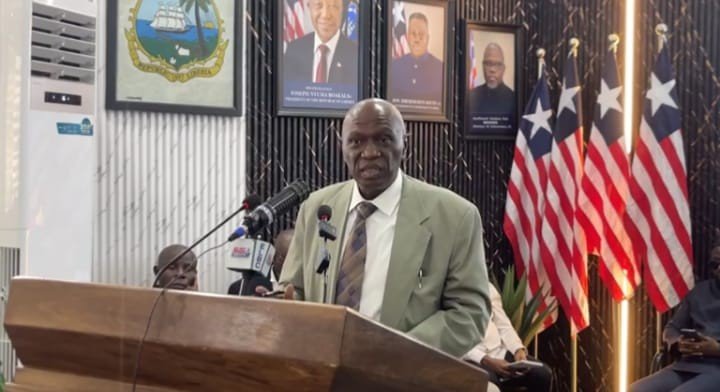
But at the Ministry of Information press briefing Tuesday, Presidential Legal Adviser Cllr. Busheben Keita said the agreement is designed to address two major challenges affecting Liberia’s development: inadequate electricity generation and poor road connectivity.
Keita described the agreement as the largest infrastructure investment in Liberia’s history, explaining that it seeks to use revenue expected from the Bea Mountain Mining Company in Grand Cape Mount County to finance major national infrastructure projects.
He said the government expects to benefit from increasing revenue from the mining operation as the company begins declaring profits, with projections indicating that Liberia’s earnings will grow in the coming years.
According to him, the government has decided to channel the projected revenue into infrastructure development rather than simply receiving the funds through the national budget and deciding how to spend them.
Addressing concerns about whether the agreement would push Liberia into debt, Keita said the project is structured to be financed through revenue from the Bea Mountain operation rather than conventional government borrowing.
He explained that the agreement has been designed to prevent other sources of government revenue from being used to settle payments under the project.
Keita further stated that even if the five-year construction period ends before the contractor is fully paid, any outstanding balance would continue to be settled through revenue from the Bea Mountain mining operation.
He said the arrangement is intended to protect the country’s other revenue sources and reduce the possibility of Liberia taking on additional financial obligations.
The Presidential Legal Adviser also addressed concerns that the construction company could inflate project costs because it is bringing its own construction firm to execute the work.
He said the government would independently hire an owner’s engineer to represent Liberia and monitor construction activities.
The Liberia Electricity Corporation (LEC) would also participate in supervising the project, while the government would retain the right to conduct independent audits at different stages of construction.
According to Keita, the agreement provides for financial penalties if overpricing or overcharging is discovered, with the penalties increasing if the violations continue.
He maintained that these safeguards are intended to ensure transparency, accountability and value for money throughout the implementation of the project.
On electricity generation, Keita said the agreement goes beyond the construction of a hydroelectric dam and reservoir, as it also includes transmission lines and substations to improve electricity supply across Liberia.
He disclosed that the project is expected to initially generate at least 270 megawatts of electricity, with the potential to reach a total capacity of 1,000 megawatts.
He said the additional power would increase Liberia’s electricity supply without replacing the country’s existing generating capacity.
The project will also include the construction of transmission lines connecting the hydroelectric facility to Bong County and other parts of the country, including areas with major mining and concession operations.
Keita said the additional substations would help reduce pressure on existing facilities and support the expansion of electricity to more communities.
He argued that inadequate electricity has continued to discourage investment, forcing some businesses and potential investors to consider neighboring countries where power supply is more reliable.
Beyond electricity generation, Keita disclosed that at least US$1 billion of the agreement is expected to be allocated to road infrastructure.
He said several road projects have been identified for inclusion in the agreement, although the government has not finalized the complete list.
Among the proposed projects are roads connecting Bomi County to Bopolu in Gbarpolu County, Cestos Junction to Cestos City and Greenville, as well as the Gbarnga-Kokoyah-Compound Number Three road.
The agreement also includes the construction of the 12th Street Bridge, connecting Banov Junction to 12th Street, the completion of the remaining section of the Low Cost Road project, and approximately 75 kilometers of community roads across Monrovia.
Keita further disclosed that additional road projects would be undertaken in Grand Kru and other counties to improve connections between major towns and existing road networks.
He said the hydroelectric project itself would require the construction of at least 146 kilometers of access roads to connect different project locations.
Keita also announced that Grand Cape Mount County is expected to receive no less than US$50 million annually throughout the five-year construction period.
He said the county would have the authority to determine how the funds should be used to support its development.
According to him, the arrangement recognizes that the mineral resources financing the project are coming from Grand Cape Mount County, and the county should also benefit from the investment.
On the expected timeline, Keita said the government anticipates that the benefits of the hydroelectric project will begin to become visible within two years as construction progresses.
He also explained that the agreement is expected to complement the electricity distribution program of the Millennium Challenge Corporation (MCC).
According to him, while the infrastructure agreement focuses on electricity generation and transmission, the MCC program will support distribution, helping to extend electricity to more towns and communities across Liberia.
He said the two initiatives are expected to work together to improve access to electricity nationwide.
Keita maintained that the government believes addressing electricity and road infrastructure challenges is necessary to attract investors, expand economic activities and improve living conditions.
He said the government had decided to pursue a major infrastructure investment rather than continue depending on smaller loans and separate projects that may not adequately address the country’s long-standing development challenges.
The agreement, which has been signed by the relevant parties and government officials, is expected to be submitted to the National Legislature following the President’s planned signing for consideration.
Keita urged Liberians to understand the objectives of the agreement, emphasizing that the government’s intention is to use projected mining revenue to address the country’s infrastructure challenges while putting safeguards in place to protect public resources.
About The Author