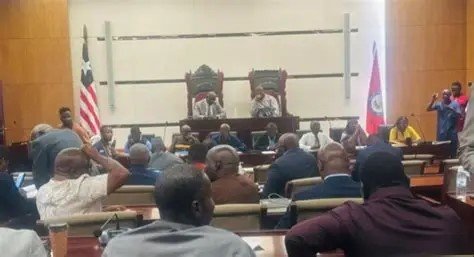
Monrovia-Liberia’s mining sector reform redux is in the offing after the House of Representatives endorsed a comprehensive review of the mining sector, with a strong focus on curbing illegal and illicit mining following a report from its Mines and Energy Committee, which has been forwarded to its Committee on Ways, Means, and Finance.
The endorsed report recommends allocating $1.5 million in the 2027 draft national budget to drive sweeping reforms across Liberia’s mining sector.
Plenary took the decision on Thursday, October 15, 2026, during its second-day sitting of the third quarter of the third session.
According to a press release issued by the House Press Bureau, plenary’s decision followed a comprehensive standing committee report highlighting illegal mining operations and severe environmental damage across the nation.
The report submitted warns that piecemeal legal amendments cannot adequately address the deep structural problems currently facing the entire mining industry.
Among the major concerns raised in the report are the widespread use of illegal excavators in forested areas, rampant mineral smuggling, and unlawful foreign participation in small-scale mining.
The committee added that, critical logistical constraints and manpower shortages continue to severely hinder the Ministry of Mines and Energy from effectively enforcing existing mining laws and regulations.
It says under the proposed reform plan, the Law Reform Commission will manage the requested funding to conduct extensive technical and legal reviews of the sector.
The allocation will also support nationwide stakeholder consultations involving local mining communities, traditional leaders, civil society groups, and environmental organizations.
This comprehensive reform aligns with Liberia’s international commitments under the Inter-Ministerial Coordinating Mechanism for the second Millennium Challenge Compact project arrangement.
The Joint Committee on Ways, Means, Finance, and Development Planning will now review the financial proposal ahead of the upcoming fiscal budget deliberations.
Liberian Senator Urges US Sanctions Over Mining Concessions and State Capture Liberian Senator Amara Konneh has urged the US to impose Global Magnitsky sanctions on mining enablers, warning of state capture by foreign giants and cartels.
The House mining sector reform consideration comes amid recent call by Senator Amara Konneh for the United States government to impose targeted sanctions on individuals and entities facilitating controversial mining agreements.
He told a roundtable discussion in Washington last week that a convergence of powerful mining giants and illicit drug cartels is driving Liberia toward complete state capture.
The intervention highlights the growing frustration among reformist politicians who feel that domestic institutions are too compromised to hold multinational concessionaires accountable for the exploitation of the country’s vast natural resources.
Konneh’s call specifically invokes the Global Magnitsky Act, a powerful US legislative tool that authorizes the Treasury Department to freeze the assets and ban the travel of foreign officials and business figures implicated in severe corruption or human rights abuses.
At the heart of the controversy are the deeply unequal terms of Liberia’s mineral development agreements, particularly those involving iron ore and gold extraction.
Recent compliance investigations by the Liberia Extractive Industries Transparency Initiative (LEITI) have scrutinized the operations of industry behemoths such as ArcelorMittal Liberia and Bea Mountain Mining Corporation. Despite generating massive revenues from Liberian soil, the state’s actual capture of this wealth remains strikingly low.
For instance, while Bea Mountain generates an estimated 1.62 billion dollars annually from its gold mining operations, the Liberian government receives only about 48.6 million dollars, representing a mere three percent of the export value.
Lawmakers are currently investigating allegations that these concession agreements were negotiated opaquely, potentially involving corrupt inducements that prioritize the interests of foreign executives and their local enablers over the welfare of the Liberian people.
At a recent Government Town Hall in Tubmanburg, citizens pushed for tougher actions to curb ongoing mishaps that have the potential to deny government legitimate and basic revenue.
Reports of illegal mining activities have inundated the national political theatre for years, with little action on the part of stakeholders, the national government, to remedy the situation.
Since the administrations of former presidents Ellen Johnson Sirleaf and George Weah, the problem is said to remain unabated with reports pointing to foreigners overshadowing the sector, denying government and host communities of requisite revenue benefits.
President Joseph Boakai recently established a taskforce on illegal mining as a way of quelling the situation.
The Town Hall, the fourth edition, focused on the extractive industry and the mining sector’s role in national revenue generation, economic growth, and Liberia’s transformation agenda.
Various speakers and presenters weighed in on how the country is losing millions of dollars due to lack of accountability, transparency in the sector.
Acting Superintendent Alphonso Sherman was one of those who called for greater transparency, accountability, and community participation in Liberia’s mining sector, stressing that the country’s mineral wealth must translate into tangible development for communities hosting mining operations.
Sherman said the county’s long history of mining, dating back to the days of the Liberia Mining Company (LMC), makes it an appropriate place for discussions on the extractive industry and its contribution to national development.
The town hall meeting focused on Liberia’s extractive industry, particularly the mining sector’s contribution to national revenue, economic growth, and the country’s transformation agenda.
Sherman said the benefits of mining should be reflected in improved public services and infrastructure, including roads, schools, clinics, and hospitals.
He questioned how the substantial revenue generated from Liberia’s natural resources could be translated into visible improvements in the living conditions of citizens, particularly those residing in communities where mining activities take place.
According to him, the country must move beyond extracting natural resources and focus on ensuring that the proceeds contribute meaningfully to community development.
“These are the questions we must address today as we move from extraction to transformation and ensure that the benefits of our natural resources reach the people,” Sherman emphasized.
The Bomi County Acting Superintendent also called for increased support from the Ministry of Mines and Energy to formalize informal mining activities, enabling miners to operate legally and safely.
He said formalizing the sector would allow miners to contribute to government revenue while improving their working conditions.
Sherman noted that cooperation between local authorities and the relevant government institutions is necessary to address the challenges confronting people engaged in informal mining.
He stressed that mining activities must be conducted in ways that promote legal compliance, protect workers, and contribute to the country’s development.
Sherman further emphasized the need for mining companies to be transparent about their commitments to host communities, particularly regarding the benefits and development projects expected from their operations.
He said residents need clear information about what mining companies have agreed to provide and whether those commitments are being fulfilled.
About The Author