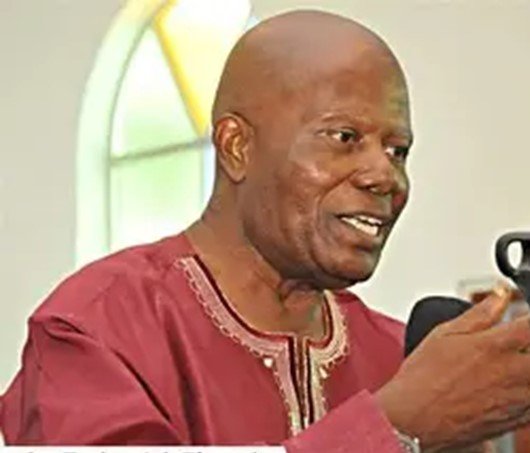
The Liberian People’s Party, LPP, on Saturday paid glowing tribute to its 1997 and 2005 presidential candidate, Comrade Dr. Togba-Nah Tipoteh, as he marks 85 years of life, describing him as a revolutionary icon who paid the price for democracy in Liberia.
In a statement signed by Acting Assistant Secretary for Press and Publicity, Darius David Sumo, the LPP said Dr. Tipoteh “is not just an individual. He is a chapter in Liberia’s history” who belongs to the generation that faced exile, prison, dismissal and death for speaking out.
Born August 24, 1940, Dr. Tipoteh’s academic journey took him from St. Patrick’s and CWA in Liberia to Ohio University, Ohio State University, and a PhD in Economics from the University of Nebraska at age 27.
Instead of pursuing personal comfort, the LPP said, he returned home in 1971 to serve ordinary Liberians. At the University of Liberia, he helped establish the College of Business and Public Administration and founded the Liberian Economic and Management Research Institute, LEMRI, to ensure research addressed real national problems.
The party recalled that because of his bold positions, he was dismissed four times from the university and reinstated four times following student and faculty agitation. “On the fifth, he walked out to directly serve the people of Liberia,” the statement noted.
The LPP credited Dr. Tipoteh as a key architect of two major progressive movements.
In 1971, drawing from Mao Zedong’s Mass Line, he helped formulate SUSUKUU, a self-help, self-governing movement that encouraged rural Liberians to “use what you have to improve your condition.” From Grand Gedeh to Lofa, the party said Susukuu became “the most practical model of community development Liberia has ever seen.”
In 1973, he co-founded the Movement for Justice in Africa, MOJA, to raise political consciousness and challenge the status quo through nonviolent means.
Dr. Tipoteh has served as Budget Advisor to President Tolbert, Minister of Planning and Economic Affairs, Chair of the African Group of Governors at the World Bank and IMF, and Senior UN Advisor. Throughout, the LPP said, his core message remained “center the poor, democratize the economy, respect the people.”
Beyond policy, the party noted his cultural impact — his African attire, “Tipoteh slippers,” baritone voice, and return to his ancestral name — as symbols of African pride.
At 85, the LPP said Dr. Tipoteh “remains erect, unbroken, and engaged,” and continues to fight for a Liberia where the masses control their resources and development. The party cited ongoing economic inequality, noting that while “the legislature alone receives 53 million,” many Liberians still live on less than $2 per day.
“LPP holds Dr. Tipoteh as a model of what an intellectual and a leader must be: rooted in the people, guided by science, and committed to liberation,” the statement said.
The party used the occasion to rededicate itself to his path: “organize the masses, speak truth to power despite the backlash, and build a Liberia where dignity is not a privilege but a right.”
About The Author