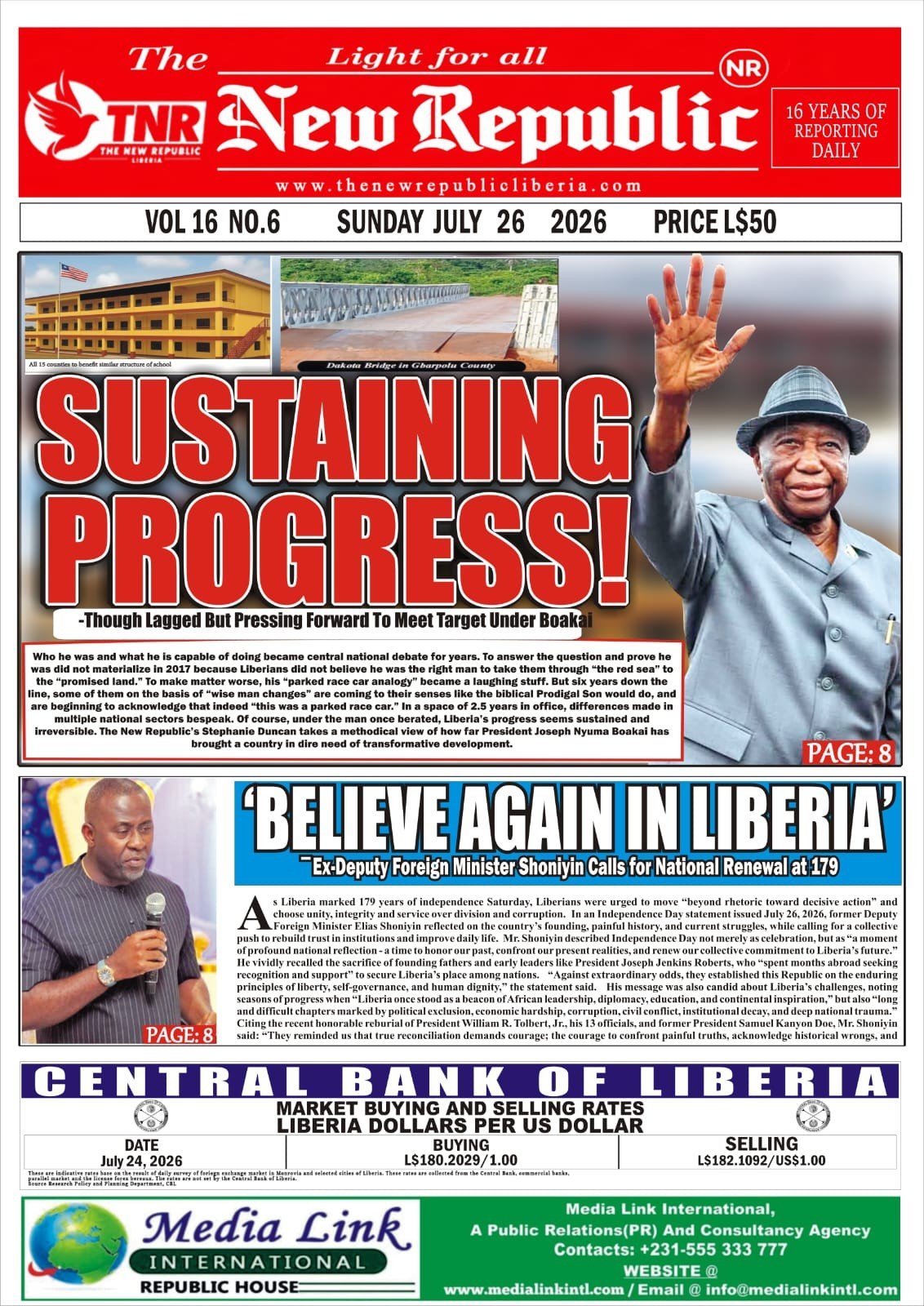
-Though Lagged But Pressing Forward To Meet Target Under Boakai
Who he was and what he is capable of doing became central national debate for years. To answer the question and prove he was did not materialize in 2017 because Liberians did not believe he was the right man to take them through “the red sea” to the “promised land.” To make matter worse, his “parked race car analogy” became a laughing stuff. But six years down the line, some of them on the basis of “wise man changes” are coming to their senses like the biblical Prodigal Son would do, and are beginning to acknowledge that indeed “this was a parked race car.” In a space of 2.5 years in office, differences made in multiple national sectors bespeak. Of course, under the man once berated, Liberia’s progress seems sustained and irreversible. The New Republic’s Stephanie Duncan takes a methodical view of how far President Joseph Nyuma Boakai has brought a country in dire need of transformative development.
As Liberia marks 179 years of sovereignty, Grand Bassa is glittering as the host of the national Independence Day celebrations with what officials and citizens describe as renewed hope.
From Buchanan’s lights coming back on the national grid to new classrooms, clinics and roads, the Boakai administration says it is “digging in the heels” to meet development targets despite fiscal and institutional constraints.
With President Joseph Nyuma Boakai at the helm since January 2024, the government’s ARREST Agenda for Inclusive Development (AAID) has placed infrastructure, human capital, and accountability at the center.
Sustained progress becomes the centrifugal force around which the administration development roadmap is revolving, ensuring progress is made where challenges remain.
Liberians celebrate continued developments across all sectors including education where the government said it is expanding access and fixing the foundation.
As a pillar of the ARREST Agenda, the administration places priority on rural access, teacher welfare, and infrastructure evident by ongoing rehabilitation and construction of public schools nationwide, with priority counties including Grand Bassa, Lofa, and Nimba.
Several schools destroyed during the civil war are being rebuilt to reduce overcrowding and ensure dignity for school-going kids.
Support to teachers – which is an implementation of the multi-year public sector salary reform has included adjustments for teachers.
According to the government, the goal is to reduce teacher absenteeism and attract qualified personnel to rural areas.
The education access endeavors also accounts for the continuation and expansion of free tuition at public universities and community colleges, which the administration says has seen increased enrollment as a result.
Government’s education reform undertakings shed light on renewed focus on WAEC performance through the Ministry of Education’s “catch-up” programs and distribution of learning materials.
Officials acknowledge learning gaps from COVID-19 and past disruptions remain, but say early interventions are underway.
In the sphere of technical and vocational education, the
drug abuse, especially “kush” and cocaine trafficking, has been declared a national emergency by President Boakai.
“With challenges stirring, a President continues to dig into the heels, ensuring that the country is positioned on the pedestal of transformative development,” one official noted.
With these developments remain huge challenge, according to citizens and education stakeholders who note that teacher shortages, lack of science labs, and late payment of some rural teachers still persist. Government optimistic that these gaps will be closed with domestic revenue growth.
Administration has been speaking of increased budgetary allocation to TVET institutions to align graduates with jobs in construction, agriculture, and energy, key sectors under current infrastructure projects.
Also, experts following developments told this about the “resetting of healthcare service delivery where health is listed as another reset area, with emphasis on primary healthcare, drug supply, and facility upgrades.
As part of primary healthcare strengthening, Liberians have with robust rehabilitation of county hospitals and health centers, including in Grand Bassa.
There are reports that the Buchanan’s referral hospital has received new equipment and support staff under the 2026 budget.
Besides, the government is said to have put efforts in the are of drug and supply chain, mounting efforts to centralize procurement through the National Drug Service to reduce stockouts.
Reports highlight improved delivery of essential medicines to county depots compared to 2023, while salary adjustments for health workers under the salary harmonization have been reversed.
A notable mark of progress involves ongoing recruitment of nurses and midwives for rural clinics to sustain the Ministry of ‘maternal and child Health’ initiative, which entails expansion of free healthcare for pregnant women and children under 5 continues.
This also includes, according to statistics, mobile clinics deployment in hard-to-reach districts. In addition,
In addition, the government placed focus on public health preparedness, working assiduously to strengthen disease surveillance and partnership with partners to respond to outbreaks, building on lessons from Ebola and COVID-19.
However, these remarkable breakthroughs still face challenge to the extent that health officials acknowledge persistent issues with infrastructure at rural clinics, inconsistent electricity, and the need for more specialists.
Liberia’s sustained progress portfolio captured incredible transformation at the Temple of Justice where 80% increase in the Judiciary budget in 2026 was matched by calls for similar boosts in health.
Liberia faced what was then referred to as “daunting drug abuse” where different kinds of substances such as tramadol, kush became household friends for some Liberians, mostly young people, with some of them falling prey to its negative side effect.
By then, Monrovia and its environment became unsafe for free movement of citizens as “drug-turned zogos” roamed everywhere, attacking and wounding citizens for their own belongings.
In his first Annual Address to the Legislature, President Boakai declared drugs a national health emergency in a effort to deter wanton drug use and sale.
The government did not only declare drugs a public health and security emergency in 2024, but also created a multi-agency taskforce led by the Ministry of Health and LDEA.
Following weeks of institutional dysfunction caused by internal rancor, President moved to bring on board new set of security experts at the LDEA and increased logistics support, to enable the entity sustain its operations and community awareness.
These efforts have seen increased forms of nationwide of awareness, including the launch of “Say No To Drugs” campaigns in schools, churches, mosques, and communities.
Along the same time, the Liberian government under President Boakai, and with the support of concerned officials, set up rehabilitation centers in Monrovia and counties to support users rehabilitation.
Since coming to office as well as the launch of the anti-drug campaign, the LDEA has seized tones of consignment of drugs from multiple users, arrested and indicted a good number of Liberians, and destroyed ghettos once used by zogos or other drugs users.
As part of the anti-drug fight, Liberia witnessed the seizure of US$19 million Europe-bound cocaine at Roberts International Airport.
Though few persons have been apprehended and indicted, government has since announced the arrest and indictment does amount to the closure of investigation.
At the same time, government announced it is cooperating with international partners to trace networks.
According to officials, the case itself shows law enforcement is intercepting larger shipments.
Government institutions have also pledged unflinching support for the fight against drugs. The national legislature is pushing for stronger penalties and treatment provisions in drug laws currently.
In spite of the feat, officials admit challenges still hover, indicating that trafficking networks remain sophisticated and that institutional independence of anti-drug agencies must be protected to sustain gains.
Anti-corruption fight, a major pledge of the Boakai under its Rescue Agenda, is said to be at an appreciative level
Accountability and connectivity are two areas the administration says define its first 2.5 years.
President Boakai made asset declaration important part of the government’s anti-corruption fight, where officials coming to government are duty-bound to declare their asset through the Liberia Anti-Corruption Commission (LACC).
The president did not just create the institution, but also set the pace for enforcement wherein he himself declared his asset, and even suspended some reluctant officials.
Beyond asset declaration, there is a major component of the anti-graft policy where the General Auditing Commission (GAC) is conducting consistent audits of several ministries and agencies and released reports, with recommendations for prosecution and recovery.
Till now, several high-profile cases are before the courts, including cases involving past procurement, payroll fraud, and the ongoing investigation into the US$19 million cocaine matter, with the government pledging that it will not interfere with judicial processes.
Liberia’s sustained progress has seen policy reforms measures with the introduction of new procurement guidelines and digitization efforts aimed at reducing leakages in government spending.
Liberia, under President Boakai, is reported to be experiencing vast national road connectivity, with flagship projects include continued paving of major corridors.
As part of the nationwide road connectivity, the govenrment has announced rehabilitation of farm-to-market roads in Bong, Lofa, Nimba and Grand Bassa to get goods to market.
Most of these projects are said to be done through domestic funding mechanism as well as partnerships with multilateral institutions to finance roads, reducing delays caused by donor dependency.
The electrification of Buchanan , reconnecting Liberia’s second largest city to the national grid decades after war destruction, is not just be celebrated by citizens, but also cited as a signature achievement.
Citizens in Grand Bassa who spoke to this paper said they see “unprecedented development initiatives on the horizon since 2024.” For them, Buchanan’s electricity, school repairs, and visible road works are “symptomatic of the positives the country stands to reap.”
Despite, the government acknowledges that road maintenance and completing paved links to the southeast remain lagging.
According to officials,the target is to have all 15 county capitals connected by all-season roads before 2029.
Recently, Finance and Development Planning Minister Augustine Ngafuan told a judicial gathering that “we’ll get nowhere if the rule of law is weak.” His sentiment echoed across government that progress in education, health, drugs and corruption all rest on institutions working.
President Boakai’s team admits the pace is “lagging” in some areas due to revenue constraints and inherited decay. However, the message in Buchanan this Independence is to press forward.
“With challenges stirring, a President continues to dig into the heels, ensuring that the country is positioned on the pedestal of transformative development,” one official noted.
As Liberia enters year 200, the Boakai administration says its focus will remain on delivering services, protecting the rule of law, and sustaining the progress, even if slowly, until targets are met. Liberia under Boakai is sustaining progress.
About The Author