
By Emmanuel Tobotinho Quiah
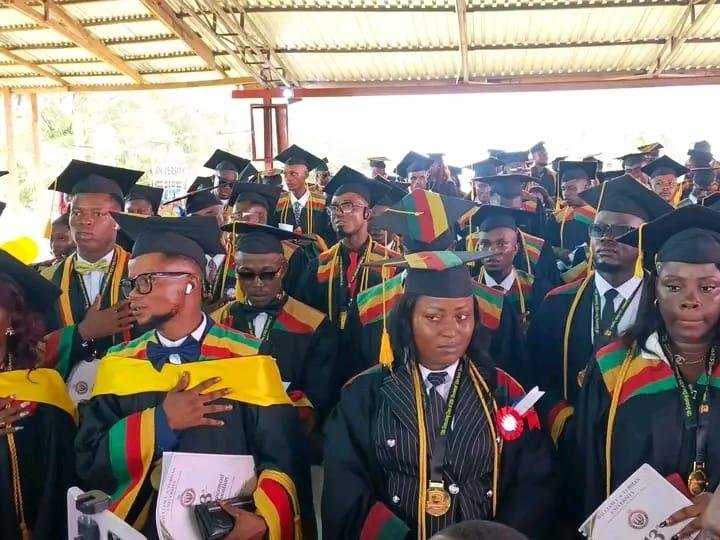
Monrovia-William V.S. Tubman University (TU) has graduated 256 students from six academic colleges, marking another milestone in the institution’s efforts to develop skilled professionals and contribute to Liberia’s human resource development.
The graduates, drawn from the university’s six colleges, were challenged to translate their academic knowledge into meaningful contributions to society, particularly in addressing some of Liberia’s longstanding developmental challenges.
Delivering the keynote address at the commencement ceremony, former Tubman University President Dr. Elizabeth David-Russell urged the graduates to pursue what she described as “worthy service” rather than simply seeking positions or opportunities for personal advancement.
Dr. David-Russell emphasized that meaningful service must produce measurable improvements in people’s lives, stressing that the true value of education lies in its ability to positively impact individuals and communities.
She reminded the graduates that Tubman University’s vision is to become a center of quality and excellence, grounded in core values that include genuine care, accessibility, academic excellence, integrity, civility, ethics, innovation, adaptability, and creativity.
According to her, these values should not remain mere institutional statements but must become guiding principles in the graduates’ personal and professional lives.
”Our focus is threefold: local, national, and international,” she emphasized, explaining that the university’s responsibility extends beyond addressing local challenges to contribute to national development and engaging with the wider international community
Dr. David-Russell identified artificial intelligence (AI) as one of the major challenges and opportunities awaiting graduates as they transition into the professional world.
She challenged them to become active and responsible users of emerging technologies rather than passive participants in the rapidly changing digital environment.
She particularly encouraged graduates to explore how artificial intelligence could be ethically applied to address critical problems confronting Liberia, including food insufficiency and the prevalence of preventable diseases such as malaria.
”Are you going to become a passive participant or a diligent mover who acts ethically and responsibly to garner the benefits of AI to help the human condition, especially in Liberia?” she questioned.
She urged graduates from the various academic disciplines to use their knowledge, creativity, and technological skills to develop practical solutions that improve living conditions and advance national development.
The former university president also questioned whether students had fully utilized the institution’s technological advancements and academic resources to prepare themselves for graduate studies and the world of work.
Reflecting on her administration’s efforts to strengthen the university’s technological infrastructure, she recalled that when she assumed leadership, the institution lacked much of the technological infrastructure she had expected to find.
She explained that, with the support of a small technical team led by Francis Fukah, the university gradually established intranet and internet systems and introduced a student advisory system.
The system enabled faculty advisers to access students’ academic records, improve academic advising, and submit grades electronically.
Dr. David-Russell noted that the institution has since advanced to more sophisticated technological systems, challenging the graduates to make effective use of such facilities in their professional development.
On academic excellence, Dr. David-Russell urged graduates to move beyond memorizing information and develop the ability to critically examine issues, analyze situations, and make informed decisions.
She stressed that the purpose of higher education is not simply to reproduce information acquired in classrooms but to equip students with the intellectual capacity to solve real-world problems.
She also highlighted the university’s former “Grow Our Own” initiative, through which selected faculty members were supported to pursue advanced studies abroad to strengthen the institution’s academic capacity.
Under the initiative, beneficiaries were expected to return and serve the university for at least two years, following institutional support for their salaries and tuition.
She described the initiative as an important investment in developing local academic professionals and strengthening the quality of higher education in Liberia.
In a direct appeal to graduates from the university’s six colleges, Dr. David-Russell challenged them to build upon the achievements and practical contributions of their predecessors.
Addressing graduates of the College of Engineering and Technology, which she referred to as the university’s “mother college,” she recalled that previous students had developed prototypes of traffic lights, cassava extraction machines, and designs intended to address the problem of deteriorating and failing bridges.
She challenged the graduates to build upon those innovations by developing practical engineering solutions to Liberia’s infrastructural and technological challenges.
For graduates of the College of Education, she recalled that their predecessors had developed early childhood education models that encouraged parents to become active partners in children’s learning and care.
She urged the new graduates to continue improving the country’s educational system by promoting innovative teaching approaches and strengthening parental involvement in education.
Addressing graduates of the College of Business Administration and Management, she highlighted previous initiatives through which students developed models for teaching community business owners more effective business management practices.
She challenged them to continue supporting local entrepreneurs, improving business practices, and contributing to economic growth through responsible leadership and innovation.
For graduates of the College of Agriculture, Dr. David-Russell recalled experiments conducted by previous students involving different methods of planting rice, Liberia’s staple food.
She questioned whether the new graduates were prepared to contribute to making Liberia self-sufficient in food production rather than continuing to depend heavily on imported staple goods.
She encouraged them to apply their agricultural knowledge to improve farming methods, increase productivity, and strengthen national food security.
Speaking to graduates of the College of Nursing and Health Sciences, she recalled the contributions of their predecessors who conducted health screenings in rural communities and played important roles in educating residents about preventive health practices during the Ebola outbreak.
She noted that these efforts helped communities understand how to prevent the spread of the disease, with no recorded cases within the county during the period referenced in her remarks.
She challenged the new health professionals to continue taking health education and preventive services to underserved communities, particularly rural populations with limited access to healthcare facilities.
Meanwhile, graduates of the College of Arts and Sciences were encouraged to preserve Liberia’s cultural heritage while creating new artistic works that reflect the country’s identity and aspirations.
She also challenged them to collaborate with professionals in the health sciences to contribute to research aimed at finding solutions to infectious and communicable diseases and reducing Liberia’s high maternal mortality rate.
Beyond professional competence, Dr. David-Russell emphasized the importance of character, ethical conduct, and responsible decision-making.
She cautioned graduates against allowing rumors, popular opinions, or personal interests to influence their understanding of situations and the decisions they make.
According to her, individuals often interpret the world differently because of their diverse backgrounds, personal experiences, and perspectives.
However, she stressed that decisions must be based on facts, sound values, and a clear understanding of right and wrong.
She further warned the graduates against compromising their principles simply to gain acceptance into influential social circles, friendships, or positions of power.
”Know which lines you are unwilling to cross in order to be let into circles of friendship and or power,” she advised.
The former president encouraged them to practice genuine care for others rather than engage in transactional relationships in which assistance is provided only with the expectation of receiving something in return.
She also urged them to maintain professionalism, dependability, trustworthiness, civic responsibility, and intellectual curiosity throughout their careers.
As she concluded her address, Dr. David-Russell shared what she described as one of her enduring beliefs about human behavior and the importance of personal reflection.
Drawing from her background in psychology, she explained that people’s attitudes, decisions, and behaviors are often shaped by their lived experiences and interpretations of those experiences.
She encouraged graduates to regularly examine their actions and evaluate whether their conduct reflects the values they claim to uphold.
Invoking a familiar expression associated with the university’s president, she challenged them to ask themselves an important question whenever they reflect on their lives.
”When you look into the mirror, the person looking back at you, are you happy with that person? Are you proud of that person?” she asked.
She explained that if individuals cannot take pride in the people they are becoming, it may be an indication that they are moving in the wrong direction and need to reconsider their choices.
Dr. David-Russell urged the graduates to carry Tubman University’s foundational values into their respective professions and communities, reminding them that their education should be reflected in meaningful service, ethical leadership, and positive contributions to society.
The graduation of 256 students from six colleges represents another contribution by William V.S. Tubman University to Liberia’s growing pool of educated professionals.
However, the central message of the commencement address was that the true measure of the graduates’ success would not simply be the certificates they received, but how effectively they apply their knowledge, uphold their values, and use their professional skills to improve the lives of others.
As they transition from the university environment into the wider world, the graduates now face the responsibility of transforming their academic achievements into practical solutions to the challenges confronting their communities, the nation, and the international community.
About The Author