
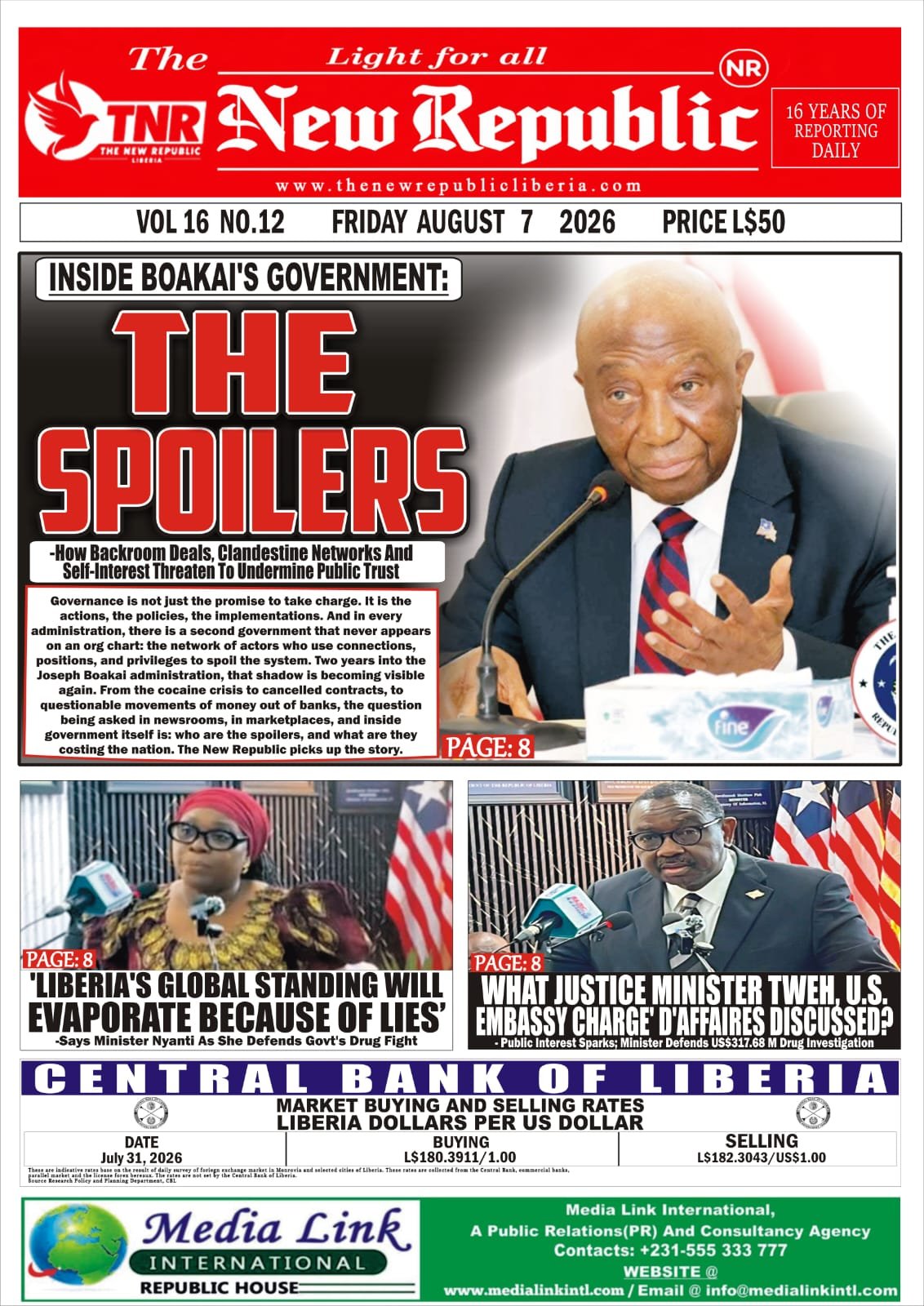
MONROVIA–Governance is not just the promise to take charge. It is the actions, the policies, the implementations. And in every administration, there is a second government that never appears on an org chart: the network of actors who use connections, positions, and privileges to spoil the system. Two years into the Joseph Boakai administration, that shadow is becoming visible again. From the cocaine crisis to cancelled contracts, to questionable movements of money out of banks, the question being asked in newsrooms, in marketplaces, and inside government itself is: who are the spoilers, and what are they costing the nation. The New Republic picks up the story.
Along with other disturbing events that have shaped the President Joseph Boakai administration since its inception, such as the Foya presidential villa quandary, the expulsion of Yekeh Kolubah, the removal of former Speaker Koffa, brutal manhandling of protesters, yellow machines controversy, the debate about private jet, and the destruction of people’s properties without substantial prior notice, the recent cocaine busts at the Roberts International Airport (RIA) and the VOA Community along the Robertsfield Highway coupled with the reported connections of government officials, including high-ranking security officers only shed added and extensive light on the ‘spoilers’ in the system.
Whether the president is aware of some of these situations is another thing, but it is clear that some of the potential spoilers in his government are known while a good number remains incognito.
Since taking office, the president has acted against officials whose actions perhaps contradicted the overall objectives and policies of the government. Despite, observers say there may be more spoilers in the system far more than those gotten rid of.
This pattern, though reportedly not strange to government and governance globally, is a form of ‘muddying the water’ every government in Liberia’s recent history has faced.
One observer said as a new team comes in with promises of reform, transparency, and clean hands, within months, old habits resurface, deals cut in the dark, favors traded for access, and public resources diverted for private gain. “This,” he said, “the Boakai administration is not exempt.”
Like his predecessors (former Presidents Sirleaf and Weah), the head of state is facing the challenge of working with people with different intentions, in most cases to promote their own agenda, at the detriment of national agenda.
The difference, he added, is the stakes wherein the President campaigned on restoring integrity and fighting corruption, indicating “That makes any breach more damaging, because it cuts at the core promise.”
Sources across the civil service describe a familiar playbook when people use crisis as cover. “When national attention is on one emergency, quiet moves happen elsewhere, hide behind procedure, cancelled once agreed deals, delayed procurements, and sudden reversals are often justified as review or due diligence.”
In most cases, officials with proximity to power become brokers, selling the idea that they can “get it done,” for a price.
One of the administration biggest promises is to fight the country’s decades-long lingering drugs crisis that past administration also unsuccessfully tried to eliminate. The promise was manifested with the president, vice president taking drugs test that came back negative.
The President bolstered these efforts with effective changes at the country’s drugs fighting agency, Liberia Drug Enforcement Agency (LDEA), bringing on board highly-rated security gurus. But no sooner than later, things fell apart and the guys went amok over control and protection of interest.
They were eventually gotten rid and also replaced with few topnotch officers from the Liberia National Police. For months, they sustained the fight, seizing, arresting, destroying and burning drugs and culprits and their abodes.
However, the nation is bleeding from a devastating drugs situation necessitated by the ongoing cocaine debacle. As one expert put it, the seizure of over $500 million worth of cocaine at Duazon and RIA that should have been a clear win for law enforcement has become the administration’s biggest test, as well as its biggest vulnerability.
Confronting the spoilers in the system, President Boakai took a swift decissive action by dismissing and suspending officials linked to two busts. In addition, detained suspects have been charged awaiting trial while investigations are ongoing.
One thing certain is that the case has also exposed how deep the rot can go, a government insider said.
Allegations have swirled that elements within and around government are pushing clandestine agendas, including leaking information to suspects, pressuring investigators, and trying to shape the narrative to protect allies.
Experts also told this paper that recent claim by Police IG Gregory Coleman that a drug cartel had “infused monies into the media,” with no evidence produced to date, only deepened suspicion about the intent of the “spoilers.”
Critics argue such statements may be intended to distract from reports implicating senior security and government officials. But whether true or not, the perception alone does damage; it tells citizens that even in the fight against drugs, self-interest may be winning.
Moreover, it is alleged that spoilers do not only operate in the drug trade. The New Republic’s review of developments in the past year points to other areas where the system is being tested, such as cancelled deals.
Several agreements signed under the previous government have been unilaterally cancelled or “put on hold.” Though some were said to be clearly problematic, others, however, were in advanced stages and their abrupt cancellation has cost the state in arbitration threats and lost investor confidence.
In the same vein, the Financial Intelligence Agency and CBL have flagged “unusual movements of money” out of commercial banks involving politically exposed persons. While no charges have been filed, the pattern raises questions about oversight and how “system spoilers” are utilizing apparent cohorts or weaknesses to dupe the government.
Across ministries, junior staff and consultants with no formal title are reported to be acting as gatekeepers, deciding who gets meetings, contracts, and approvals. None of this proves guilt, but according to an observer, together, they paint a picture of a system where access can still be monetized.
As one governance expert puts it, the spoilers are not always the people in front of cameras, they are former campaign operatives now trading on relationships, rebranded officials with “mutilated characters” from past administrations who reappear with new titles.
They are also said to be civil servants who leak documents, slow files, or redirect funds for a cut, as well as the distractors – voices inside and outside government – who push conspiracy and counter-narrative to drown out scrutiny.
“Their goal is to milk the system at the detriment of the government, the nation, and the people,” remarked the governance expert.
Those closed to the presidency said, President Boakai’s credibility rests on integrity, adding that the ARREST Agenda, the push to abolish school registration fees, the NPLs conference planned for September, can be undone if the public concludes that spoilers are running the show behind the scenes.
Amid the drugs scandal rocking the government, it is alleged one of the principal accused has been in the company of the president, apparently posting as investor. Wednesday’s edition of Spoon Talk spotlighted photos of him with the president at the Executive Mansion and his Rehab home.
The question is not about the president knowingly interacting with the guy in question, but about those who gave him access at the Mansion and the Rehab residence. Some panelists believed there are “spoilers” at the Mansion responsible for it for their selfish interest.
According to experts, people in the system doing other things has its own practical costs.
They said investors and donors are watching when deals are cancelled without explanation and when drug cases are not properly handled, adding “money stays away and jobs don’t get created.”
On top of that, ordinary Liberians pay the price, they added. “If the administration wants to defeat the spoilers, it will take more than speeches,” said an expert in governance. He added that it needs transparent investigations, and the President must be seen removing, not just suspending, officials credibly linked to misconduct, regardless of affiliation.
Another expert told this paper that “Governments don’t fail only because of bad policy, but they fail because of the people who quietly work against good policy.” According to him, the spoilers are betting that Liberians have short memories, that after the pr
ess conference, after the hashtag, the public will move on.
“The Boakai administration still has time to prove them wrong, but time is short,” he said. “In the fight between reform and the backroom, there is no middle ground. Either the spoilers are exposed and cut off, or they will continue to milk the system, until there is nothing left to milk.”
About The Author