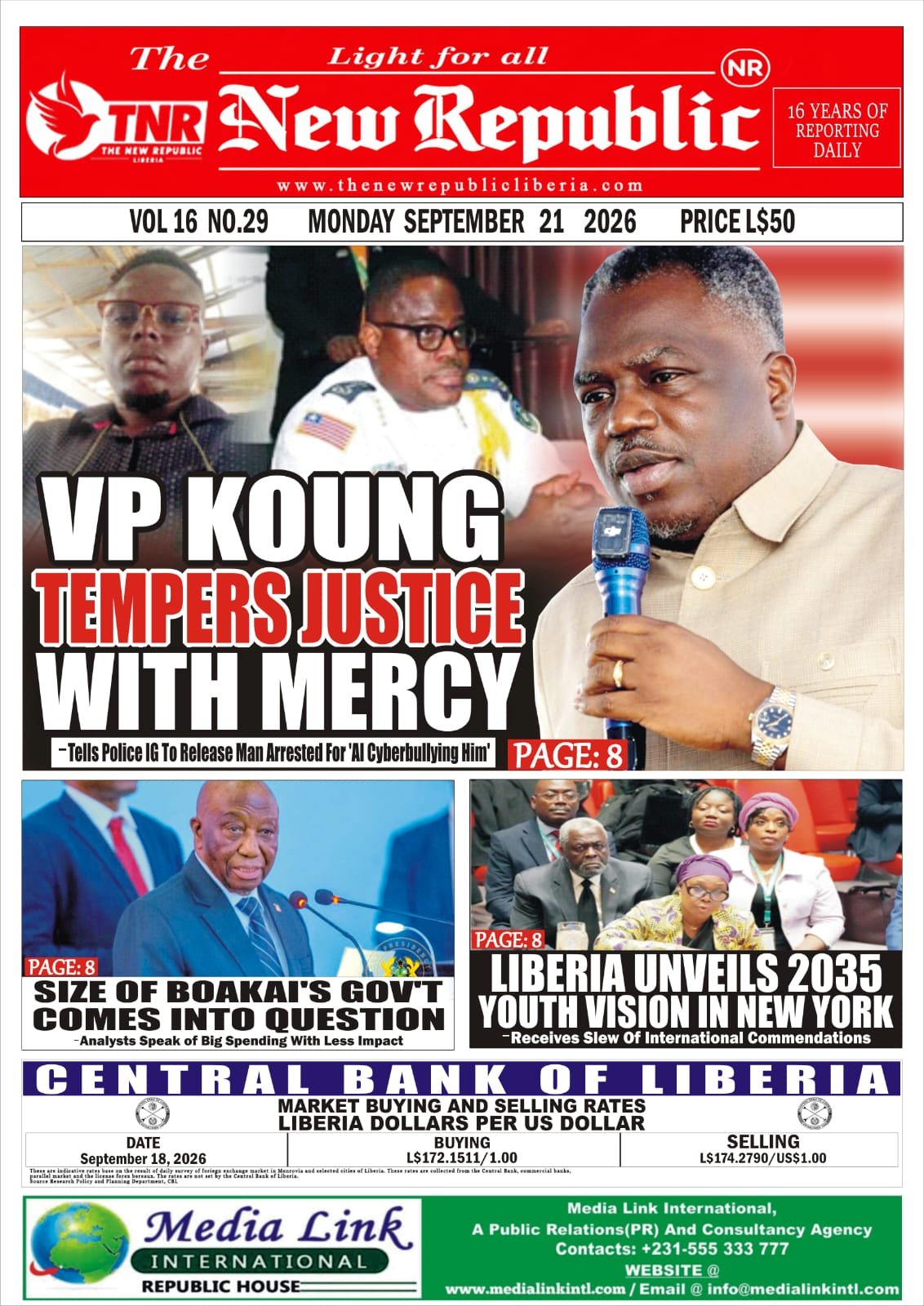
Monrovia-Vice President Jeremiah Kpan Koung over the weekend demonstrated high-stake leadership maturity when he intervened to secure the release of a young Liberian arrested for allegedly cyberbullying him with AI-generated images and videos posted on Facebook.
The action dubbed ‘tempering justice with mercy’ won the vice president exceptional public praise, with many describing it “mark of good leadership” and also referring to him as a “man of peace.”
Those knowledgeable of his activities told this paper that VP Koung in many instances sought to pursue amicable approach to issues in which he is accused, smeared and brazenly caricatured.
The latest intervention into a matter that had the tendency to cause public uproar and backlash followed series of social media posts by US-based journalist Gibson Jerue, quoting family sources about the arrest and harsh treatment of a boy, Jerry Nyantee Wratto, by the Liberia National Police in connection to alleged AI generated photo of the VP on social media being interrogated by Airport security details in Europe.
The social media flooded images sparked national debate, and according to analysts shed light on Liberia’s deepening toxic political field.
“Jerry Nyantee Wroto, the man arrested by the Liberia National Police in connection with an alleged AI-generated photo of Vice President Jeremiah Koung, is expected to spend tonight in detention at the National Police Headquarters on Capitol Bypass, family members and sources have told reporters,” Jerue wrote Saturday evening in an effort to raise public awareness.
According to him, Wroto was arrested on orders that sources link to a complaint from the Office of the Vice President.
He emphasized that “The Vice President is said to have complained that Wratto published an AI-generated image depicting him without a shirt before police at the Brussels Airport.”
As of Friday evening, police had not formally charged Wratto, family members said.
He quoted family members as alleging that Wratto endured difficult conditions following his arrest in River Gee and during his transfer to Monrovia.
“According to them, Wroto was prevented from eating during the journey on grounds that officers were running late to bring him to Monrovia,” Jerue reported on his social media platform.
“Jerry is hungry. The people refused to let him eat something coming all the way from River Gee,” one family member said.
He said the family also alleged that police used intimidation, harassment and psychological pressure to obtain information, and that his Miranda rights were not read to him while being questioned without a lawyer present.
“It appears the police officers have concluded that Jerry is already guilty and only need to fight to prove himself innocent, a very opposite approach to the law,” a source close to the matter claimed.
At the LNP Headquarters in Monrovia, family members further alleged they were denied access to see him. One family member, nearly sobbing on the phone, said: “Jeremiah Koung’s wickedness is up to God.”
Under Article 21 of the Liberian Constitution, a person arrested must be charged and presented before a court within 48 hours.
Family members say that window expires tonight, but claim one officer told Wroto in their presence that he will remain in jail until Monday or Tuesday.
“If Wroto is not charged and presented before a court within the constitutional period, his continued detention would raise legal concerns,” Jerue said.
The case centers on a photo that has circulated on social media showing Vice President Koung standing without a shirt before what appears to be police officers at Brussels Airport. The Vice President’s office has described the image as fake and AI-generated.
According to him, Liberia’s Penal Law and cyber-related statutes criminalize the publication of false and misleading information that could injure the reputation of another person, but civil society groups have increasingly argued that such cases should be handled as civil defamation rather than criminal detention.
However, VP Koung didn’t allow the issue to slide as he immediately took steps to not further blot his image, having been informed of the matter.
In a statement, Koung revealed how he received several calls about the arrest and immediately contacted Inspector General of Police Gregory Coleman, who he said confirmed the arrest was made under Liberia’s Cybercrime Law.
“While I respect the law and the responsibility of the police to enforce it, I have made it clear that I have no desire to press charges against this young man, or anyone else, merely for creating or sharing such content about me. I have therefore requested his immediate release,” Koung wrote.
“Public office comes with criticism, ridicule and sometimes deliberate provocation. I understand that reality, and I am built for it. Our laws must protect citizens, but leadership must also exercise tolerance, restraint and compassion. Again, this is part of the package.”
The move has been described by many Liberians online as a display of political maturity and democratic tolerance at a time when public officials are increasingly accused of using cybercrime laws to silence critics.
This is not the first time Vice President Koung has responded to provocation with restraint, according to political observers who recall similar maturity in other matters.
They made mention of the 2023 campaign attacks when he Koung, then Senator of Nimba County and running mate to Joseph Boakai, was the target of intense personal attacks and disinformation, including questions about his education and business dealings. He largely refused to engage in personal counter-attacks, focusing instead on the Unity Party’s rescue message.
They also recalled how after years of political tension in Nimba County between supporters of the late Senator Prince Johnson and other factions, Koung has consistently preached unity over retribution, even after taking the second highest office in the land.
But according to them, he has maintained relationships across political divides in the county rather than pursuing political payback.
He is seen as also being tolerant to media criticism unlike some officials who have threatened lawsuits or arrests against journalists and bloggers, maintaining a relatively open approach to the press, rarely responding angrily to critical newspaper headlines or talk show commentary.
The Vice President’s statement quickly went viral, with many Liberians contrasting his action with other officials who have been accused of ordering arrests for far less.
“This is statesmanship. This is how you build democracy,” one Facebook user commented. “You can’t claim to be a leader and be thin-skinned.” “You are a man of peace,” wrote a commentor.
Under Liberia’s Cybercrime Law, publishing content deemed to harass, defame or bully a person online can lead to arrest, but enforcement has been controversial, with critics saying it is often used to target young people and opposition voices.
By publicly requesting the release and declaring he will not press charges for AI memes or satirical videos about himself, Koung has set a different precedent that criticism, even when deliberately provocative, is part of the package of public service.
The Liberia National Police is yet to confirm whether the young man has been released, but the Vice President’s office says his instruction was clear, immediate release, no charges.
About The Author