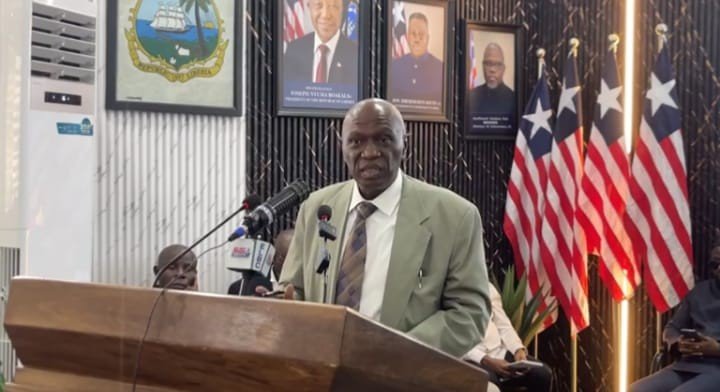


Monrovia-What is what in terms of cost and projects consideration and implementation arrangements in the November 4, 2026 Master Infrastructure Development Agreement (MIDA) reached between the Liberian Government and the Grand Cape Mount County-based Bea Mountain Mining Company (BMMC).
In practice, it lists 22 public infrastructure projects at a whooping US$4,4513 billion dollars.
It represents different segments of projects put at the foot of BMMC in terms of execution and implementation in specific time frames and arrangements.

The MIDA itself, from its current makeup, is seen as a complete reset of how the Liberian government’s investment perspectives, ensuring concessionaires align their intake with the country’s development priorities.
In the agreement, it is the first eight the ‘primary projects’ that set the tone for the entire deal.
As per the documents available, those eight alone carry a combined base cost of US$4.4513 billion, including land acquisition and resettlement compensation.
The other 14 require separate signed Project Proposal Agreements (PPA) before they can move forward. And at the centre of it all is BMMC expected to pay first, build first, and recover later.
On top of the projects is a VIA Hydropower Plant of 100 MW on the VIA River, a Reservoir of 8.7 billion m³ at a water level of 255 m., US$2,070.60 million 2SP-4 Hydropower Plant10 MW on the St. Paul River. It also includes a Reservoir of 1.2 billion m³ at 256 m., to includes a water transfer channel and tunnel.
There is also a US$634.44 million 3SP-3 Hydropower Plant100 MW on the St. Paul River, and a Reservoir of 46 million m³ at 195 m.
US$1,170.96 million is for a Public Biomass Power Plant60 MW near the VIA Dam, connected to the national grid for public electricity supply, which includes equipment for cutting, sizing and transporting feedstock.
Included is a US$147.90 million Transmission Line150 km, 300 MVA, connecting the four public power plants to the existing Mount Coffee substation.
A US$76.50 million Nimba Transmission Line150 km, 100 MVA, from the VIA Power Plant to Nimba County, including an endpoint substation.
It captures a US$53.04 million for Bong Transmission Line5 km, 60 MVA, branching from the VIA–Mount Coffee line to Bong County, including an endpoint substation.
US$13.26 million is earmarked for Liberia Development Road totaling 146 km.
The agreement gives the length and a minimum 40 m right-of-way. It leaves the route and endpoints unspecified.
The eight-project is subtotaled US$234.60 including design fees, while US$4,401.30 million is for expropriation and resettlement compensation
The three hydropower plants provide 210 MW and have a combined stated reservoir capacity of 9.946 billion m³, while the public biomass plant brings total installed generation for public supply to 270 MW, supported by 305 km of primary transmission lines.
Annex B gives a combined base cost of US$3.876 billion for the three hydropower projects and gives no separate reservoir-only prices.
The 146 km Liberia Development Road averages US$1.61 million per km at base cost, including design and before indexation. Annex D indexes the road cost and fixes the base costs of the seven primary power and transmission projects.
The Agreement also sets aside fourteen projects requiring further approval, while the remaining 14 projects cannot start until a separate Project Proposal Agreement is signed for each one.
Under the road development segment, the agreement considers several swathe of road projects across the country, not just Grand Cape Mount which is the host of BMMC.
Under the road development segment of the MIDA, Bomi to Gbarpolu Road, Tubmanburg to Compoundzu, Brewerville to Bopolu, Cestos Junction to Cestos City, one lane in each direction are captured.
Also are the Cestos Junction to Greenville City and Greenville Port, Gbarnga–Kokoyah, Compound 3–Buchanan Road, Gbarnga through Kokoyah and Compound 3 to Buchanan, across Bong and Grand Bassa counties.
Greenville–Klowne Town Road, Coastal road from Greenville to Klowne Town, one lane in each direction are under the arrangement.
Also are the Kesselly Boulevard Bridge Road from 12th Street via the new bridge to Bardnesville Junction, Konia to Voinjama, and Concrete-paved road in Monrovia.
The agreement leaves the alignment unspecified. Saclepea, Boutuo, Bahn and Karnplay, Pleebo–Big Suehn Junction Road covers two stated sections, Pleebo to Barclayville and Grandcess to Big Suehn Junction, with one lane in each direction.
There are also the Sengeh–Mbaloma–Gongu–Kinjor–Bandela road connecting the five communities in Grand Cape Mount County.
Tubman Boulevard Road and Bridge Road works on Tubman Boulevard and a new bridge with two lanes in each direction.
The 13 additional road and bridge projects share a US$1 billion base-cost cap.
In lieu of the high level of ambitions attached, analysts however indicated the Government and BMMC need to agree on their priority order, and proposals proceed one at a time.
According to them, a project can be skipped if its proposed base cost exceeds the remaining allocation or the Government misses the decision deadline.
“Once the allocation is fully committed, further road works require a separate written agreement.This version gives no individual lengths or prices for these 13 projects,” one expert said.
The National Grid Reinforcement has its own US$230 million base-cost cap. If both allocations are fully used, they bring the US$4.4513 billion primary package to US$5.6813 billion on a base-cost basis, before applicable adjustments and other charges.
Source: Articles 3.8, 3.9, 3.12 and 3.13 and Annexes A and B.3. Separate BMMC Mining ProjectArticle 3.4 also provides for a separate 60 MW biomass plant and transmission line for BMMC’s mining operations.BMMC will fund a 60 MW build-operate-transfer biomass plant near the VIA Dam under a separate contract. It includes a 150 km, 60 MVA transmission line to BMMC’s concession and an endpoint substation.
BMMC and its affiliates have exclusive use during mining operations.The agreement provides for transfer to the Government through LEC when those operations end, generally at no charge, with a fair-market-value exception for specified Government defaults.
BMMC bears the cost as its own capital investment, and the project is ineligible for set-off.
As per Articles 3.4–3.6 of the MIDA, only three public projects have a fixed two-year completion period under Article 15.1, they are the public biomass plant, the Main Transmission Line and the Bong Transmission Line.
The clock starts when the last applicable condition is met, including effectiveness, required land and right-of-way handover unless otherwise agreed, and an executed Implementation Agreement.
For the other public projects, including all three dams, the agreement ties completion timing to the availability of entitlements for set-off. Annex C contains a milestones heading but no milestone schedule in the copy reviewed.
BMMC pays approved public project costs and recovers them by offsetting eligible amounts against obligations covered by the agreement.
MAPA is named as the engineering, procurement and construction contractor. The agreement assigns operation and maintenance of public power and transmission assets to LEC and of the road and bridge assets to the Ministry of Public Works.
On paper, Liberia gets 270 MW of public power, 305 km of transmission, a 146 km development road, and the promise of 14 more projects worth up to US$1.23 billion.
In practice, the agreement sets a tone where BMMC carries the bulk of the load upfront – financing, building, and then recovering through set-off – while the Government’s biggest obligations are land, right-of-way, approvals, and eventually, taking over and maintaining what is built.
Whether that load is fairly balanced will depend on what the set-off entitlements are, how fast the Government delivers land and approvals, and whether the 14 follow-on projects ever get their separate agreements signed.
About The Author