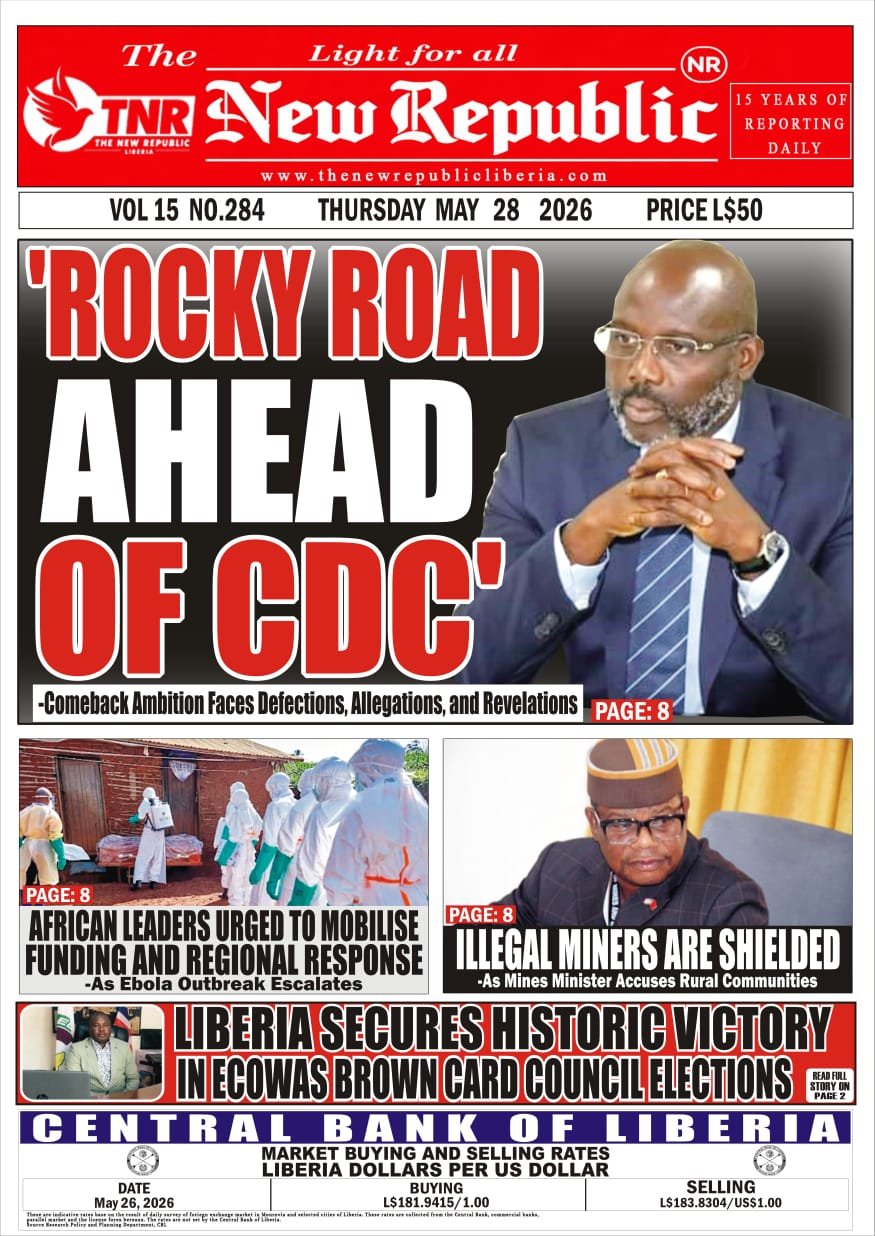
Ex-President Weah
Monrovia – The Coalition for Democratic Change (CDC) is signaling a push to return to power, but the party’s comeback ambition is running into a rough patch of defections, internal allegations, and public revelations that are testing its cohesion and public image.
Once Liberia’s ruling party from 2018 to 2024, the CDC has spent the last two years in opposition under President Joseph Nyuma Boakai’s Unity Party-led government.
Party officials say they are reorganizing at the county level and preparing for the 2029 election cycle. But recent political shifts are raising questions about whether the party can present a unified front when the next campaign begins.
Serious challenges are lurking, analysts claimed, that could prove very detrimental for the party that still sees itself rooted and grounded.
Party critics are whisking off the CDC’s 2029 return push as mere political deviltry, arguing it would be like pushing it donkey through a needle hole for the CDC to see power anytime soon.
“Liberians trooped to the CDC and massively supported it simply because they did not know what it was made up,” said a critic who believes the idea of CDC return is a far-fetched pursuit.
“They have been tested,” he added, “there is no secret about their performance.”
However, the most visible challenge facing the CDC has been the loss of elected officials and senior partisans to other political formations.
Several former CDC lawmakers and local officials have crossed over to the Unity Party and to emerging movements like the National Independent Movement for Boakai (NIMBO).
The defections have been concentrated in Montserrado, Nimba, and Bong counties—areas where the CDC once posted strong results.
Social media pages are flooded with claims and allegations against its political leader, most of which many say have the potential to drive away supporters away if not addressed. The CDC strongman is accused of being too soft, don’t care about how his name is being dragged in the mud.
“In politics, silence is dangerous,” remarked one analysts. “The former President needs to respond to some of the things people say about him. It is more of a negative than positive.”
Recently, our reporter came across three CDC supporters who expressed displeasure with his silence on national issues. “CDC is talking about comeback in 2029, but the man is quiet; he is not saying anything; Liberians are not hearing his voice about the direction of the country under the UP administration.”
They appeared dismissive of the CDC comeback refrain amid their political leader conspicuous silence on issues, including allegations of wrongdoing.
Party leaders frame the exits as opportunistic moves tied to access to state resources. Defectors, on the other hand, cite lack of internal democracy and marginalization of grassroots members as reasons for leaving.
Political observers say the cumulative effect is a thinner bench of incumbents and financiers heading into the next electoral cycle. For a party that relied heavily on incumbency and patronage networks to mobilize, the thinning ranks matter.
On the top of this severely troubling development are issues of corruption involving some of its dependable officials, others hinted.
Its former Finance and Development Planning Minister, Samuel Tweah regarded as party ideologue, is still facing corruption probe.
Though acquitted of wrongdoing in the $6 Million theft of property case brought against him by the Liberian government, Tweah is being questioned by the Asset Recovery and Property Retrieval Taskforce (AREPT) in connection to $20 Million rice subsidy scheme initiated during the CDC administration.
What happens in this case, according to political and legal analysts, may play into the hands of the CDC and add lubricants to its 2029 comeback.
The CDC’s opposition narrative has centered on governance failures, corruption, and the cost of living under the Boakai administration.
But the party has also been on the defensive over allegations and revelations tied to its own time in office.
Audits released since 2024 have flagged procurement breaches and questionable concessions signed during the CDC administration.
While no party officials have been convicted, the findings have been used by opponents to challenge the CDC’s credibility on anti-corruption.
Internally, public spats between senior figures over party direction and resource control have spilled onto social media and talk radio.
Those disputes have given the impression of a party struggling to manage post-defeat succession politics.
Despite the setbacks, the CDC retains a national structure and a loyal base in key urban centers. Party chairman and standard bearer hopefuls argue that voter dissatisfaction with the current government’s handling of the economy and jobs creates an opening.
According to experts, to capitalize, the party would need to halt further defections by renegotiating roles for county leaders and resolving internal disputes before they become public, and also shift from nostalgia for 2018-2024 to a forward-looking platform that addresses youth unemployment, road connectivity, and health security—issues that dominated the 2023 campaign.
Others said it also needs to develop a coherent response to audit findings and allegations that acknowledges missteps without ceding the anti-corruption ground to the ruling party.
Political analysts say the CDC’s brand remains recognizable, but brand recognition alone won’t close the gap created by defections and resource constraints.
“The party’s ability to recruit new financiers and retain mid-level organizers will be critical,” remarked one analyst.
At the same time, the opposition space is said to be fragmenting. It is noted that alongside the CDC, smaller parties and independent movements are positioning themselves to capture voters disillusioned with both the UP and CDC.
For the CDC, the challenge is to prevent a repeat of 2005 and 2011, when internal division weakened its presidential runs.
For the Boakai administration, keeping the CDC divided reduces the risk of a consolidated opposition challenge in 2029.
As one CDC county chairman put it at a recent meeting in Monrovia: “We can’t fight the government and ourselves at the same time.”
With few years to the next presidential election, the CDC has time to rebuild, said a diehard partisan.
He however argued that the path from opposition rhetoric to a viable comeback will run through party primaries, financial negotiations, and a public that is increasingly skeptical of political recycling.
The road ahead looks torturous—and how the party navigates it will determine whether 2029 is a comeback or another cycle of retreat.
About The Author