By Jamesetta D Williams
MONROVIA – Minister of Agriculture Dr. Alexander Nuetah has defended President ‘s Executive Order No. 166, which bans the export of unprocessed rubber, describing the measure as a necessary step to protect Liberian farmers, promote local processing, and safeguard jobs.
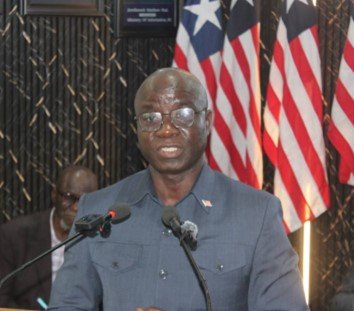
Speaking Thursday at the Ministry of Information’s regular press briefing, Dr. Nuetah said the Executive Order, which took effect on July 1, was issued after extensive consultations and careful assessment of challenges facing Liberia’s rubber sector.
The minister said the order was intended to ensure that Liberian farmers receive fair prices for their rubber while creating a stable supply of raw materials for domestic processing factories.
He rejected claims by the Liberia Small Rubber Farmers and Brokers Union that the Executive Order is unconstitutional, insisting that the President acted within the law and in the national interest.
According to Dr. Nuetah, the government began reforming the rubber sector in 2024 when President Boakai established an inter-ministerial committee to oversee pricing in the industry. The committee, chaired by the Ministry of Agriculture and comprising representatives from the Ministries of Justice, Commerce, Labour, the National Investment Commission, the Rubber Development Fund, and other stakeholders, was mandated to set monthly farm-gate prices based on international market trends.
He noted that the committee increased the official farm-gate price for processed rubber from about US$545 per metric ton in June 2025 to US$801 per metric ton by June 2026, with the July 2026 price further rising to US$840 per metric ton.
“The President took this action to ensure our farmers receive fair value for the hard work they put into producing rubber,” Dr. Nuetah said.
The Agriculture Minister explained that while licensed processors comply with government regulations by paying taxes and statutory fees, some exporters of unprocessed rubber were avoiding those obligations, giving them an unfair advantage in the market and depriving the government of much-needed revenue.
He said the practice also created shortages of raw materials for local rubber-processing companies, forcing some factories to operate below capacity.
According to Dr. Nuetah, companies involved in processing Technically Specified Rubber (TSR) complained that they were unable to secure enough raw materials to sustain production. He added that one major processing company informed the government it was operating at less than half of its production capacity because of inadequate rubber supply, putting hundreds of jobs at risk.
The minister said a committee established to review complaints from major agricultural concessionaires later recommended a complete ban on the export of unprocessed rubber. That recommendation ultimately led to the President issuing Executive Order No. 166.
He stressed that the government’s objective is to encourage value addition within Liberia by ensuring that locally produced rubber is processed domestically before export, creating employment opportunities and strengthening the national economy.
Dr. Nuetah also dismissed concerns that farmers would lose access to markets, assuring rubber producers that demand from local processing companies remains strong and that all quality rubber brought to licensed buyers would be purchased.
During the question-and-answer session, the minister declined to identify companies allegedly exporting unprocessed rubber outside the approved system, saying investigations were still ongoing. He explained that the government had established that some exporters were bypassing legal procedures, including the payment of taxes and statutory fees, enabling them to offer higher prices to farmers while depriving the government of revenue.
Dr. Nuetah also highlighted the Ministry of Agriculture’s youth and student employment initiatives. He said the ministry works with companies across the country to provide vacation jobs for students, including those pursuing agriculture-related studies, adding that the program offers practical experience while supporting young people’s education.
On the ministry’s budget, the Agriculture Minister praised the Boakai administration for increasing funding to the agriculture sector. He said the sector’s allocation has risen significantly compared to previous years, with the Ministry of Agriculture receiving more than US$13 million in the current fiscal year.
Although acknowledging that funding remains below the ministry’s long-term needs, Dr. Nuetah said the increased allocation has enabled the ministry to recruit additional personnel, improve field operations, and provide mobility for technical staff to better serve farming communities across Liberia.
He maintained that the government remains committed to expanding investment in agriculture in future budgets to strengthen food production, support farmers, and grow the sector.
Dr. Nuetah concluded by urging farmers not to be misled by misinformation surrounding the Executive Order, insisting that the measure is intended to protect their interests, promote local industrial growth, and preserve jobs for Liberians.
About The Author