
By Jamesetta D. Williams
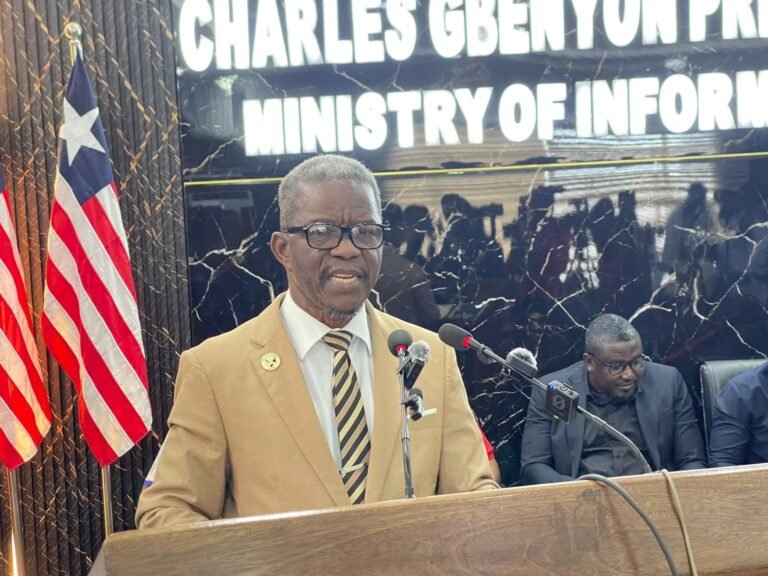
Monrovia-As political parties begin positioning themselves ahead of Liberia’s 2029 presidential and legislative elections, Citizens Movement for Change (CMC) Political Leader Musa Hassan Bility has given back-kick to any form of coalition politics, emphasizing that his party has no intention of joining any political coalition that fails to address Liberia’s governance challenges and provide a clear direction for the country.
Appearing on Spoon FM’s One on One with CEO Stanton Witherspoon Sunday, he discussed the political situation in Liberia, recent developments within the opposition and his party’s plans ahead of the 2029 elections.
According to Bility, CMC is prepared to work with other political actors, but only within a framework that addresses what he described as the “issues of yesterday,” questions of governance and the future direction of Liberia.
“CMC have absolutely no intentions of being part of any coalition that fail to address the issues of yesterday, the issues of governance and the issues of where we are taking this country to,” Bility said.
His comments come as several opposition parties have begun discussions aimed at strengthening cooperation ahead of the 2029 elections.
Five opposition political parties recently signed a joint communiqué following a roundtable hosted by Movement for Progressive Change (MPC) Political Leader Simeon Freeman at Sinkor Palace in Monrovia.
The meeting brought together former President George Manneh Weah, ANC Political Leader Alexander Cummings, MOVEE Political Leader Dee-Maxwell Kemayah, Freeman and ULDP Political Leader Jonathan Mason.
CMC, however, was not part of the signing.Bility’s position suggests that CMC intends to maintain an independent political path rather than immediately joining the emerging opposition arrangement.
He further described his party’s approach as the formation of a “third lane” in Liberian politics, separate from both the Coalition for Democratic Change (CDC) and the ruling Unity Party.
“We are forming the third-lane to oppose the CDC and the Unity Party,” Bility said.
The statement places CMC in a distinct position as political parties begin to consider possible alliances, candidates and governing platforms ahead of 2029.
Bility also made a strong personal declaration about his own political ambitions, saying he believes he should be elected president rather than either President Joseph Nyuma Boakai or former President George Weah.
“I think nobody should be elected besides me, I am the one who should be elected, not Joseph Boakai, not George Weah, not anyone else,” Bility said.
The declaration comes nearly three years before the next presidential election and indicates that Bility intends to remain a significant political figure as the 2029 political conversation develops.
While CMC is maintaining its independent position, MPC Political Leader Simeon Freeman has indicated that the door remains open for future cooperation with Bility.
“Musa Bility can’t criticize an unborn child, we will work with him in the future,” Freeman said.
Freeman’s comments suggest that differences between CMC and other opposition parties may not permanently prevent future cooperation.
The contrasting positions also highlight the broader challenge facing Liberia’s opposition as parties seek to determine whether they can work together while maintaining their individual political identities and presidential ambitions.
For CMC, Bility is emphasizing governance reform and a clear national direction as conditions for political cooperation.
For the parties participating in the recent roundtable, the focus has been on building a broader framework for cooperation and holding the current government accountable.
The emerging political situation means that the 2029 election conversation is likely to involve not only competition between the ruling Unity Party and the CDC, but also efforts by smaller and emerging political forces to establish themselves as independent alternatives.
With the election still years away, it remains unclear whether the current opposition discussions will eventually produce a unified ticket, multiple opposition candidates or a broader coalition involving additional parties.
For now, Bility’s position is clear that the CMC intends to pursue its own political direction while remaining open to cooperation that meets its stated demands on governance and Liberia’s future.
As the political calendar moves closer to 2029, the ability of opposition parties to reconcile their different ambitions, policy priorities and leadership claims will remain an important part of Liberia’s developing electoral landscape.
About The Author