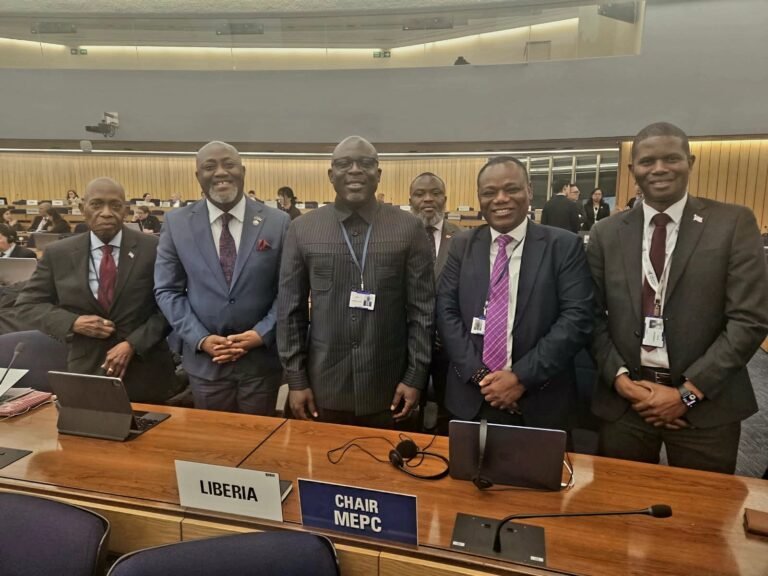

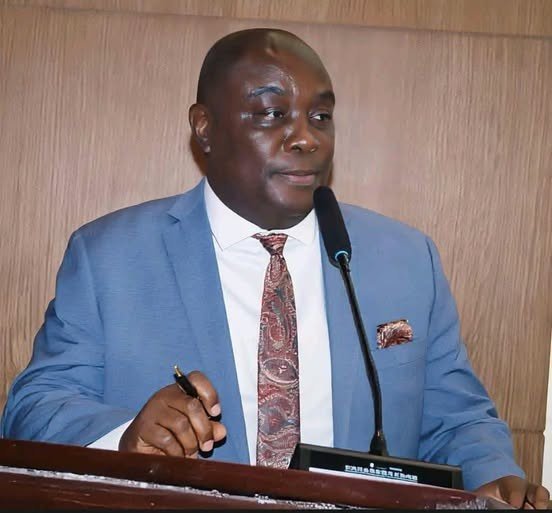
Monrovia-Sinoe County Senator Crayton O. Duncan has criticized the government of President Joseph Nyuma Boakai and Vice President Jeremiah Kpan Koung, questioning its emphasis on road construction and yellow machines despite its pledge to rescue Liberians from poverty.
Sen. Duncan said the government came to power promising to rescue the Liberian people from poverty, but argued that public discussions about its performance have largely centered on road projects and yellow machines.
“The Boakai government said they came to rescue us from poverty, but the only things we keep hearing about are yellow machines and roads,” Duncan said.
Speaking recently in a radio interview in Monrovia, he expressed concerns about the government’s stated rescue agenda and the issues dominating public discussions about its performance.
Duncan’s comments touch a raw nerve in the national debate, according to political analysts.
Recall that when the Unity Party campaigned in 2023, its central message was “Rescue Mission,” a promise to rescue Liberians from what it described as grinding poverty, high cost of living, corruption, and neglect under the former Coalition for Democratic Change government.
Candidate Boakai’s famous pledge that “no car will get stuck in the mud” became the most memorable symbol of that mission. Upon taking office in January 2024, President Boakai declared roads as a national emergency and deployed dozens of yellow machines to all 15 counties with fanfare.
Nearly three years later, yellow machines have become the administration’s most visible achievement, and its most debated one.
While supporters argue the machines represent action, critics like Senator Duncan, said they represent a narrow definition of rescue.
“Roads are important, but roads alone do not take a person out of poverty,” a political analyst in Monrovia said in reaction to Duncan’s comments. “If you build a road but the farmer has no fertilizer, the market woman has no capital, the youth has no job, and the price of rice still doubles, have you rescued anyone?”
Duncan, who represents Sinoe County, one of the counties most affected by bad roads in the southeast, knows the road crisis firsthand.
Travelers to Sinoe, Grand Gedeh, River Gee and Grand Kru have in recent weeks posted harrowing videos of vehicles stuck for days in Duogee Town Swamp near Tapita and on the Greenville-Zwedru corridor. Prices of basic commodities have doubled in Zwedru and Fish Town.
The Ministry of Public Works itself confirmed the poor conditions two days ago, warning travelers about soft and unstable ground and advising heavy-duty vehicles to reduce loads to 20 tons.
Yet Duncan’s point is that while roads are a crisis, poverty is a bigger one.In Sinoe, as in most of Liberia, agriculture employs the majority, but according to Senator Amara Konneh’s recent analysis, agriculture grew at only 1.3% while mining, which creates few jobs, grew at 16.6% and now accounts for 23.4% of GDP.
Youth unemployment remains at 70%, the drug crisis is worsening with LDEA seizures up 300% in 2025, and public schools like those in Gbarpolu’s Gbarma District have three students per desk with leaking roofs.
“When we say rescue from poverty, we mean jobs, food on the table, health centers with drugs, schools that work,” Duncan implied in his interview. “You cannot rescue people from poverty with yellow machines alone.”
Duncan’s criticism raises questions about how the government’s infrastructure initiatives align with its broader ARREST Agenda, an encapsulation of Agriculture, Roads, Rule of Law, Education, Sanitation and Tourism.
While Roads is the second pillar, Agriculture is the first. Yet PSIP execution in health and education is only about 4%, according to the Senate Public Accounts Committee, and farmers still lack feeder roads, fertilizer and markets.
Commerce Minister nominee Stephen Yekeson, in his confirmation hearing Tuesday, acknowledged the same, saying “Cargo can take close to two weeks to clear the Freeport of Monrovia. Then come duplicate fees, paper permits, and costly transport to the counties. None of these add value. All of them add price.”
The implication is that without cutting those costs, providing finance for Liberian businesses, and ensuring government and concessions pay local suppliers on time, all commitments Yekeson made, roads alone will not reduce poverty.
Duncan’s criticism also adds to the early positioning for the next election. Information Minister Jerolinmek Piah, speaking at the MICAT press briefing last Thursday, admitted that “No government can solve all of the problems in a country within six years,” a statement that itself has sparked debate about whether the Unity Party oversold the rescue promise.
Supporters of the government counter that Duncan, as a sitting Senator, is part of the government and should be proposing solutions rather than just criticizing.
They argue that roads are a prerequisite for poverty reduction, without roads, farmers cannot get goods to market, teachers cannot reach schools, and health workers cannot reach clinics.
“Roads are not separate from poverty, they are at the center of it,” a Unity Party youth leader said.
Ultimately, Duncan’s remarks highlight what ordinary Liberians say daily: they want rescue they can feel.
In Kpayekorleh, Ngowolala District, Gbarpolu, citizens told Senator Konneh they welcome yellow machines but fear financing delays will stall works.
They asked for health workers to be placed on payroll, for police for security, and for schools to be fixed.In other words, they want yellow machines that actually lead to roads, roads that actually lead to markets, and markets that actually leave money in their pockets.
Until then, the debate will continue as to whether the Boakai-Koung government is rescuing Liberians from poverty, or just grading the road that leads deeper into it.
It is now up to the administration to answer, not with more photos of yellow machines, but with results Liberians can count in their kitchens.
About The Author