
MONROVIA – Several years after leaving office, former President Ellen Johnson Sirleaf, Liberia’s first post-war democratically elected head of state and Africa’s first elected female president, is facing renewed national condemnation over her government’s handling of concession agreements.
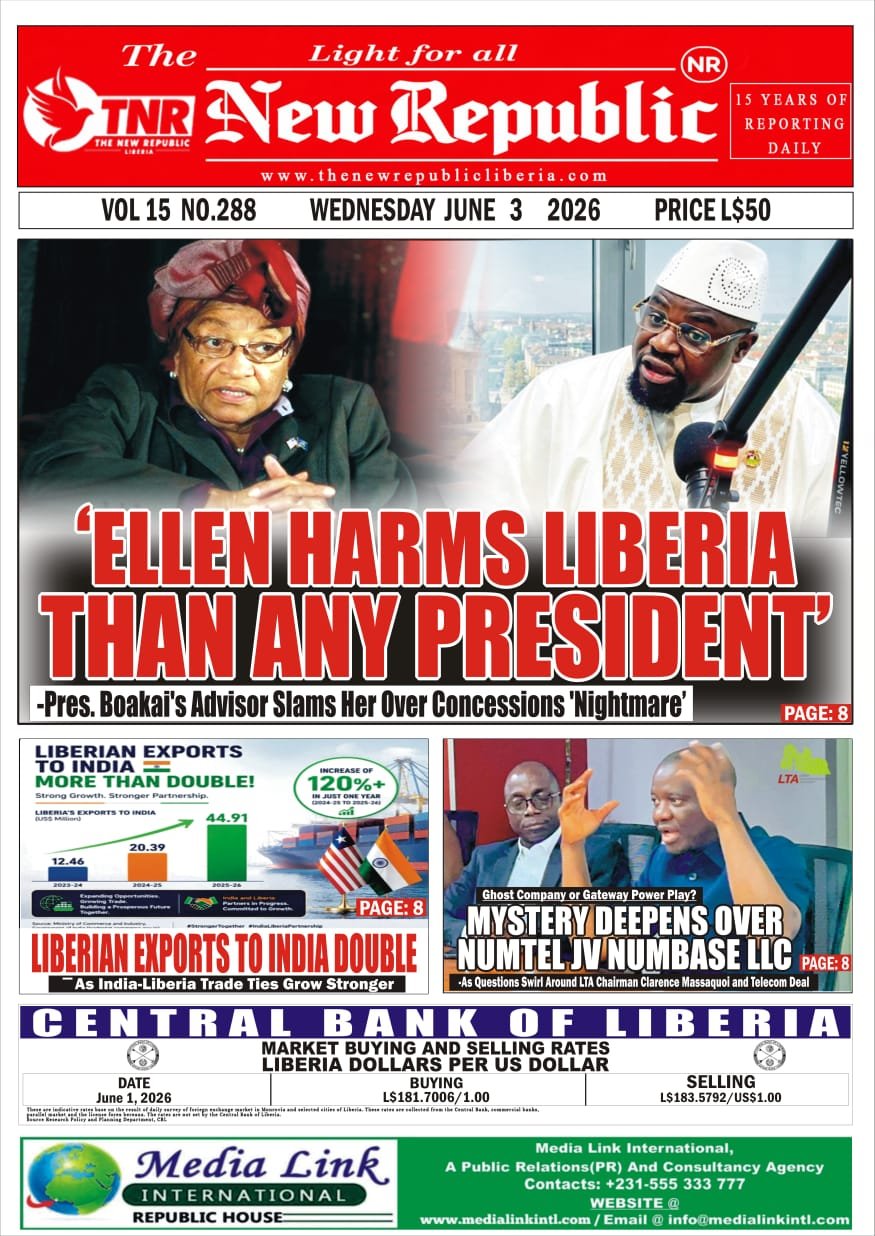
The latest criticism came from Presidential Advisor, Amb. Sheikh Al-Moustapha Kouyateh, who squarely blamed Sirleaf for what is described as a “nightmare” of lopsided deals that cost Liberia billions.
Reacting to the poor handling of those agreements on Spoon Talks Monday evening, Kouyateh went further, saying “Sirleaf did more harm to Liberia than any president.”
Kouyateh expressed anger over concession contracts signed during the Sirleaf administration, arguing that the terms overwhelmingly favor foreign investors while Liberia sees minimal returns.
Bad concession deals debate is renewed amid recent revelations from current and former Boakai administration officials that foreign companies are reaping billions of dollars while Liberia benefits little or nothing.
Former Lands and Energy Minister Wilmot Paye disclosed made what many described as startling revelation about how much Bea Mountain is accruing from weekly export of gold.
According to him, the company whose mineral development agreement (MDA) came into being during the Madam Sirleaf administration, is reaping $31 million dollars weekly, a company is yet to react to.
“Almost all agreements signed during the Ellen administration did not meet or go through required standards of law,” Kouyateh said, citing findings reportedly made by an international firm sometime ago.
He said the failure to follow legal and due-process standards left the country exposed to deals with limited benefits for citizens.
Sirleaf served two terms from 2006-2018, inheriting a war-shattered economy and leading Liberia’s post-conflict recovery.
Her government pursued concessions in mining, agriculture, and forestry to attract foreign investment and fund reconstruction. But that strategy has become one of the most contentious parts of her legacy.
Liberia’s concessions regime under Sirleaf has been described by critics as “not one of exhilaration, but one of extreme national loss, frustration and agitation over its lopsided benefits.”
The frustration stems from several recurring issues raised over the years several factors including revenue benefits.
The Ambassador-at-Large for Special Duties and Special Presidential Envoy sparked debate recently when he accused members of the House of Representatives of passing concessions that did not favor the Liberian people.
He also spoke of how lawmakers received bribes from European interests to award contracts.
Amb. Kouyateh has however denied ever accusing members of the current Legislature of routinely accepting bribes to approve concession agreements.
“I never stated that members of the current Legislature routinely take bribes before signing concession agreements,” Kouyateh maintained, adding that his concerns were centered on the overall structure and outcomes of concession deals rather than individual legislators.
He argued that, as a citizen, he retains constitutional rights to express opinions on matters of national interest when speaking in a personal capacity.
Despite the dispute, Kouyateh reaffirmed his support for the Boakai administration and its agenda for accountability, transparency, reconciliation, and national development.
He insisted to remain vocal in the interest of the Liberian people, saying “I stand between two blades: one is about state and is convictions.”
The controversy continues to generate public debate over the fairness of Liberia’s concession agreements, the balance between free speech and public accountability, and the relationship between government officials and the Legislature.
It is argued that the fiscal terms, tax breaks, and stabilization clauses in many deals reduced government revenue at a time when post-war Liberia needed funding for roads, schools, and hospitals.
Compliance and process also formed part of the overall concession anger, with claim that “almost all agreements” bypassed required legal standards touches on concerns about transparency, competitive bidding, and legislative ratification.
Civil society groups have long called for stricter adherence to Liberia’s Public Procurement and Concessions Commission laws.
One growing concern has to do with large land and resource allocations, communities near concession areas that often complained of unmet promises on jobs, infrastructure, and social services.
That gap between agreement and implementation fuels what Kouyateh calls a “long-running nightmare facing post-war governance and attending infrastructural development demands and socio-economic wellbeing for all Liberians.”
As the first post-war democratically elected president, Sirleaf stands “at the vertex of national anger” over those agreements.
Her administration is credited with restoring international credibility, debt relief, and attracting initial investment after 14 years of war.
But critics say the concession debate has become a counterpoint in assessments of her presidency.
The “Madam Sirleaf did more harm to Liberia than any President” label from a sitting presidential advisor reflects how raw the issue remains in 2026.
For many Liberians, concessions represent missed opportunities: land and resources committed, but limited transformation in living standards.
Sirleaf’s supporters often argue that post-2003 Liberia had few options. With destroyed infrastructure, no credit history, and urgent need for capital, concessions were one of the few tools available to bring investors in.
They also note that her government did push some reforms, including the Liberia Extractive Industries Transparency Initiative and efforts to p…
The claim that 60% of concession agreements in Liberia are illegal relates to the aftermath of the civil war, specifically regarding the country’s forestry and logging sector.
Following the end of the conflict, official reviews and investigations by government and international watchdogs, such as Global Witness, found that a vast majority of the country’s early post-war large logging contracts were highly flawed.
Many of these agreements, including land-use contracts, Private Use Permits (PUPs), and timber concessions, were found to be illegal because they were either awarded improperly, operated in violation of national laws and environmental codes, or both.
This historic crisis has prompted sweeping reforms, moratoriums, and independent investigations into Liberia’s resource governance to recover lost revenue and enforce the rule of law.
About The Author