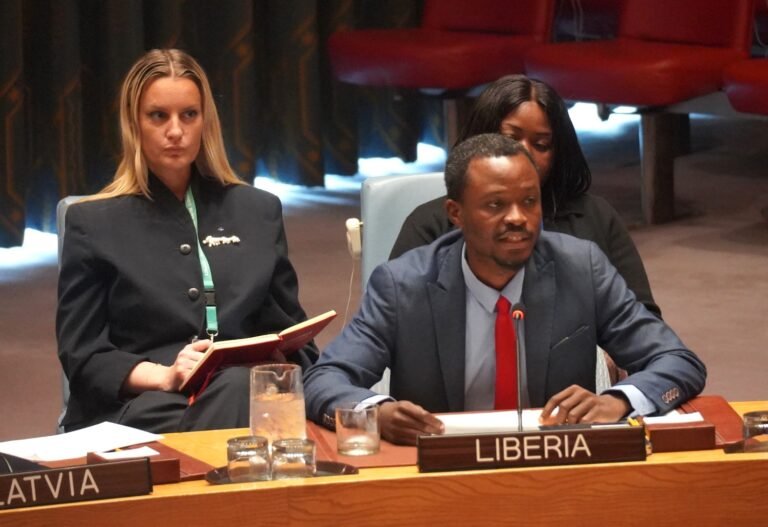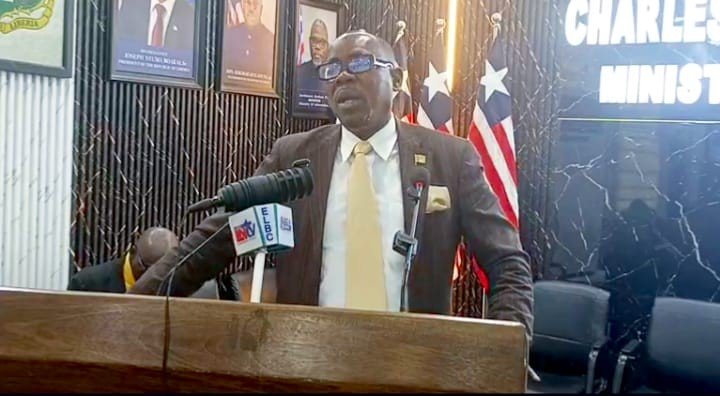
Acting INHRC Boss, Fahnbulleh
By Jamesetta D Williams
Monrovia-In what appears to be some sort of damage control initiatives, the Independent National Commission on Human Rights (INCHR) said it has begun a series of institutional and governance reforms aimed at restoring public confidence, strengthening accountability and rebuilding relationships with national and international partners.
Acting Chairperson, Cllr. Mohammed Fahnbulleh said the reforms are intended to restore the image of the Commission and strengthen its ability to protect and promote human rights in Liberia.
INCHR has been at the center of leadership controversy between Fahnbulleh and suspended chairman Cllr. Dempster Brown, who himself was Wednesday arrested and charged with alleged forgery. He was released on bail, according to reports from the court.
Fahnbulleh who made the disclosure Thursday at the Ministry of Information where he provided highlights on the work of the Commission and its efforts to improve its operations since the appointment of the current leadership on June 26.
President Joseph Nyuma Boakai sometimes ago suspended Cllr. Brown and appointed an acting leadership team headed by Cllr. Fahnbulleh.
He said the decision to appoint him with others in acting leadership capacity created an opportunity for the institution to “restore sanity,” rebuild its image and give the Liberian people renewed confidence in the Commission.
According to him, the new leadership is focusing on accountability, transparency, professionalism and institutional integrity.
Cllr. Fahnbulleh said one of the major priorities since the new leadership took office has been rebuilding the Commission’s relationship with its national and international partners.
He said the Commission’s relationship and public image had declined over a period of nearly five years due to internal disagreements within the institution.
According to him, the situation affected the confidence of partners and created challenges for the Commission in carrying out its responsibilities.
The new leadership subsequently began engaging international partners, including the European Union and United Nations agencies, to explain the changes taking place within the institution and encourage continued support.
Fahnbulleh said the engagements are already producing results, with relations between the Commission and its international partners improving.
He emphasized that although the INCHR is an independent institution and does not take instructions from the government, it works in coordination with government institutions, civil society organizations and national and international partners.
The Acting Chairperson said the Commission has also introduced reforms to strengthen its internal governance and ensure that officials and employees properly perform their responsibilities.
He disclosed that the Commission is required to hold board meetings twice each month but said regular meetings were not held for approximately two years before the suspension of the former chairperson.
He alleged that during that period, members continued receiving salaries despite not properly carrying out their responsibilities.
Fahnbulleh said the new leadership has taken steps to ensure that the Commission operates as a professional institution.
Staff members are now expected to report to work regularly, while new systems have been introduced to improve accountability and monitor performance.
The Commission has also received support from the Civil Service Agency and the Liberia Anti-Corruption Commission to strengthen its human resource management, according to Fahnbulleh.
He said the Commission discovered that several employees were working without clearly defined terms of reference, while some individuals had reportedly been brought into the institution without following the proper recruitment process.
Under the new system, staff members are expected to have clear terms of reference and develop work plans outlining their responsibilities.
The Commission has also introduced staff performance management and evaluation systems.
Fahnbulleh said a human resource management software system has been developed to help monitor staff attendance, work records, leave and other employment information.
Beginning November 1, he said employees will also be required to use a fingerprint system to record their attendance.
The system, according to him, is intended to ensure that employees report to work and perform the duties for which they are being paid.
The INCHR has also appointed a training manager to coordinate professional development sessions for employees twice every month.
Fahnbulleh said the sessions will cover areas including procurement, public financial management, reporting and other areas considered necessary to improve staff capacity and professionalism.
He said the reforms are part of a broader effort to improve the Commission’s internal systems and restore confidence in its work.
Despite the institutional challenges, Fahnbulleh reaffirmed the Commission’s responsibility to protect and promote human rights in Liberia.
He said the Commission’s independence remains important to its work and that the institution will continue cooperating with government agencies, civil society organizations and international partners while maintaining its independent mandate.
Fahnbulleh said the current leadership is committed to building an institution that is more accountable, transparent and professional.
He said the reforms are ultimately intended to restore the credibility and integrity of the INCHR and enable it to effectively carry out its mandate of protecting and promoting the rights of the Liberian people.
“We believe these reforms are necessary to restore the credibility, professionalism, and integrity of the Independent National Commission on Human Rights,” Fahnbulleh said.
He added that the Commission’s goal is to become a stronger and more accountable institution capable of effectively protecting and promoting human rights across Liberia.
About The Author