
By Stephanie M. Duncan
Liberia recorded a 5.1 percent growth in real Gross Domestic Product (GDP) in 2025, up from 4 percent in 2024, as the government reviews the first year of implementation of the Arrest Agenda for Inclusive Development (AAID) 2024–2029.
The review is being held during the National Steering Committee Meeting for the National Development Plan under the theme, “Consolidating AAID Gains and Accelerating Implementation into Measurable and People-Centered Outcomes.”
The meeting brings together government institutions and development partners to assess progress, identify implementation challenges and develop measures to accelerate the delivery of programs under the AAID.
Finance and Development Planning Minister Augustine Kpehe Ngafuan, presenting an assessment of the first year of implementation, said Liberia’s economic growth is projected to reach 5.5 percent in 2026.
GDP per capita increased from US$849 in 2024 to US$861 in 2025, while inflation remained relatively manageable despite pressures from global fuel prices.
According to Minister Ngafuan, inflation increased from 3.2 percent in January 2026 to 5 percent by June 2026, largely as a result of global fuel price shocks.
Public debt also declined, with the debt-to-GDP ratio falling from 56.1 percent in 2024 to 54 percent in 2025. It is projected to decline further to 49.6 percent in 2026.
Domestic revenue collection recorded significant improvement, increasing from US$69 million in 2024 to US$848 million in 2025 and reaching US$761.1 million by June 2026.
The Ministry said Liberia remains on track to achieve its 2026 domestic revenue target of US$1.3 billion, which it said provides a stronger foundation for financing development priorities under the AAID.
Despite the positive economic indicators, the first-year assessment found uneven implementation across government institutions.
While some institutions have made encouraging progress, others continue to face delays, capacity limitations and coordination challenges.
The Ministry of Finance and Development Planning said stronger coordination, effective budget preparation and execution, and timely reporting are needed to ensure that public resources are directed toward projects with measurable development impact.
Minister Ngafuan said the Ministry will continue working with implementing institutions to strengthen planning, financing, monitoring and reporting under the AAID framework.
He further called for recommendations emerging from the meeting to be properly documented, communicated and followed up to strengthen implementation, improve institutional performance, enhance accountability and keep the AAID on course to achieve its development outcomes.
The assessment also highlighted planning reforms that have improved the government’s ability to track commitments and assess institutional performance.
Deliberations at the meeting are expected to focus on understanding the challenges confronting implementing institutions and identifying practical solutions to accelerate the delivery of planned interventions.
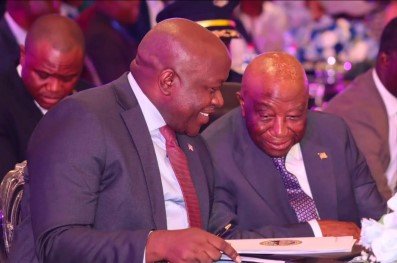
Making special remarks, President Joseph Nyuma Boakai emphasized the importance of collective responsibility and coordinated action in addressing Liberia’s development challenges.
President Boakai stressed the need for Liberia to move from poverty toward prosperity, urging citizens and institutions to take responsibility for the country’s development.
He acknowledged progress made during the past year in aligning national platforms and mobilizing resources for key interventions but also pointed to implementation gaps and institutional governance challenges that must be addressed.
The President called for timely and honest reporting, efficient use of public resources and stronger accountability across government institutions.
He also emphasized the importance of partnerships involving the government, development partners, private sector and civil society in achieving sustainable economic growth, creating jobs and improving public services.
President Boakai called for deeper cooperation with civil society in national planning and implementation, noting that civil society organizations can help bridge the gap between government and citizens and ensure that institutions deliver planned interventions effectively.
He also urged government institutions to collect and consolidate employees’ permission-to-travel documents to prevent travel-related administrative delays from affecting productivity under the inclusive development agenda.
The President further called for strengthening Liberia’s national data system and building institutional capacity to enable ministries, agencies and development partners to use data platforms for real-time monitoring and reporting of AAID implementation.
He noted that the inclusive development agenda, launched in January 2025, was intended to move the government beyond rhetoric and toward measurable improvements in the lives of Liberians.
President Boakai also expressed appreciation to international partners for their support to Liberia’s development efforts, stressing the importance of strong partnerships in delivering meaningful and sustainable results.
For her part, United Nations Resident Coordinator Christine N. Umutomi commended Liberia’s leadership in advancing the inclusive development agenda and highlighted the Inclusive Partnership Act and the Integrated National Financing Framework as important steps toward strengthening national ownership and development financing.
Umutomi called for stronger coordination and innovative financing mechanisms, stressing the need for Liberia to transition from a model focused primarily on funding to one centered on broader financing.
She said Liberia must leverage domestic resources, private sector investments and innovative financing mechanisms to support its development priorities.
According to the UN Resident Coordinator, key areas requiring increased investment include human capital development, economic transformation and digital inclusion.
She said the United Nations will continue to support Liberia through technical expertise, partnerships and efforts aimed at mobilizing transformative investments.
The National Steering Committee meeting is expected to produce recommendations aimed at strengthening AAID implementation, improving institutional performance and accountability, and ensuring that Liberia’s development agenda delivers measurable and people-centered outcomes.
At the end of the meeting, the National Steering Committee reaffirmed its commitment to effectively implement, monitor and report on the AAID in a transparent manner in 2026 and beyond.
Having reviewed the achievements, challenges and lessons from the first one and a half years of implementation, the committee described the AAID as a shared national commitment to translating policies, reforms and investments into inclusive economic growth, improved public services, stronger institutions, greater accountability and tangible improvements in the lives of Liberians across all communities.
The committee committed to consolidating the gains made during the first year by scaling up successful interventions across all AAID pillars, addressing implementation gaps and ensuring that lessons learned inform subsequent phases of implementation.
It also called for diversification of development financing and partnerships through stronger domestic resource mobilization, deeper engagement with development partners to align financing and disbursements with AAID priorities, and increased engagement with the private sector and Liberian diaspora to attract investment in strategic sectors.
The committee further called for the exploration of innovative and blended financing mechanisms to safeguard and sustain AAID financing and implementation amid domestic and global economic pressures.
On accountability, the committee said ministries, agencies, commissions, development partners, the private sector and civil society organizations must fulfill their respective commitments with transparency and measurable results.
It also committed to aligning AAID priorities with national, regional and global developments, ensuring that Liberia’s development agenda remains responsive to emerging challenges and opportunities while advancing the country’s commitments to the Sustainable Development Goals and the African Union’s Agenda.
The committee emphasized the need to empower citizens and communities by strengthening their participation in national development, with particular attention to ensuring that women, young people, persons with disabilities and other vulnerable groups are active participants and beneficiaries of Liberia’s development.
It also called for renewed political and institutional support, urging leaders at both national and subnational levels to champion the AAID as Liberia’s pathway toward resilience and prosperity.
The committee further pledged to accelerate the transition from plans to tangible outcomes by prioritizing high-impact interventions and investments that create jobs, expand economic opportunities, improve access to essential services and strengthen the livelihoods of Liberians.
Recognizing that achieving the objectives of the AAID will require sustained commitment, strong coordination and effective resource mobilization, the National Steering Committee pledged to strengthen the systems and partnerships necessary to ensure that implementation remains responsive, efficient and transparent, with a firm focus on measurable development impact.
About The Author