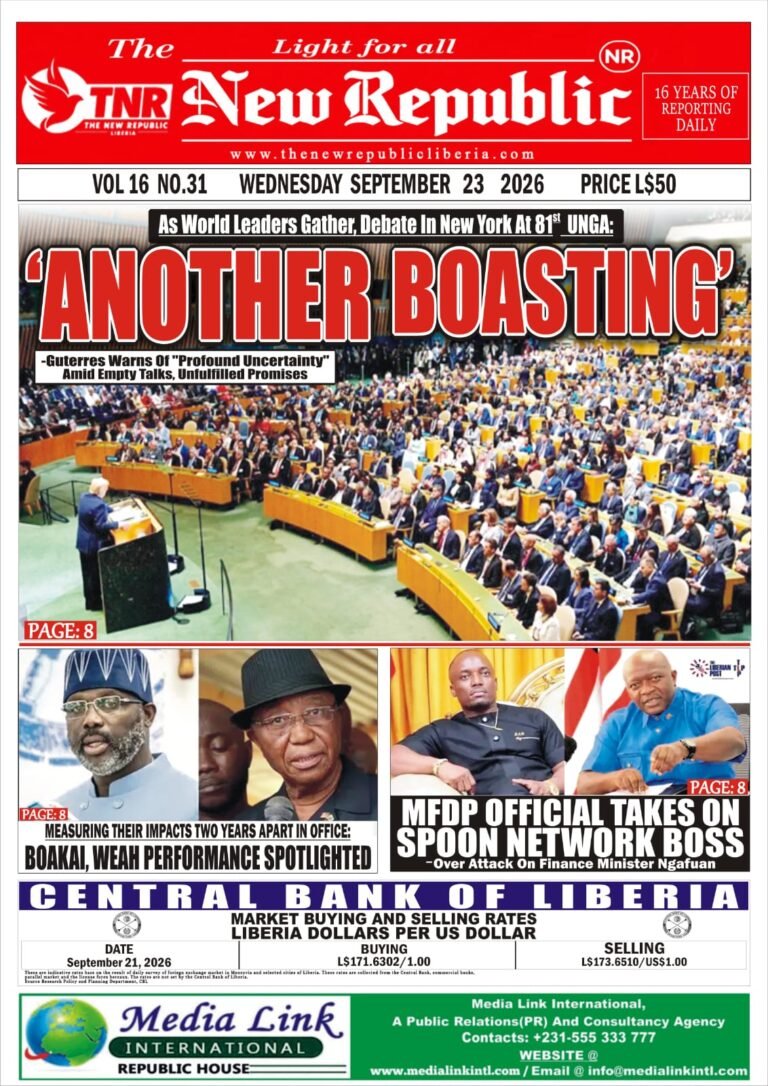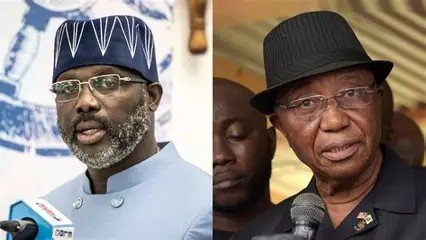
Monrovia-Current and former Presidents Joseph Boakai and George Weah have been spotlighted in terms of their performance and the impacts made in service delivery in the first two years of their respective administrations.
In tea shops in Duala, on motorbikes in Ganta, and on talk shows in Monrovia, one debate that dominates Liberia’s political conversation centers on the performance of current Joseph Boakai and former President George Weah, in terms of who delivered more in his first two years in office.
The issue of who has made the more impacts in two years is likened to a ‘daily meal’ debate between their supporters, and even citizens of other political establishments feeling either the positive and negative impacts.
It is an undeniable fact, according to analysts, that both men inherited a fragile post-war state, but at different moments and with different mandates.
Weah took over in January 2018 from Ellen Johnson Sirleaf with massive youth expectations, oil money hangover, and a promise to change Monrovia for the better, while Boakai took over in January 2024 from Weah with a promise to rescue Liberia, restore integrity, and fix systems.
According to analysts, two years into each presidency offers a revealing mirror.
In Weah two years between 2018-2019, he launched his Pro-Poor Agenda for Prosperity and Development (PAPD), marking his first two years with ambitious, populist moves, including free tuition at public universities (University of Liberia, William Tubman University), a controversial salary harmonization exercise that cut take-home pay for many civil servants while claiming to clean ghost names, and the injection of US$25 million into the economy to mop up excess Liberian dollars to stabilize exchange rates, an exercise that later sparked the L$16 billion scandal probe.
Those with economic knowledge said inflation in Weah’s two years spiked to over 28% by 2019, exchange rate deteriorated from L$125 to over L$200 to US$1 while growth was sluggish (1.2% in 2018, -2.5% in 2019). Amid of these economic situations, he made visible payments to WAEC and WASSCE fees, and market women loans were launched.
They also stressed that the second year of the Weah’s administration faced daunting challenges imposed by COVID-19, which every nation of the world experienced, impacted the global supply chain, undercut export and import and undermined domestic development initiatives.
Joseph Boakai who two years oscillate between 2024-2026, came with the ARREST Agenda – Agriculture, Roads, Rule of Law, Education, Sanitation, Tourism. His economic team, led by Finance Minister Augustine Ngafuan who returned in September 2024, focused on fiscal discipline and revenue.
As a measurable headline, his government in August 2026 ensured Liberia cross US$1 billion in domestic revenue for the first time, up from about US$700-750 million under Weah. The government says the was achieved through stricter controls at LRA, blocking leakages at the port, and digitalization.
Minimum wage policy, according to analysts, Boakai ensured no central government civil servant earns below US$150 per month as of January 2025, closing gaps left after Weah’s harmonization where some still earned US$65-80.
They also indicated that inflation has moderated to single digits (about 7-8% in 2026) and the Liberian dollar has stabilized around L$185-195 to US$1. However, they said the cost of living remains high, with rice and transport costs still biting, and youth unemployment largely unchanged.
Delivering their verdict on the economy, they also indicated that Weah spent big on symbolic pro-poor gestures but lost macro stability while Boakai has restored macro discipline and revenue, but tangible relief in markets is still slow to be felt.
In two years, those with information said Weah launched massive road projects, including the Doe Community Road, GSA Road, 14 Military Hospital Road, and began the RIA Highway. They also recalled how he completed the Japan Freeway (formerly Somalia Drive) started by Sirleaf and pushed the Coastal Highway concept.
They added that many projects were financed by opaque pre-financing loans with high interest, and some were incomplete by end of year two.
For Boakai, this paper was made to understand that he inherited debts to contractors, adding that instead of new loans, his government launched the Yellow Machines initiative, procuring earth-moving equipment for all 15 counties for road connectivity, farm-to-market roads, and laterite road rehabilitation.
They spoke of major corridors like Gbarnga-Voinjama, Sanniquellie-Loguatuo, and Barclayville-Pleebo seeing reconditioning, while the RIA Highway is now near completion.
Critics say Boakai has been better at completing and maintaining than starting new showpiece roads, referring Weah to showman of asphalt, and Boakai to mechanic of connectivity.
Commenting on rule of law, they recalled how Weah first two years were marred by major scandals, including L$16 billion alleged missing banknotes, US$25 million mop-up exercise controversy, and the dismissal of critical audits.
They claimed that the Liberia Anti-Corruption Commission (LACC) was weak while press freedom was relatively open, but officials were seen as untouchable.
Boakai made anti-corruption a central promise. In 2024, he issued Executive Order 131 establishing the Office for the War and Economic Crimes Court (OWECC-L), a landmark move Weah refused to take. He empowered the GAC and LACC, published assets, and allowed audits of the Central Bank and other entities.
Recent high-profile drug cases, including the arrest of former VP Jewel Howard Taylor linked to 4.2 tons of cocaine seizure in July 2026, have signaled a tougher stance on transnational crime.
Yet critics say prosecution remains slow, and some Boakai allies accused of corruption have not been charged.
According to them, Weah promised to fight corruption but was perceived to have shielded it. Boakai has created institutions to fight it, but convictions remain pending.
As it relates to international relations, they said Weah maintained strong ties with ECOWAS, AU, and was popular internationally as a former Ballon d’Or winner, but Liberia critics argued lost diplomatic weight, with little presence at major global forums beyond football diplomacy.
For Boakai, they said within two years, Liberia won a non-permanent seat on the UN Security Council for 2026-2027, after 55 years. Liberia will preside over the Council in December 2026. The government has launched the Women, Peace and Security NAP III and the 10-year PATHWAYS Framework for youth at the UN.
Foreign Minister Sara Beysolow Nyanti has elevated Liberia’s role in preventive diplomacy, stressing “This is arguably Boakai’s biggest measurable international win.”
They referred to Weah’s free tuition policy as biggest social legacy where thousands enrolled at UL who could not have afforded it, while recalling that he also built 14 Military Hospital and some housing units for the army and police.
In their analysis, Boakai focused on quality, including restoration of scholarship programs based on merit, regularization of volunteer teachers and health workers onto payroll, salary top-ups for health workers, teachers, engineers, soldiers and judiciary beginning 2025, and reintroduction of school feeding discussions.
Education outcomes have not yet shifted dramatically, but teacher absenteeism is down in some counties.
For supporters of Weah, impact is measured in what you can see: a paved road, free tuition receipt, a market loan. For supporters of Boakai, impact is measured in what you can feel working: systems, revenue, rule of law, international respect, and a government that at least attempts to be accountable.
A market woman in Red Light summed it best: “Weah gave us free school and road. Boakai is giving us country that makes revenue and catches big people selling drugs. We need both.”
Two years apart, Weah ruled with heart and popularity. Boakai is ruling with process and restraint. Liberia is still waiting for the president who can deliver both.
About The Author