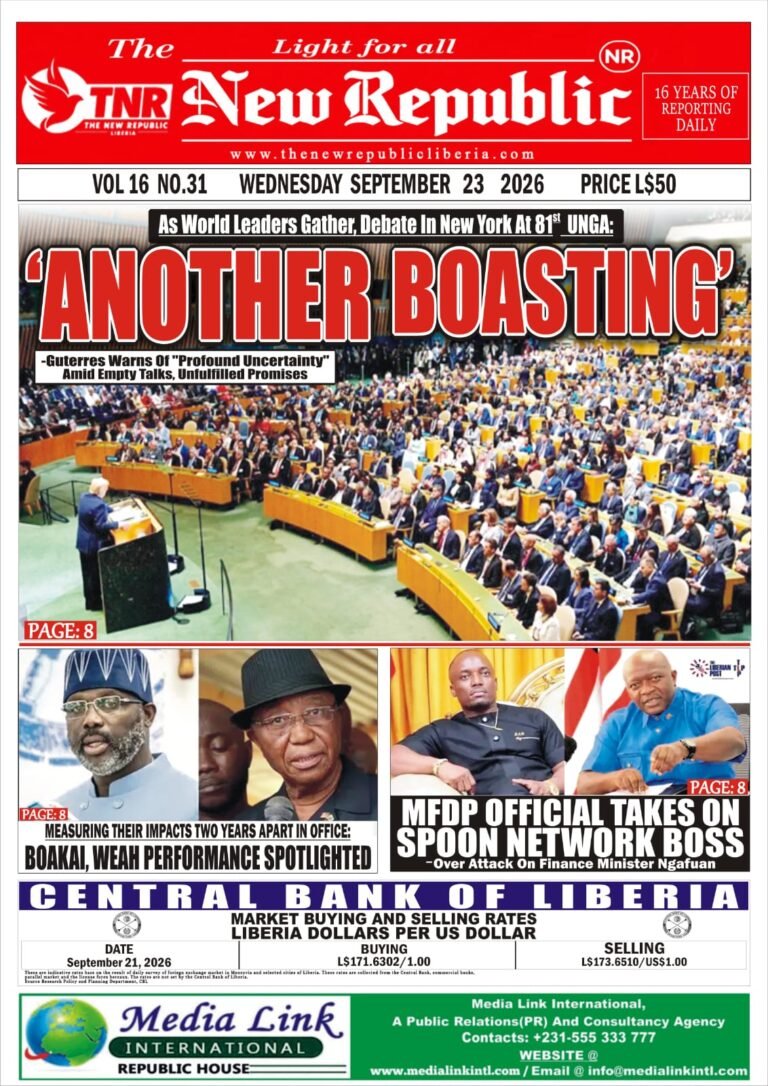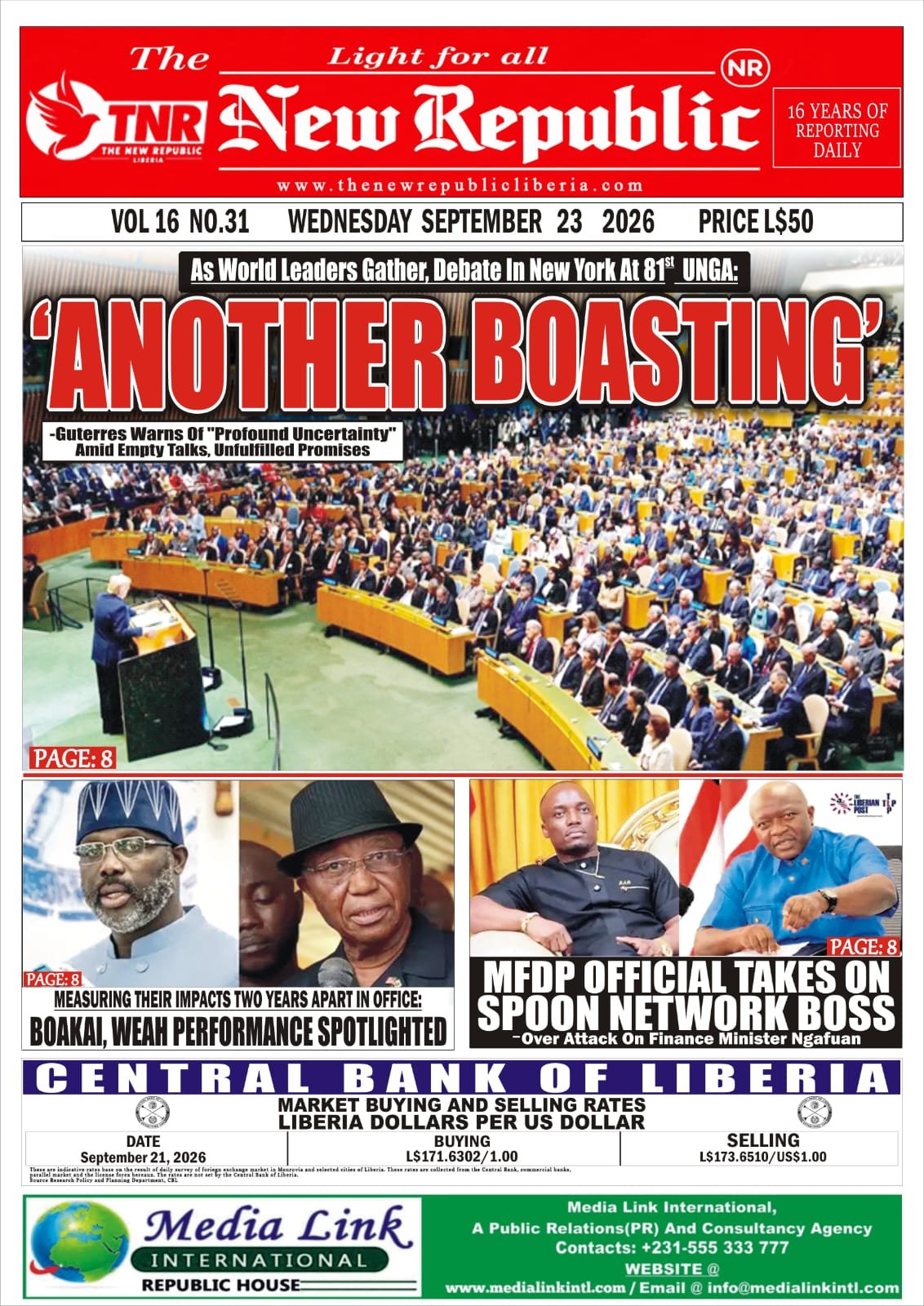
Monrovia-As the 81st United Nations General Assembly (UNGA) opened its high-level debate on Tuesday, September 22, UN Secretary-General Antonio Guterres captured the mood in one line, saying that the world has entered “an era of profound uncertainty.”
For many analysts watching from the galleries and corridors of UN Headquarters, that uncertainty is fed by what they describe as the annual ritual of unnecessary show-offs, empty and wild talks, and bold promises that rarely materialize.

More than 150 heads of state and government have converged on New York, including Liberian President Joseph Nyuma Boakai, Sr., leading Liberia’s largest diplomatic delegation since the country won a non-permanent seat on the Security Council.
US President Donald Trump kicked the ball rolling with a uncanny brag about his administration’s gains in repositioning the US economically, militarily, engineering and most powerful nation in the world.
He also had a strong warning for Iran to make a deal soon or face severe consequences for its pursuit of a nuclear weapon. “I have a big decision to make: Will a deal be made with Iran that lets them rebuild and create a far greater country than it ever was before – maybe one of the greatest in the Middle East or even the world?” Trump told the United Nations General Assembly.
“Or do I annihilate the Islamic Republic and do it quickly, never giving them a chance to kill and destroy people and countries again? Do I drive them into hell with no chance of survival and no hope of future greatness or generations?”
On paper, the agenda is heavy with the fifth year of the war in Ukraine, Israel’s military operations in Gaza, the escalating US-Iran confrontation disrupting oil prices and shipping through the Strait of Hormuz and Bab al-Mandeb, Sudan’s catastrophic civil war, the global economy, and for the first time in UNGA history, the governance of Artificial Intelligence.
In practice, critics say, UNGA has become a platform for flaunting domestic progress rather than fixing global problems.
“They often use the platform to bring challenges facing their respective nations as well progress made in their localities to the front-burner, while making bold announcements, commitments with unyielding promises,” one analyst familiar with UNGA proceedings confided.
Following Guterres’ stark report on the state of the world, Brazilian President Luiz Inácio Lula da Silva – as tradition demands – opened the debate, followed by US President Donald Trump.
Day one also featured Iranian President Masoud Pezeshkian and Ukrainian President Volodymyr Zelenskyy, who was expected to hold a high-stakes bilateral with Trump on the margins.But diplomats privately admit expectations for breakthroughs inside the General Assembly Hall itself are low.
Attention, they say, is focused on what happens away from the spotlight – the bilateral huddles, corridor negotiations, and side-events where deals on ongoing conflicts are actually shaped.
A meeting between Guterres and Russian Foreign Minister Sergei Lavrov is already scheduled for September 24.
France announced on the eve of the debate it is working on a new Security Council resolution aimed at reopening the Strait of Hormuz and ensuring freedom of navigation – a tacit admission that the GA speeches alone will not resolve it.
Guterres, for his part, has placed AI among the “three existential threats” of our time, alongside climate crisis and growing inequality, and is pushing for a first-ever global agreement to set limits on its development.
For Liberia, this UNGA is historic regardless of the show-off label. President Boakai arrives not as the leader of a country that spent 14 years on the Security Council agenda during its civil wars, but as a member of the Council itself, set to assume its Presidency in December 2026.
While global powers trade barbs over war and AI, Boakai is pushing Liberia’s peace credentials rather than its problems.On Sunday, September 21, he launched Liberia’s Third National Action Plan on Women, Peace and Security (NAP III) in Conference Room 5, paying tribute to women at the Peace Hut in Fish Market who “made themselves impossible to exclude” during the war.
On September 18, he unveiled the 10-year PATHWAYS Framework for youth, peace, security and development at the African Union Observer Mission.With Foreign Minister Sara Beysolow Nyanti and Youth Minister Cornelia Kruah, Boakai is presenting the Peace Hut model as Liberia’s contribution to the global WPS toolkit – an example of localization that worked.
He is expected to address the General Debate later this week, outlining Liberia’s priorities as a Council member: preventive diplomacy, women and youth inclusion, and locally-led solutions to West Africa’s democratic reversals, transnational crime and insecurity.
Boakai has also held meetings with UNFPA Executive Director Diene Keita and UN Assistant Secretary-General for Youth Affairs Felipe Paullier.
With Trump, Macron and other leaders in attendance, the list of those staying away is equally telling: Russian President Vladimir Putin, Italian Prime Minister Giorgia Meloni, and Indian Prime Minister Narendra Modi are not attending in person.
Chinese President Xi Jinping sent a high-level delegate to New York, though he is expected to meet Trump in Washington immediately after UNGA.For President Boakai, the 81st Session is more than a speaking slot.
It is Liberia’s re-entry as a contributor to global peace, not just a recipient.
But in an Assembly where analysts say many leaders come to impress rather than to solve, the question lingers is whether this year will be different, or is just another show-off.
As Boakai himself said at the WPS launch: “A seat is an opportunity, not an achievement. What we do with it is the achievement.”
According to Fox News, more than 100 presidents and prime ministers will descend on New York this week for one of the busiest gatherings on the diplomatic calendar, arriving at a United Nations confronting wars in the Middle East and Ukraine, economic pressure from disrupted energy markets and fresh questions about the institution’s ability to respond to an increasingly fractured world.
The U.N. expects 73 heads of state and 45 heads of government, alongside 49 ministers, 11 vice presidents and one crown prince, U.N. spokesperson Stéphane Dujarric told reporters Friday.
Member states have already submitted roughly 1,000 requests for bilateral meetings, while 168 events are scheduled during high-level week, according to Dujarric.
About The Author