
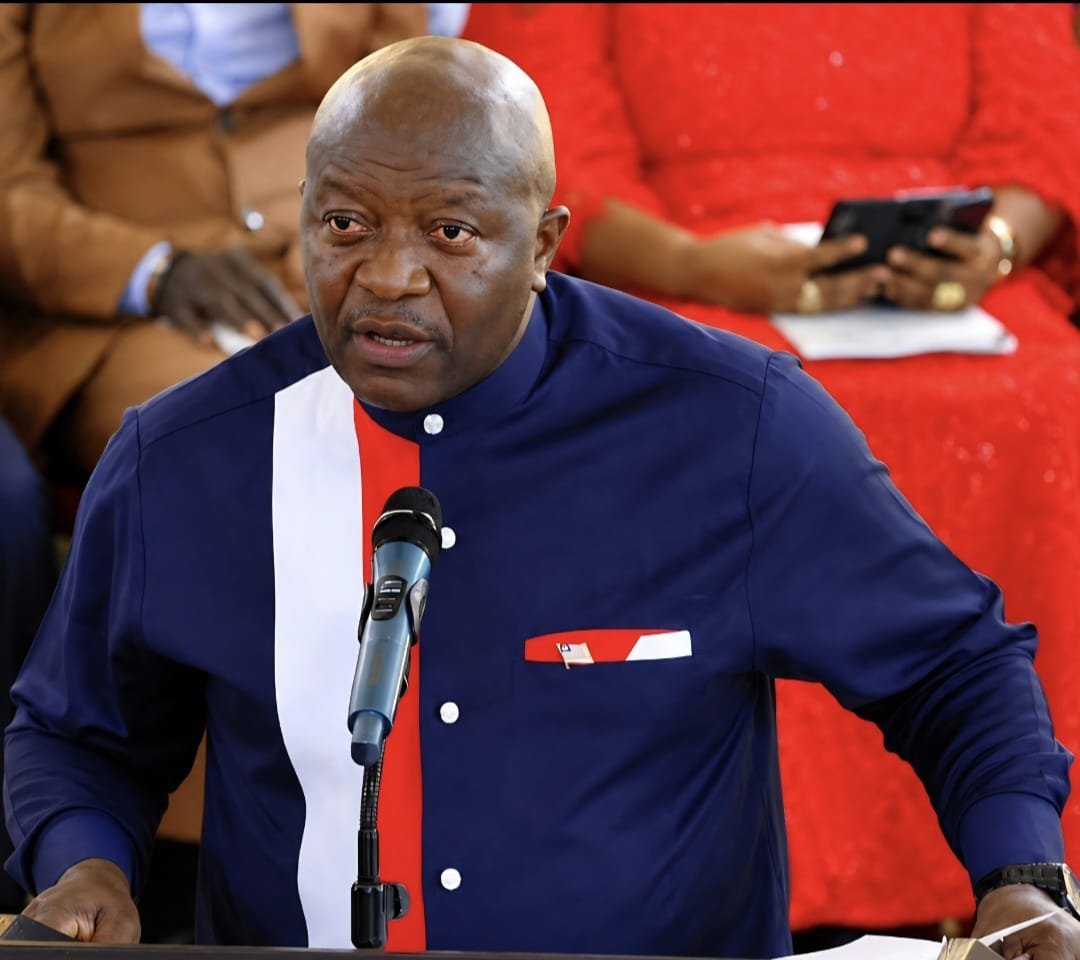
MONROVIA-Finance and Development Planning Minister Augustine Kpehe Ngafuan has called on Liberians to transform their love for the national flag into practical action, urging citizens to put national interest above political, tribal, county and personal affiliations.
Ngafuan made the call Monday while delivering the oration at Liberia’s 179th National Flag Day celebration under the theme, “From Heritage to Hope: The Flag That Unites Us.”
The Minister used the occasion to reflect on Liberia’s history, the significance of the Lone Star, national unity, patriotism, public responsibility, political tolerance and the government’s development agenda.
He said Liberia’s national flag is more than a symbol of the country’s past, describing it as a representation of the nation’s shared identity and a source of hope for future generations.
Ngafuan said the national flag has witnessed Liberia’s finest moments as well as some of its darkest periods, including political transitions, civil war, public-health emergencies, economic challenges and the country’s continuing efforts toward reconstruction and development.
He recalled his personal experience as a first-grade student at Bolahun Public School in Wawoma Clan, Kolahun District, Lofa County, when he participated in a Flag Day parade in 1978.
According to him, the memory remains vivid nearly five decades later and demonstrates the importance of creating opportunities for Liberian children regardless of their backgrounds.
He said every Liberian child should be able to look at the Lone Star and believe that their circumstances at birth do not determine their future.
Every Liberian child should be able to look at the Lone Star and say: My country sees me. The circumstances of my birth do not determine the boundaries of my possibilities.”
Ngafuan said this, in his view, represents the Liberia that the current generation must work to build.
The Finance Minister said Liberia’s diversity should be viewed as a strength rather than a reason for division.
He noted that Liberians may come from different counties, tribes, religions, professions, political parties and social groups, but remain united under one national flag.
Using students participating in the Flag Day parade as an example, Ngafuan said the children may have worn different school uniforms and marched in different formations, but they all ultimately saluted one flag.
He said the same principle should apply to the broader Liberian society.
Ngafuan recalled a statement he made in 2010 at the induction of officers of the Federation of Lofa Associations in the Americas, in which he argued that county identity should never undermine national identity.
He extended that argument to politics, declaring “Our party-centricity must never undermine our country-centricity.”
According to Ngafuan, Liberia must remain above political, county and other affiliations.
The Minister also urged Liberians to avoid judging people solely based on their political affiliation, county, tribe, religion or association.
He said belonging to a particular group does not automatically make someone good, just as belonging to another group does not automatically make someone bad.
Ngafuan encouraged citizens to judge individuals based on their character, actions, values and contribution to the national interest.
He rejected the notion that everyone outside government is automatically good while everyone in government is bad.
He said patriotic citizens exist both within and outside government and that the contribution of individuals should be assessed based on their conduct rather than their location.
“The location of a person matters less than the character and patriotism of the person.”
Ngafuan welcomed what he described as a renewed spirit of patriotism among Liberians at home and in the Diaspora, particularly the growing display of national colors during Independence Day celebrations.
However, he cautioned that patriotism must go beyond wearing Liberia’s colors, singing the national anthem or waving the national flag.
He said patriotism must be demonstrated through responsible conduct.
According to the Minister, a public official who protects state resources, a teacher who prepares adequately for the classroom, a healthcare worker who faithfully serves patients, a security officer who resists criminal influence, a businessperson who pays legitimate taxes, a journalist who responsibly pursues the truth and a citizen who rejects corruption are all demonstrating patriotism.
“Patriotism is not only what we say about Liberia. Patriotism is what we do for Liberia.”
Ngafuan said the presence of the national flag in government offices should serve as a constant reminder that public office is a position of trust.
He said the flag represents millions of Liberians and should remind public officials that government offices are not private spaces for advancing personal interests.
Instead, he said public office carries an obligation to serve the people and protect national resources.
The Minister urged public officials to remember three principles, Think Liberia. Love Liberia. Build Liberia.
He stressed that holding public office does not give anyone greater ownership of Liberia; rather, it increases their responsibility to the country.
Ngafuan described Liberia as a common national enterprise in which every citizen has a stake.
He also expanded the concept of leadership beyond elected officials and government ministers.
According to him, pastors, imams, teachers, political leaders, journalists, talk-show hosts, bloggers, social-media influencers, business leaders, health professionals, sports leaders and community leaders all have the ability to influence the behavior and thinking of others.
With that influence, he said, comes responsibility.
“Wherever influence exists, responsibility follows.”
He urged people in positions of influence to recognize the impact of their words and actions on national peace and development.
The Finance Minister warned that Liberians sometimes behave as though the country belongs to nobody simply because it belongs to everybody.
Referencing the economic concept known as the “tragedy of the commons,” Ngafuan said citizens can pursue individual interests in ways that ultimately damage the collective national interest.
He cited examples including littering, tax evasion, interference with law enforcement and defending wrongdoing because the accused person belongs to one’s political party, county, tribe, church, family or social circle.
He said protecting Liberia requires citizens to take responsibility for resources and institutions that belong to everyone.
Turning to national development, Ngafuan said Liberia’s journey from heritage to hope requires practical investments in infrastructure and human development.
He identified the government’s ARREST Agenda for Inclusive Development as an instrument for translating national aspirations into plans, projects and measurable improvements in citizens’ lives.
He said national hope must be planned, financed and supported by strong institutions, discipline, hard work, innovation and what he described as “thinking equity.”
Ngafuan argued that inclusive development can itself become a powerful force for national unity.
He pointed to roads, electricity, schools and healthcare as examples of national investments that should benefit Liberians regardless of political affiliation, county or tribe.
“A road connecting two counties connects more than geography it connects people, markets, opportunities, and hopes.”
He also disclosed that government is preparing to rehabilitate or construct more than 100 schools for foundational learning.
In one of the major economic announcements of his address, Ngafuan said Liberia is expected to reach a US$1 billion national budget in September 2026, which he described as a historic milestone for the country.
He said the government has been working to expand domestic revenue and strengthen Liberia’s fiscal capacity despite skepticism that the country could achieve such a target.
However, Ngafuan cautioned that reaching the billion-dollar mark should not be viewed as an accomplishment in itself.
He said the real measure of success will be whether the increased fiscal space translates into tangible improvements for citizens.
He identified more roads, expanded electricity, better schools, stronger healthcare, increased jobs and opportunities, stronger institutions and measurable improvements in living conditions as the areas by which the larger budget should ultimately be judged.
Ngafuan also highlighted the government’s infrastructure ambitions, saying Liberia is moving toward a future where major parts of the country will be connected by paved roads.
He said Liberians will, in the coming years, be able to travel on paved roads from Monrovia to Harper, as well as from Gbarnga through Zorzor, Voinjama, Kolahun and Foya toward Mendikorma on the Sierra Leone border.
According to him, such infrastructure projects represent development opportunities that previous generations could only have imagined.
He said improved roads will connect communities, markets and people while creating opportunities for economic growth.
Despite Liberia’s political differences, Ngafuan called for political competition without hatred.
He said citizens should be able to disagree over policies and compete for political power without treating opponents as enemies.
The Minister warned against a political culture in which one person’s success is seen as requiring another person’s destruction.
“We can be competitive without being cruel. We can succeed without destroying. We can win without hatred.”
He emphasized that political offices are not the personal property of politicians but positions held in trust for the Liberian people.
Ngafuan proposed what he described as a minimum Patriotic Covenant, built around basic national principles that should unite Liberians regardless of political, religious, social or economic differences.
Among the principles he outlined are that Liberia must come first; political power must be pursued peacefully; public resources belong to the people; corruption is wrong regardless of who commits it; truth matters; differences should never justify hatred; and the Constitution and rule of law must prevail over personalities.
He also stressed that no political victory is worth destroying Liberia and that every generation has a responsibility to leave the country stronger than it found it.
Ngafuan said these principles should not be viewed as government or opposition values but as Liberian values.
Reflecting on Liberia’s history, Ngafuan warned that peace should never be taken for granted.
He called on citizens to protect peace, strengthen democracy and uphold the rule of law.
He also urged political leaders, journalists, religious leaders and social-media users to recognize the power of their words.
According to him, a microphone, radio program, political platform or social-media post can either educate and build bridges or inflame tensions and deepen divisions.
“Our children deserve to inherit our progress. Not our divisions. Not our hatred. Not our anger.”
In a reflective portion of his address, Ngafuan challenged Liberians to reverse the traditional question of what they see when they look at the national flag.
He asked what the flag would see if it could look back at Liberia.
He challenged citizens to consider whether it would see leaders putting national interest above personal interest, young people receiving opportunities, political opponents disagreeing without hatred, peaceful communities and public resources being transformed into roads, schools, hospitals, electricity, jobs and opportunities.
He said the answers to those questions would not be determined by speeches but by the actions of Liberians.
Concluding his address, Ngafuan called on Liberians to move beyond symbolic displays of patriotism and begin living the values represented by the national flag.
He said citizens raise the flag when they raise their standards, integrity, children, communities and one another.
He urged Liberians to move, From waving the flag to living the flag.From saluting Liberia to serving Liberia.From hoping for a better Liberia to building a better Liberia.
Ngafuan said Liberia’s national flag came from history, but the future of the country remains the responsibility of the present generation.
He ended by calling for continued peace, unity and national development, declaring:
“May the Lone Star forever unite us. May peace remain within our borders. May hope rise in every Liberian heart.”
About The Author