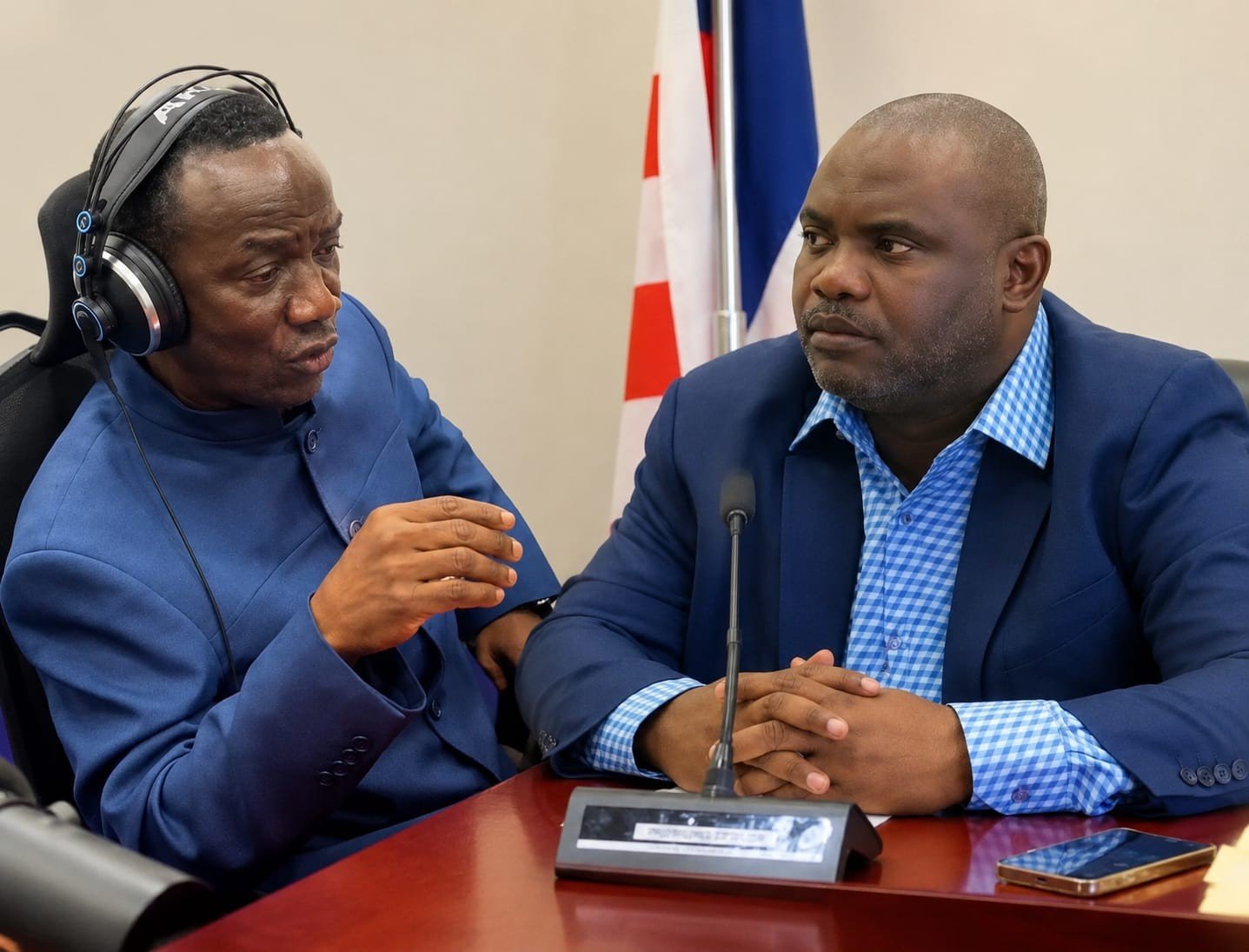
By Benjamin Q. Z. Johnson
Monrovia-Former Mines and Energy Minister Wilmon Paye has raised questions about an alleged business relationship between Nimba County Senator Saah H. Joseph and mining giant ArcelorMittal Liberia, arguing that any direct or beneficial interest by a sitting senator in a mineral right could potentially violate Liberia’s Minerals and Mining Law.
Paye made the allegation during a discussion on Liberia’s mining sector, questioning whether an elected lawmaker should maintain a commercial interest connected to a major mining operation while simultaneously serving in the National Legislature.
According to Paye, his concern is not rooted in political rivalry but in the need to protect the integrity of Liberia’s mineral governance system and prevent public officials from maintaining private financial interests that could overlap with their official responsibilities.
“I’m not saying it because I competed against him in 2023,” Paye said, stressing that his criticism was based on what he described as a matter of principle. “I’m saying it because it’s wrong. It’s a form of corruption,” he added.
According to the former Mines and Energy Minister, Liberia’s Minerals and Mining Law of 2000 contains specific restrictions concerning senior public officials and mineral rights.
Section 4.2(f) provides that the President, Vice President, members of the National Legislature, Justices of the Supreme Court, judges of subordinate courts of record, Cabinet Ministers and managing directors of public corporations are not eligible to hold Mining Licenses during their tenure in office.
The provision further states that where any of those officials already held a Mineral Right before assuming public office, the official may either dispose of the Mineral Right or place it in a blind trust.
The law therefore places a direct restriction on sitting members of the National Legislature holding Mining Licenses.
However, Section 4.2(f) does not, by itself, establish that every commercial contract or business relationship between a senator and a mining company is prohibited.
Whether an alleged relationship involving Senator Joseph violates the law would depend on its precise nature including whether it involves ownership or control of a Mineral Right, a beneficial interest in a mining license, a concession interest, or another form of commercial arrangement.
That distinction makes the details of Paye’s allegation particularly significant.
Paye questioned the propriety of any arrangement under which Senator Joseph could allegedly have an investment, concession-related interest, commercial contract, subcontract, consultancy arrangement or other financial relationship with ArcelorMittal Liberia.
ArcelorMittal Liberia is one of Liberia’s major iron-ore operators, with mining activities centered in Nimba County.
Paye’s allegation, if substantiated, raises questions about whether Senator Joseph has any direct or indirect beneficial interest in a Mineral Right or mining operation and, if so, whether such an interest existed before or after he assumed legislative office.
The former minister argued that the public deserves transparency whenever elected officials have private business interests that could intersect with industries over which they exercise legislative or oversight responsibilities.
“If, for example, the Ministry of Mines and Energy establishes a policy and a company is doing business with a major operator in the sector, why should the representative or senator involved in that company not be questioned?” Paye asked.
The controversy comes against the backdrop of Liberia’s legal framework, which places ownership of the country’s mineral resources in the Republic.
Section 2.1 of the Minerals and Mining Law provides that minerals found on the surface, in the soil and subsoil, rivers, streams, water courses, territorial waters and continental shelf of Liberia are the property of the Republic.
The law permits eligible persons and companies to acquire Mineral Rights under prescribed conditions, subject to the requirements and restrictions established by law.
Section 4.2(f), however, draws a specific line for certain senior public officials, including members of the National Legislature, by making them ineligible to hold Mining Licenses while in office.
The provision is intended to prevent senior public officials from directly holding mineral interests while simultaneously exercising public authority.
Separate from the Minerals and Mining Law, Liberia’s National Code of Conduct establishes broader conflict-of-interest principles for public officials.
The Code of Conduct is grounded in Article 90 of the 1986 Constitution, which provides that no person holding public office shall engage in activities that constitute a conflict of interest or are against public policy.
Liberia’s Anti-Corruption Commission has also emphasized the requirement for public officials to disclose their assets, interests and liabilities under the Code of Conduct. Members of the Senate and House of Representatives are among officials covered by the asset-declaration regime.
The broader conflict-of-interest question, therefore, is whether an elected lawmaker maintains a private financial interest that could improperly intersect with his or her public responsibilities.
Beyond his criticism of Senator Joseph, Paye called for a fundamental rethink of Liberia’s concession system.
He argued that Liberia should consider establishing stronger national entities capable of retaining meaningful ownership stakes in major mineral projects rather than relying primarily on arrangements in which foreign companies receive rights to develop the country’s mineral resources.
Under the model he proposed, the government could establish a national entity capable of holding an interest in major mineral assets and subsequently partnering with private investors through negotiated ownership arrangements.
Paye suggested that structures such as 30/70 or 40/60 ownership arrangements could allow Liberia to retain a meaningful stake while still attracting international capital, technology and technical expertise.
Paye argument is that Liberia should better recognize the value of its mineral assets before negotiating away control over their development.
“The companies are making money,” Paye said, while acknowledging the importance of mining companies to Liberia’s economy.
He maintained, however, that the country must change its approach to ensure that mineral wealth produces greater long-term benefits for Liberians.
At the center of the controversy is the unanswered question of what, if any, business relationship exists between Senator Joseph and ArcelorMittal Liberia.
He has not, in the material reviewed for this report, produced documentary evidence establishing that Senator Joseph currently holds a Mineral Right or Mining License in violation of Section 4.2(f) of the Minerals and Mining Law.
Paye allegation therefore remains an allegation requiring independent verification.
The senator’s alleged relationship with ArcelorMittal could take several forms, including a direct ownership interest, beneficial interest, consultancy, subcontract, commercial contract, investment arrangement or another business relationship.
If Senator Joseph holds, directly or indirectly, a Mineral Right while serving as a member of the National Legislature, Section 4.2(f) would be directly relevant.
If, however, the alleged relationship involves an ordinary commercial contract unrelated to the senator holding a Mineral Right, additional legal provisions including Liberia’s conflict-of-interest and asset-disclosure rules would have to be examined before reaching a conclusion about legality.
Senator Joseph and ArcelorMittal Liberia should therefore clarify whether any commercial relationship exists between them and, if so, disclose the nature of the relationship, the parties involved and the legal basis under which it operates.
The controversy goes beyond one senator and one mining company. It raises a broader question about whether Liberia has adequate safeguards to separate public authority from private commercial interests in the country’s lucrative mining sector.
The Minerals and Mining Law places the country’s mineral resources under state ownership while permitting eligible applicants to obtain rights to explore and exploit those resources under licenses and other approved arrangements.
At the same time, the law specifically excludes sitting senators and other senior public officials from holding Mining Licenses during their tenure.
The central question now is whether Senator Joseph has any interest that falls within the prohibited category or whether Paye’s allegation concerns a different type of commercial relationship.
If no such relationship exists, a clear denial from the senator and ArcelorMittal Liberia could help settle the controversy.
If a relationship does exist, disclosure of its precise nature, ownership structure, contractual basis and any applicable approvals would allow the public and relevant regulatory authorities to determine whether the arrangement complies with Liberian law.
For Paye, however, the larger issue is Liberia’s management of its natural resources.
He argues that the country should move beyond simply granting mineral rights and instead develop arrangements that give Liberia a more meaningful and sustainable stake in the wealth generated from its natural resources.
As Liberia continues to depend heavily on mining, the questions raised by Paye are likely to remain central to the national debate: Who owns the interests behind Liberia’s mining arrangements? Who benefits from the country’s mineral wealth? And can public officials exercise independent oversight when private business interests potentially intersect with public responsibilities?
About The Author