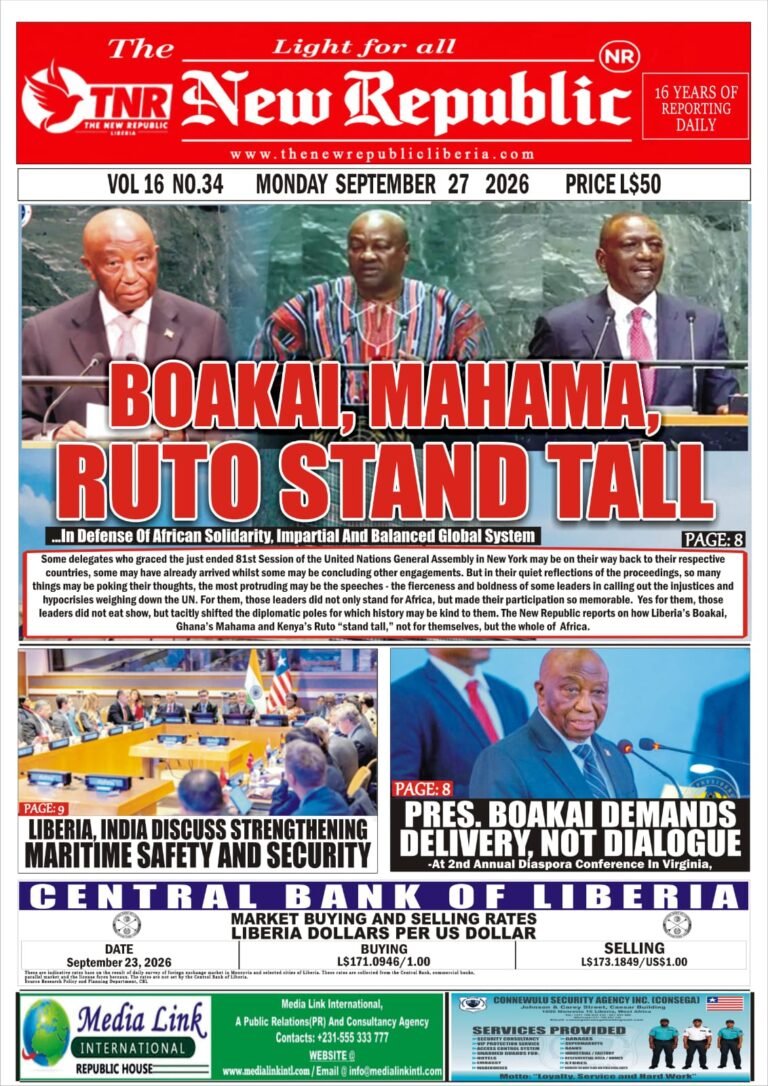
Monrovia-President Joseph Nyuma Boakai, Sr. Friday challenged Liberians in the diaspora to move beyond annual talk-shops to measurable delivery, announcing five practical commitments to turn patriotism into projects.
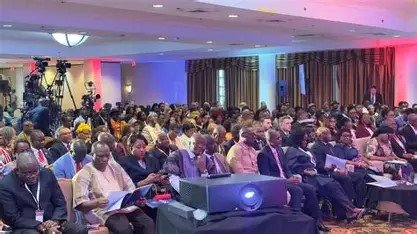
Addressing the 2nd Annual Diaspora Conference in Alexandria, Virginia, under the theme “From Dialogue To Delivery: Mobilizing The Global Liberian Diaspora For National Transformation,” Boakai said the era of treating Liberians abroad as observers is over.
“I pledged then that you would not be treated as observers, but as full stakeholders in Liberia’s future. That commitment remains unchanged,” Boakai told hundreds of Liberians drawn from across the United States and around the world.”You are an integral part of the Liberian nation. I have described you as Liberia’s ’16th County’ and as the ‘Fifth Estate’ of the Republic.”
The Alexandria conference comes exactly a year after the inaugural Diaspora Conference, held under the theme “Building the Future Together.”
That meeting produced nine recommendations anchored in four areas, including reconciliation, education, health and investment.
For this year, however, Boakai said it is time for accounting, saying “from dialogue to delivery means moving from resolutions to responsibilities; from intentions to implementation; and from annual conferences to year-round partnership,” he said. “Today, we must ask: What have we achieved? What remains unfinished? And who is responsible for delivering the next result?”
The President listed modest progress such as support for the establishment of the Legislative Diaspora Caucus, strengthening of the Office of Diaspora Affairs through the National Budget, and advancement of a legal and institutional framework for diaspora engagement.
He also said government has continued discussions on greater diaspora participation in national life, consistent with the Constitution, laws, electoral systems and democratic safeguards.
President Boakai also paid tribute to decades of diaspora sacrifice, paying school fees and medical bills, building homes, financing businesses, and responding to national emergencies.”Liberia is grateful,” he said.”But the next stage of Diaspora engagement must complement remittances with productive investment, skills transfer, and institution building.”
He called on Liberian doctors to partner with hospitals and medical schools, educators with universities, engineers with infrastructure programs, technology professionals with Liberia’s digital transformation, and entrepreneurs with Liberian businesses.
The President also pointed to medical, humanitarian and educational missions already carried out by diaspora groups as proof that “service to Liberia does not depend only on where you live; it depends on what you are prepared to do.”
President Boakai equally cited the Maryland-Liberia partnership as an example of the bridges the diaspora can build, connecting trade, education, agriculture, technology, infrastructure, workforce development and investment.
“Its success, however, will not be measured by signatures. It will be measured by projects completed, businesses created, jobs generated, and lives improved,” he cautioned.
In a striking admission, Boakai said government cannot effectively engage a global community it does not adequately understand, welcoming a Rapid Survey conducted through diplomatic missions to map the diaspora.
“Liberia needs a credible and regularly updated Diaspora information system so that we can connect skills to needs, investors to opportunities, institutions to partners, and our younger generations to the country of their heritage,” he said.
On reciprocal partnership, Boakai said government must do its own part to make diaspora engagement worthwhile, pointing to reforms under the ARREST Agenda for Inclusive Development and the recent historic crossing of the US$1 billion mark in domestic revenue mobilization.
“But the true value of that achievement will not be measured by the number alone. It will be measured by better roads, better schools, health services, jobs, opportunity, and improved livelihoods,” he said.”We must therefore match revenue with accountability, investment with integrity, and policy with implementation. Diaspora engagement cannot be sustained by appeals to patriotism alone. Government must help make returning home, investing at home, sharing expertise, and building partnerships practical, predictable, and worthwhile.”
President Boakai said the conference must end with five practical commitments, one that organizes our global community, stronger coordination among diaspora organizations, professionals, businesses, youth, women, and diplomatic missions.
He also said it must one that connects skills to national needs, create practical pathways for professionals abroad to teach, mentor, advise, volunteer, and provide specialized service even when they cannot relocate permanently, as well as turn capital into productive investment, with credible projects, professional due diligence, transparent rules, and investment mechanisms that create enterprises, infrastructure, and jobs.
According to him, it must invest in the next generation , connecting young Liberians abroad to Liberia through internships, mentorship, innovation, cultural exchange, and opportunities to visit and invest.
“If we lose that generation, we lose an important part of our national future,” he stressed, adding that every major recommendation should have a lead institution, a partner, a timeline, and a measurable result, with an implementation scorecard when they meet again showing what was promised, delivered, delayed, and why.
In a direct plea for unity, Boakai warned that Liberia’s progress will fail if diaspora politics mirrors the toxicity at home.”None of this will succeed if we carry our divisions into every space where Liberians gather. We can disagree on politics, policies, personalities, and priorities without allowing those disagreements to destroy our common purpose,” he said.”I hope there will come a time when Liberians will disagree but not be abusive. Liberia needs a Diaspora that can debate vigorously and still work together; criticize constructively and still contribute.”
He linked the diaspora to Liberia’s global moment, serving on the UN Security Council during 2026-2027, calling diaspora diplomacy a “force multiplier” for the Republic.
“You are bridges between Liberia and the societies in which you live. Your universities, businesses, professional institutions, communities, and networks can open doors for investment, knowledge, technology, education, tourism, and development cooperation.”
President Boakai called for action, noting “From dialogue to delivery must become more than the theme of this conference, it must become a standard by which we measure ourselves, we have talked, we have listened, have consulted, and must now organize, invest, serve, connect, and deliver.”
He added: “To those who can return permanently, we welcome you. To those who can return for a season of service, we welcome you. And to those who cannot return now but can contribute from where they are, your contribution is equally part of our national effort.”
He wooed the gathering of Liberians to turn patriotism into participation; participation into projects; and projects into measurable improvements in the lives of our people, adding that Liberia will no longer move backwards.
“The conference continues in Alexandria with panels on investment, health, and dual citizenship, with Vice President Jeremiah Kpan Koung and several senators expected to join.
About The Author