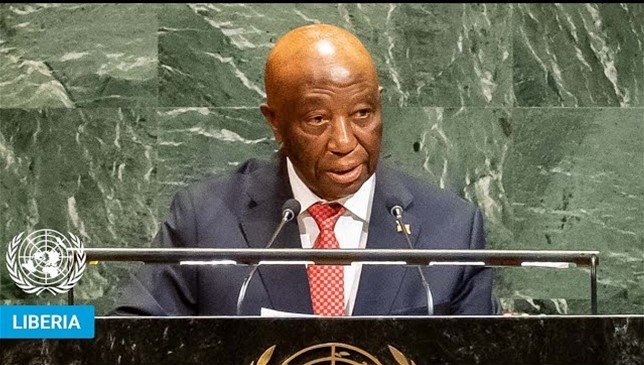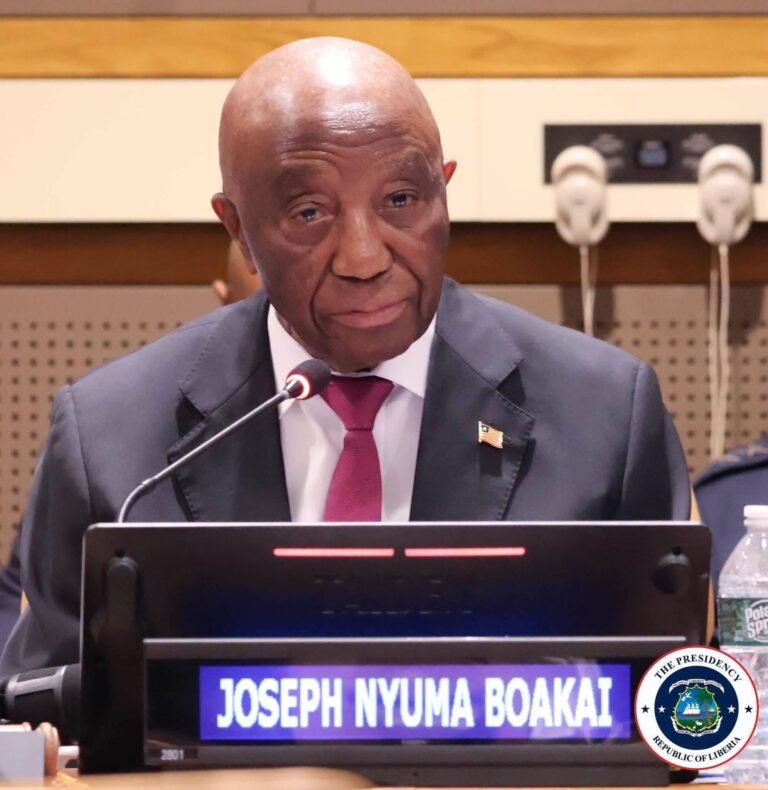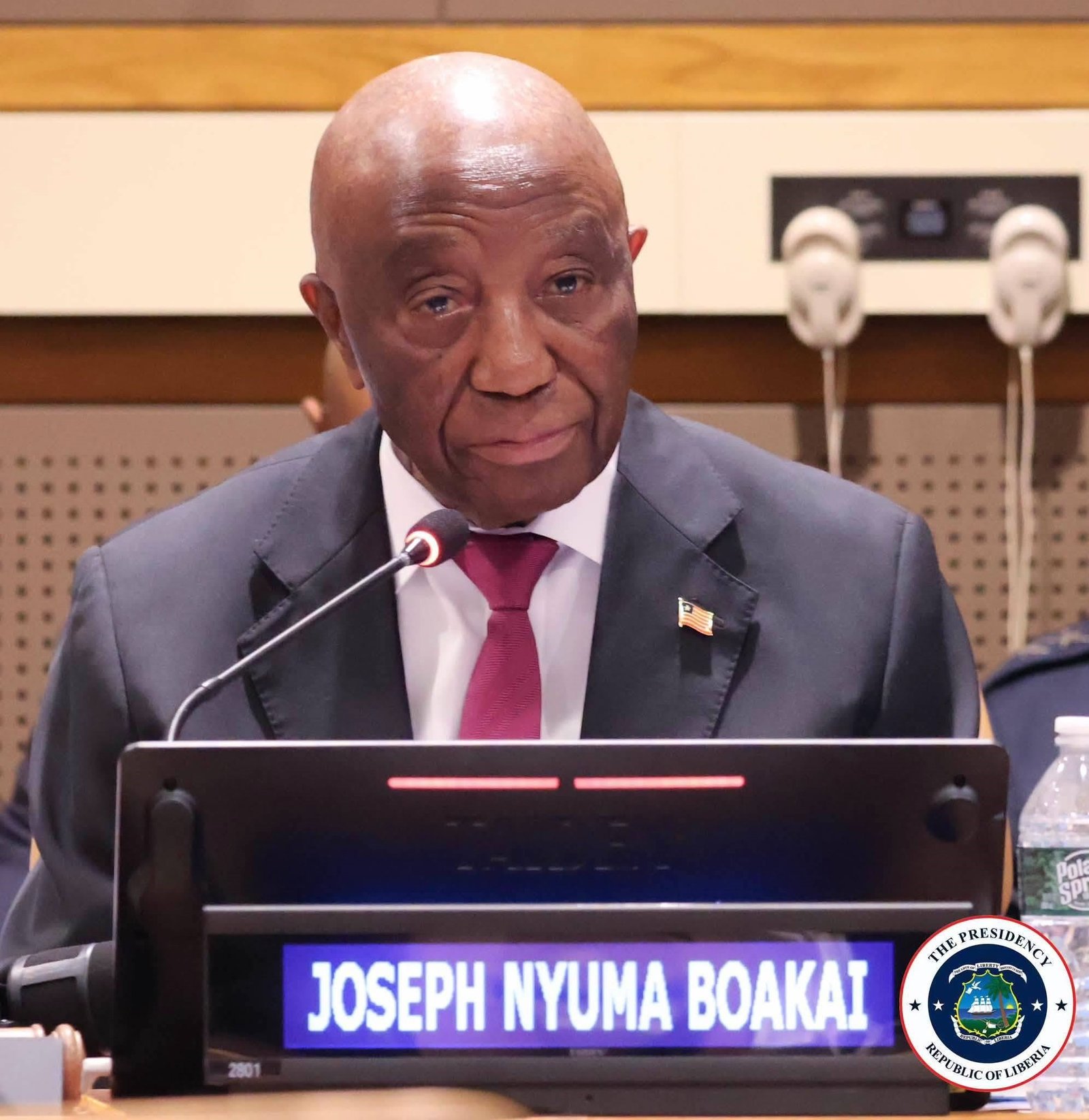
Monrovia-President Joseph Nyuma Boakai, Sr. has used his address to the 81st Session of the United Nations General Assembly to highlight Liberia’s transformation from civil conflict to constitutional democracy, outlines his administration’s development priorities, and reaffirm the country’s growing role in international peace, security and global governance.
Addressing world leaders and international delegates at the United Nations Headquarters in New York, President Boakai placed Liberia’s national experience at the center of his remarks, emphasizing the country’s resilience, ongoing institutional reforms and efforts to build a more accountable and inclusive society.
Speaking under the theme “Restoring Trust, Managing Transformation: A United Nations that Delivers for All,” President Boakai said Liberia’s own history demonstrates the importance of rebuilding trust, strengthening institutions and pursuing dialogue after conflict.
The president reminded the Assembly that Liberia was among only four African nations that signed the United Nations Charter in 1945.
He said Liberia entered the founding process with a belief that lasting peace depends on international law, respect for human rights and human dignity, and a shared commitment to development.
More than eight decades later, he said, Liberia’s own experience offers an important example of national recovery.
Having emerged from years of devastating civil conflict, Liberia has rebuilt its constitutional institutions and maintained its democratic transition, which President Boakai presented as evidence that dialogue and institutional rebuilding can overcome division.
“Liberia is living proof that dialogue can overcome division and that institutions can be rebuilt,” he told the Assembly.
He also highlighted efforts by his Administration to strengthen governance at home. He noted that his Government is working to improve public accountability, promote prudent financial management, intensify the fight against corruption and support the judiciary in rebuilding public confidence in state institutions.
The President presented these efforts as part of Liberia’s broader national transformation and its commitment to building institutions capable of delivering services and opportunities.
President Boakai outlined the ARREST Agenda for Inclusive Development as the principal framework guiding his Administration’s development priorities. The agenda focuses on Agriculture, Roads, Rule of Law, Education, Sanitation and Tourism.
He told the international community that Liberia has made progress in areas including revenue administration and infrastructure development, particularly rural roads designed to connect agricultural communities and farmers with markets.
The President’s emphasis on agriculture and rural infrastructure reflects his Government’s broader effort to link economic activity, food production and improved access to markets with national development.
The president also highlighted Liberia’s contribution to regional and international security as a current member of the United Nations Security Council.
He said Liberia is confronting emerging threats affecting West Africa, including transnational organized crime, cyber warfare and illicit narcotics trafficking along maritime routes in the Gulf of Guinea.
He pointed specifically to the country’s joint security efforts against transnational drug trafficking and called for international cooperation in strengthening Liberia’s capacity in coast guard surveillance, intelligence sharing and port security.
According to President Boakai, these threats cannot be effectively addressed by individual countries acting alone, making international cooperation essential.
Climate change was another major component of the President’s message. He noted that Liberia contributes very little to global greenhouse-gas emissions, yet Liberian communities are already experiencing the effects of climate change through coastal erosion, flooding and disruptions to agricultural cycles.
The President emphasized Liberia’s environmental importance, noting that the country contains approximately 42 percent of the remaining Upper Guinean Rainforest, an important global carbon sink.
Boakai however, called for greater international climate justice, urging industrialized countries to honor their climate-financing commitments and strengthen mechanisms addressing loss and damage.
Investing in Liberia’s Youth
President Boakai placed Liberia’s young population within the broader African development challenge, calling for greater investment in education, technology and technical skills.
He emphasized the need for STEM education, digital literacy and technical training, arguing that African young people should become active participants and creators in the global digital economy.
For Liberia, the President said, equipping young people with relevant skills is critical to the country’s long-term transformation.
The Liberian leader also used the occasion to reaffirm Liberia’s commitment to advancing women and girls.
He said gender equality remains central to sustainable development and called for full political, economic and social equality for women and girls.
His remarks placed women’s participation alongside youth development as key components of Liberia’s efforts to build a more inclusive society.
The President further positioned Liberia within the emerging global conversation on artificial intelligence and digital governance. He welcomed international efforts to develop frameworks for responsible AI and called for developing countries to have the capacity to participate in the development and governance of new technologies.
For Liberia and other developing nations, he argued, the digital future should not be limited to consuming technologies developed elsewhere.
He supported stronger ethical standards and regulation of artificial intelligence, particularly in military applications, stressing that technological innovation should advance human development.
President Boakai also used Liberia’s position on the UN Security Council to renew the country’s support for greater African representation in global decision-making.
He reaffirmed Liberia’s backing for the Common African Position on the Reform of the United Nations Security Council, including Africa’s demand for permanent representation.
The President argued that Africa’s contribution to international peace and security should be reflected in its representation within the UN’s most powerful decision-making body.
He maintained that reform would strengthen the credibility and legitimacy of the United Nations while addressing what he described as a longstanding structural imbalance.
In concluding his address, Boakai connected Liberia’s national experience to the broader international challenge of restoring trust.
He said Liberia’s journey from civil conflict to constitutional democracy demonstrates that societies can rebuild when they commit themselves to institutional reform, dialogue and accountable governance.
As Liberia continues its transformation under the ARREST Agenda, President Boakai used the global platform to present the country as a nation seeking stronger institutions at home, greater investment in its development and a more meaningful role in shaping international decisions.
Recalling Liberia’s participation in the founding of the United Nations in San Francisco in 1945, President Boakai reaffirmed the country’s commitment to the principles of peace, human dignity, international cooperation and development.
For Liberia, he said, the task ahead is not only to continue rebuilding at home, but also to contribute to a stronger international system capable of delivering peace, development and opportunity for all.
About The Author