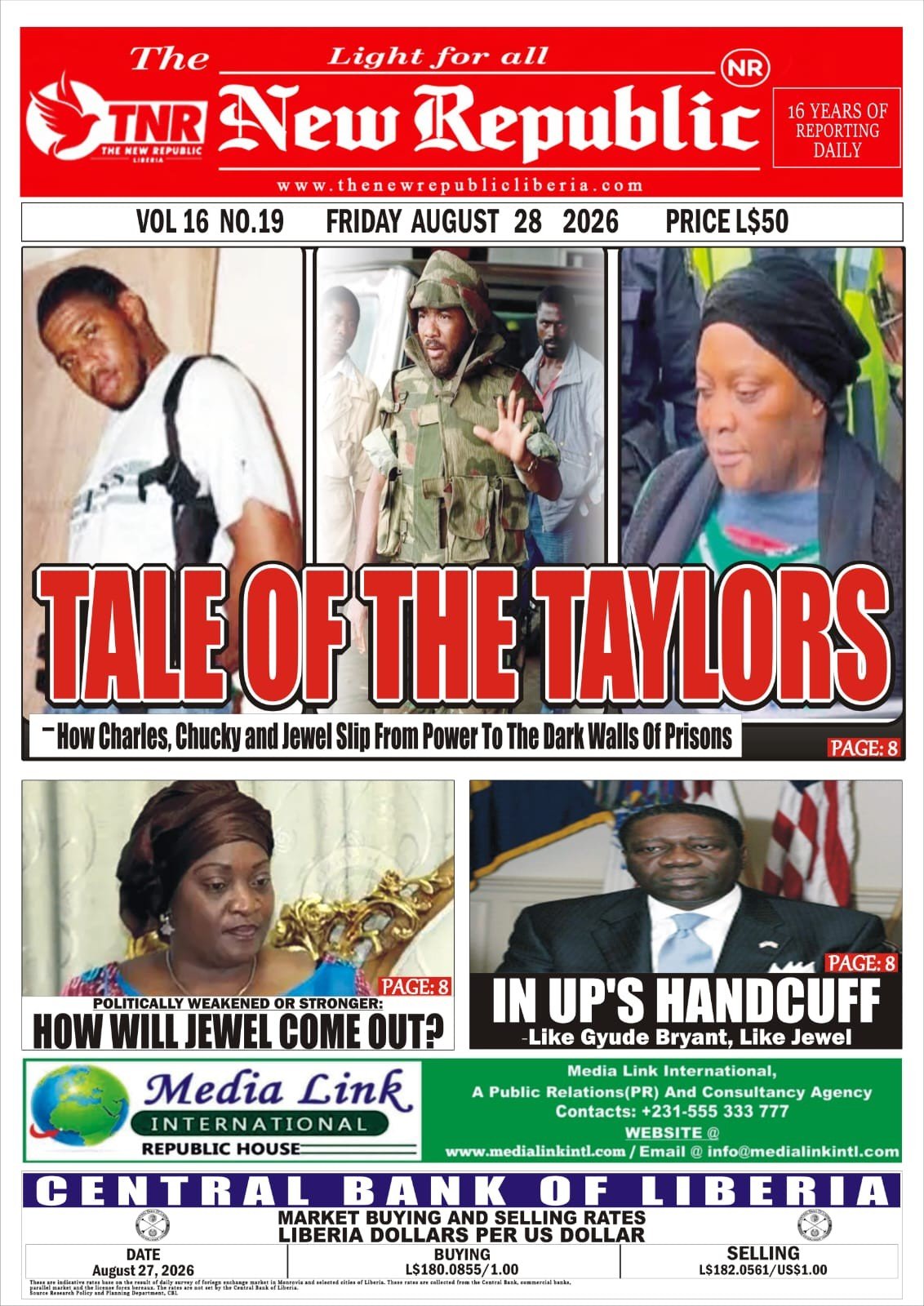
MONROVIA==Former President Charles Taylor, his son, Chucky Taylor and estranged wife, Jewel Howard Taylor are all behind the dark walls of prisons in Africa, United States and Great Britain for crimes against humanity and alleged drug trafficking. Their story, according to experts, sheds light on how power’s unbalanced pillars often shift against the very people who enjoyed its trappings, and at times used it against others.
This seems to be the case with one name, three different prisons, and three different countries. It is one family arc that ran from the Executive Mansion to war, to politics, and now to the dark walls of incarceration.
Political analysts call it a “sad story”-tale of the Taylors- of how power’s pillars shift, that what once shielded them is now what the law is using against them.
The chronology of their cases
It started with Charles Ghankay Taylor, once feared character during Liberia’s dark days of war he initiated – a so-called revolution he framed after corruption.
Now in HMP Frankland Prison, County Durham, United Kingdom for war crimes and crimes against humanity, Taylor rose from rebel leader to President of Liberia in 1997, after a civil war that killed an estimated 250,000 people.
He ruled until 2003, when pressure from LURD rebels war and international sanctions forced him to resign and go into exile in Nigeria.
He was arrested in 2006 while allegedly trying to cross into Cameroon, though those who knew the story counter-argued such narrative. According to them, he was set up by the Nigerian Government then led by Olesugon Obasanjo in order to pacify Washington.
The Nigerian President was in the United States, about to meet former President George Bush but faced hiccups. According to reports, Bush insisted he could not meet him if he did not turn Taylor over to face justice for his alleged crimes in Sierra Leone. Taylor was used as the atonement to get the two former leaders sat face to face.
The Special Court for Sierra Leone charged him with 11 counts of war crimes, crimes against humanity, and other serious violations for his role in supporting Sierra Leone’s Revolutionary United Front, RUF, during that country’s civil war. Prosecutors said he traded arms for “blood diamonds.”
After a trial in The Hague, he was convicted in 2012 and sentenced to 50 years, and transferred to the UK to serve his sentence in 2013.
Today, the man who once hosted heads of state at the Executive Mansion in Monrovia lives under prison rules in northern England. He has maintained his innocence and filed several appeals, all denied.
As President of Liberia, Taylor ruled with iron-hand, went after opponents and those he felt uncomfortable with. Under his presidency, press freedom and freedom of expression were not allowed. He cracked down on journalists and shot down as many papers as possible.
Charles “Chucky” Taylor, Jr
Charles MacArthur Emmanuel, known as “Chucky,” is the son of Charles Taylor and his first wife, not Jewel. He grew up in the U.S. and later returned to Liberia during his father’s presidency.
During the 2003 war, Chucky commanded the Anti-Terrorist Unit (ATU), one of the notorious groups of state security fighting to beat back LURD’s incursion. He was accused of systematic executions of the very soldiers fighting along with him.
He fled to the US after his father tuned over power to Moses Z. Blah in August 2003. Two years later in 2005, U.S. authorities arrested him in Miami, and charged him under a 1994 law that allows prosecution of torture committed abroad by U.S. citizens or residents.
Prosecutors alleged that as commander of the Anti-Terrorist Unit, ATU, in Liberia between 1997 and 2003, Chucky Taylor oversaw killings, torture, and other abuses.
Evidence presented included witness testimony and photos.In 2008 he was convicted on charges including torture, conspiracy to commit torture, and using a firearm during a violent crime.
He was found guilty and sentenced to 97 years in federal prison, the longest sentence ever handed down in a U.S. torture case, where he remains incarcerated in the U.S. federal system.
Legal experts said his case was significant because it was the first time the U.S. used its torture statute against someone for acts committed overseas.
Jewel Howard Taylor
Jewel was First Lady between 1997-2003 when her then husband, Charles Taylor, served as president. Few years later, she returned to power having been elected Senator of Bong County before becoming Vice President to then President George Weah.
Since leaving power in 2024, Jewel remained a vocal national voice, speaking on critical national issues including drug abuse, which has been confronting Liberia since her former husband Taylor launched the bush war against the Samuel Doe government.
Making her presence felt on national issues, Madam Taylor joined thousands of Liberians, most of them young people, in the famous “Say No To Drugs March”, where she was seen garbed in black T-shirt depicting national resistance, awakening and conscience.
However, almost a year after the anti-drug gathering, she found herself trapped in legal chains for the very drugs she marched against.
Now behind bar at the Monrovia Central Prison, or “South Beach”, she is facing 8-count indictment including drug trafficking and money laundering, awaiting trial.
She entered politics as Senator of Bong County, then became Vice President of Liberia from 2018 to 2024 on the CDC ticket with former President George Weah.
Since leaving office she has remained politically active in the National Patriotic Party, NPP.
On August 19, en route to the Roberts International Airport (RIA), Jewel was intercepted by state security officers, returned to Monrovia and taken to the headquarters of the Liberia National Police (LNP) where she was questioned on her alleged connections to drug cartels by the Joint Special Investigation Team (JSIT).
She was eventually indicted on counts of Illicit trafficking of controlled substances, importation of controlled substances, exportation of controlled substances, criminal conspiracy, criminal facilitation, criminal solicitation, money laundering, aiding the consummation of a crime.
Following her indictment, she suffered asthmatic attack and high blood pressure and was hospitalized at GOMIS in Congo, where she spends about two days before being taken to court.
State prosecutors allege she received US$135,000 from individuals linked to a transnational cocaine network, including US$45,000 during a trip to Dubai, US$75,000 channeled through Sheikh Bashiru Kante for her Jewel Star Fish Foundation, and US$15,000 in August 2026.
The state says it has travel records, audio recordings, and witness testimony.
The court denied her lawyers request for compassionate detention at home and ordered her remanded to Monrovia Central Prison where she remains.
She remains presumed innocent until proven guilty, and no trial date has been set. Her party, National Patriotic Party (NPP) has called for due process and respect for her health.
Legal experts and political observers say the Taylor story illustrates how power in Liberia has often operated outside institutions, and how institutions, eventually, catch up.
That Charles Taylor is convicted by an international tribunal for fueling a regional war, Chucky Taylor also convicted in the U.S. for alleged torture committed under his father’s government, and Jewel Howard Taylor is charged in Liberia under domestic law for alleged drug and financial crimes more than 20 years after the war ended speaks well of power.
“Power unbalanced its own pillars,” one Monrovia analyst said. “The same networks, the same name that opened doors, are now the ones prosecutors are tracing.”
For supporters, the three cases are proof that no one is above the law, while critics argue the timing and politics behind the charges should be scrutinized.
Charles Taylor continues to serve his 50-year sentence in the UK, Chucky Taylor serving his 97-year sentence in the U.S. and Jewel Howard Taylor awaits pre-trial hearings in Monrovia.
Political observers say her political future, including any 2029 ambitions, now rests with the court.
From State House receptions to prison visitation rooms, the trajectory of the Taylors has become a case study in Liberia of how war, politics, and alleged crime can collapse into a single family name that is behind bars on three continents.
About The Author