
By Jamesetta D. Williams
MONROVIA–The University of Liberia (UL) says it is pursuing an ambitious plan to position the institution among the top 300 universities in Africa, while undertaking major reforms in academic scheduling, faculty development, infrastructure, digital education and institutional fundraising.
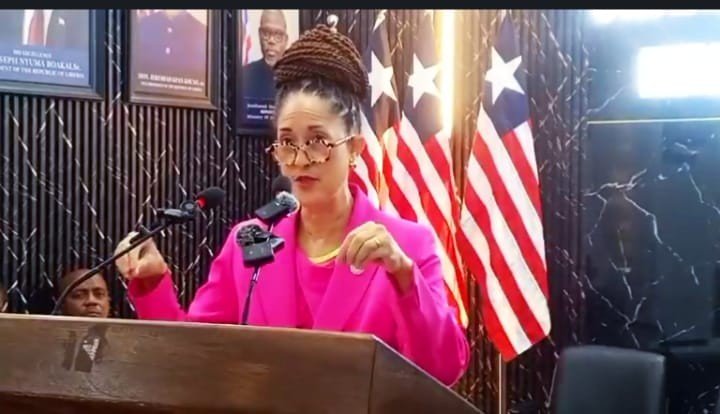
President of the University of Liberia, Dr. Layli Maparyan, made the disclosure Thursday during an engagement with the Ministry of Information, and members of the press, outlining her administration’s priorities and responding to questions about the university’s ongoing challenges.
Dr. Maparyan said the university’s ranking ambition is not simply about achieving a position on a list, but about using international ranking standards to address more than 20 areas considered essential to building a globally competitive institution.
She identified time to graduation, faculty credentials and the quality of facilities as three critical areas being prioritized by her administration.
According to the UL president, the university has already taken steps to regularize its academic calendar in an effort to reduce delays in students completing their programs.
She said the Joint Faculty Senate and Academic Coordinating Committee approved a new regularized academic calendar in February last year, allowing the university to run three regular academic terms punctuated by a vacation school.
Dr. Maparyan said the move is intended to help students complete their degrees within the expected four-to-six-year period and represents an important step toward achieving the university’s top-300 goal.
On faculty credentials, the UL president said approximately 19 percent of the university’s faculty members currently hold PhDs or other terminal degrees, representing about 150 people out of approximately 800 full-time faculty members.
She said increasing the number of doctoral-level faculty members remains a major strategic priority.
According to her, three individuals have recently been sent to the University of Delhi in India on fully funded PhD scholarships, while three women are expected to travel to the University of Botswana on scholarships funded by the university’s Vice Chancellor.
She also disclosed that a Liberian woman is pursuing a funded PhD at Duke University, while more than 15 other individuals are already on study leave pursuing doctoral degrees or preparing to return to UL after completing their studies.
Dr. Maparyan said the effort is also aimed at improving gender balance within the university’s professoriate.
She further announced that the university has added Université Cheikh Anta Diop in Dakar, Senegal, to its list of partner institutions where UL faculty can pursue advanced degrees.
Infrastructure remains another major component of the university’s transformation agenda.
Dr. Maparyan said the Government of Liberia allocated approximately US$6.3 million to the University of Liberia in the 2026 fiscal year for infrastructure renovation and modernization.
However, she said the amount is only an initial step toward the university’s broader infrastructure ambitions.
“If we were only talking about basic repairs what we might describe as putting zinc and paint on buildings we could probably renovate our campuses for approximately US$12 million,” she explained.
She said fully renovating and modernizing UL to the standards of a digitally empowered and globally competitive university could cost approximately US$100 million.
The university, she explained, intends to pursue the work in three overlapping phases: emergency repairs, medium-term upgrades and full-scale renovation and modernization.
The immediate phase will address urgent problems such as leaking roofs and non-functioning bathrooms. The second phase will provide temporary or “swing space” where students and classes can be accommodated while major construction takes place. The final phase will involve comprehensive renovation and modernization of UL’s buildings and facilities.
Dr. Maparyan said the university will continue seeking assistance from government, development partners and private donors to bridge the funding gap.
As part of the modernization effort, she disclosed that UL recently hosted a representative of Fuwei LN Education Group, a company specializing in science laboratory equipment and infrastructure.
The university is working with the group to develop a comprehensive plan for renovating and modernizing laboratories in key STEM disciplines.
She said laboratory upgrades must be coordinated with building renovations to ensure that the necessary electrical and energy systems are incorporated into the overall infrastructure design.
The UL president also highlighted the Solar Oasis Student Utility Park at the Fendall campus, which she said will provide 26 new bathrooms and a mini student center with 24-hour device charging and internet services.
The facility will be fully powered by solar energy and is intended to serve as a demonstration project for what a fully solarized University of Liberia could look like.
Responding to questions about measures taken since she assumed office, Dr. Maparyan said her administration has also worked to regularize faculty and staff payments.
She said faculty members previously faced uncertainty over salary payments, particularly those working additional or overload assignments, resulting in accumulated arrears.
The administration, she said, has worked to address those arrears and remains committed to ensuring that employees are paid for the work they perform.
She also pointed to increased opportunities for faculty to pursue PhDs, improvements in disability access and the development of new bathroom facilities as other initiatives undertaken by her administration.
The university has added ramps, with some supported by Orange Liberia, and has introduced measures to allow persons with visual and hearing disabilities to participate in the university entrance examination.
Dr. Maparyan said UL has administered entrance examinations in Braille, describing the move as part of efforts to make the institution more accessible and inclusive.
The university’s reopening date also featured prominently during the press engagement.
Asked whether UL would reopen on August 25, 2026, as previously scheduled, Dr. Maparyan responded that the situation was “complicated.”
She said the university would be open and begin certain activities, but students should not necessarily expect to immediately return to regular classroom instruction on that date.
According to her, delays in the registration process are partly responsible for the uncertainty.
She added that the administration is also awaiting the outcome of ongoing student leadership and General Assembly processes that could affect the reopening arrangements.
However, she said the Vice President for Academic Affairs, Vice President for Student Affairs and Dean of Students have confirmed that preparations for academic activities are underway.
Students, she said, have been invited to return to campus and participate in registration, orientation and other activities while the administration works to resume classroom instruction as soon as possible.
The shortage of classroom chairs also remains an issue at UL.
Dr. Maparyan said she could not guarantee that the university would have enough chairs for every student when classes fully resume, but noted that efforts are underway to increase the supply.
She disclosed that the National Port Authority previously raised funds to purchase chairs for UL, but the funds had not yet resulted in the purchase of the furniture.
She said she has since engaged the authority’s leadership to ensure the initiative is implemented.
She also said Voices of the Elders of Liberia, or VOTE-RL, is working to secure funding to purchase a container of modern metal and plastic chairs from China for the university.
At the same time, Dr. Maparyan appealed to students to protect university property, noting that chairs are sometimes moved, damaged or destroyed.
She said the university is considering different ways to keep chairs in classrooms while also taking fire-safety requirements into account.
Dr. Maparyan said one of the most important lessons she hopes to bring from universities in the United States to UL is reliable 24-hour electricity.
She described constant electricity as a basic requirement that could transform the University of Liberia and said it has become one of the top strategic priorities of her administration.
She also outlined plans for smart classrooms, stronger campus-wide internet connectivity and greater access to digital devices for students, faculty and staff.
The UL administration is working with the university’s Chief Information Officer and potential partners to develop strategies for expanding digital connectivity and providing computers to members of the university community.
On the university’s financial needs, Dr. Maparyan said UL’s current budget remains below the level required to operate a globally competitive institution.
She said many universities across Africa operate with annual budgets of approximately US$100 million, while UL’s current budget is about US$46 million.
After removing the approximately US$6.3 million capital allocation, she said the university is left with roughly US$40 million for other operations.
She acknowledged that the Government of Liberia may not currently be able to provide an additional US$60 million annually, but said the comparison illustrates the level of resources required to achieve UL’s ambitions.
The university, she said, is therefore strengthening its ability to raise funds from donors and development partners.
Earlier this year, she said, UL established a new Division of Institutional Advancement, expanding the responsibilities previously handled by the Public Relations Department.
The division includes communications and marketing, development and partnerships, fundraising and external relations.
Dr. Maparyan said donors are more likely to support institutions with sound administrative systems, well-maintained campuses and credible financial audits, areas she said UL is working to improve.
The UL president also explained how fees collected from students are utilized.
She said students pay different categories of fees, including entrance, registration and graduation fees, with each category supporting different university needs.
Entrance fees, she explained, contribute to general university revenue and help cover expenses associated with the admissions and testing process.
Registration and other student-related fees help support specific services, while graduation fees largely cover the cost of organizing graduation ceremonies.
Dr. Maparyan said the university also receives government support for tuition and operations, but that the funding is insufficient to cover all operational costs, requiring UL to supplement its budget with internally generated revenue.
She noted that some fees collected from students do not reflect the actual cost of providing the services.
As an example, she said a modern student identification card could cost approximately US$5 to US$6 to produce, while the amount collected from students for the service is significantly lower.
Despite the challenges facing the institution, Dr. Maparyan said she remains confident in her administration’s reform agenda and described her position as president of UL as her “dream job.”
She acknowledged that members of the university community hold different views about her administration, with some strongly supporting the reforms, others opposing them and many simply wanting a stable academic environment.
Still, she said her administration remains committed to transforming the University of Liberia into a modern, inclusive and digitally empowered institution.
The university’s goal of becoming one of Africa’s top 300 universities, she emphasized, is ultimately about more than rankings.
It is intended to strengthen academic standards, improve graduation timelines, increase the number of highly qualified faculty, modernize infrastructure, expand digital education and create a better environment for teaching, learning and research.
Dr. Maparyan said these reforms are aligned with the ARREST Agenda for Inclusive Development, particularly its focus on human capacity building, and are aimed at positioning the University of Liberia to play a stronger role in Liberia’s national development.
About The Author