
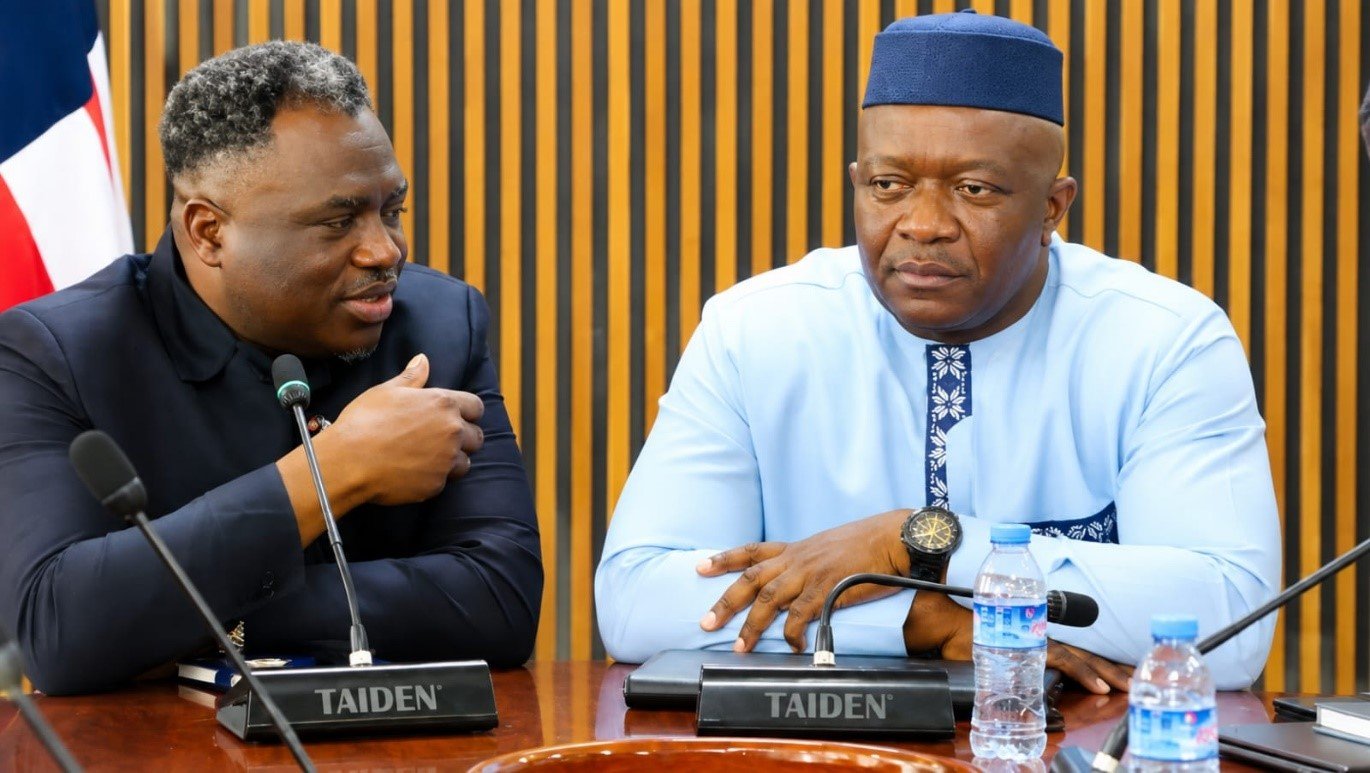
Vice President Jeremiah Kpan Koung has urged the Ministry of Finance and Development Planning (MFDP) to place greater emphasis on improving the living conditions of ordinary Liberians, strengthening economic opportunities and adequately funding institutions critical to national security.
Vice President Koung made the remarks during a working visit to the Ministry of Finance and Development Planning, where he commended Minister Augustine Kpehe Ngafuan and the Ministry’s leadership and staff for their demanding role in the functioning of government.
The Vice President described the MFDP as one of the most heavily tasked institutions in government, noting that decisions taken by the Ministry have direct implications for ministries, agencies and public institutions across Liberia.
He also commended the Ministry for improvements in the regularity of salary payments, describing the progress as an important achievement for public-sector workers.
However, Vice President Koung said government must now move beyond what he described as the initial phase of rescuing the country and focus on restructuring and rebuilding the Liberian economy.
The process of rescuing is over. The boat is on shore now. What we need to do now is to get it ready and fix it,” he said.
Vice President Koung called for greater attention to groups that are often overlooked in national policy discussions, including market women, small-scale borrowers and commercial motorcyclists.
He said commercial motorcyclists play an important role in transporting people and connecting communities, particularly in areas where road infrastructure remains limited.
He therefore urged the Ministry to consider targeted interventions that could support these groups and promote more inclusive economic growth.
The Vice President also stressed the need for increased support to the Liberia Drug Enforcement Agency (LDEA) as the government intensifies its campaign against illicit drugs.
Referencing President Joseph Nyuma Boakai’s declaration of a national “war on drugs,” Vice President Koung said the LDEA must receive the necessary financial and institutional support to effectively combat drug trafficking and abuse.
As you do your budget, don’t forget DEA. That makes them stronger,” he emphasized. For his part, Finance and Development Planning Minister Augustine Kpehe Ngafuan informed the Vice President that preparations for the 2027 National Budget have commenced following the official launch of the process in July.
Minister Ngafuan said the government remains committed to submitting the proposed budget to the Legislature by the statutory deadline of October 31, 2026.
According to him, the early start of the budget process is intended to provide sufficient time for consultations with ministries, agencies and other stakeholders to identify priorities, challenges and funding requirements for the 2027 fiscal year.
The budget preparation process has started. We launched the preparation process by the middle of July, and we are to submit the new budget by the deadline in the law, by the 31st of October,” Minister Ngafuan said.
Minister Ngafuan disclosed that the Ministry will hold a comprehensive review with key institutions within the security sector as part of the budget preparation process.
The engagement is expected to bring together the Minister of Justice and Attorney General, the Director of the Liberia National Police, the leadership of the Liberia Drug Enforcement Agency, the Liberia National Fire and Rescue Service and other security institutions.
He described the planned meeting as a “deep dive” into the sector’s operational challenges and priorities, with the aim of ensuring that critical needs are properly reflected in the 2027 National Budget.
The Ministry is also expected to engage the Liberia Electricity Corporation (LEC) on the country’s energy situation, including its development plans and areas requiring government support.
Minister Ngafuan said the discussions will help government better understand LEC’s priorities and determine how public resources can be strategically aligned to improve and expand electricity services.
Another major priority highlighted by Minister Ngafuan is the government’s planned engagement with the National Social Security and Welfare Corporation (NASCOP) to address outstanding obligations and broader challenges affecting workers.
He said the Ministry intends to convene a comprehensive “one-stop-shop” dialogue involving institutions with outstanding obligations or concerns related to NASCOP.
Among the institutions expected to be part of the discussions are the University of Liberia, Liberia Revenue Authority, ministries, agencies and public corporations. Some private-sector entities are also reportedly behind on their obligations.
We want to be able to have this panoramic discussion and to understand all the challenges. We’re not going to put things on the carpet,” Ngafuan said.
The Minister acknowledged that some of the obligations have accumulated over several years, stressing that the government is determined to confront the issue and identify lasting solutions.
He further emphasized that retirement should be a period of dignity and security rather than uncertainty, saying government wants workers to have confidence in their future after years of service.
The initial engagement with NASCOP, he said, will form part of a broader policy discussion that will eventually be presented to President Boakai and Vice President Koung for consideration and appropriate policy action.
Minister Ngafuan also disclosed that the Ministry of Finance and Development Planning will engage the Ministry of Education as part of the ongoing consultations on national priorities and resource allocation.
The discussions are expected to focus on the education sector’s pressing needs and determine how those priorities can be accommodated within the framework of the 2027 National Budget.
Vice President Koung concluded his visit by thanking Minister Ngafuan and the MFDP staff for their continued service, emphasizing that effective coordination and strategic allocation of government resources remain essential to achieving Liberia’s development objectives.
He said the government’s focus should now be on consolidating gains made during its initial phase while advancing reforms that improve public services, expand economic opportunities and enhance the welfare of Liberians.
About The Author