
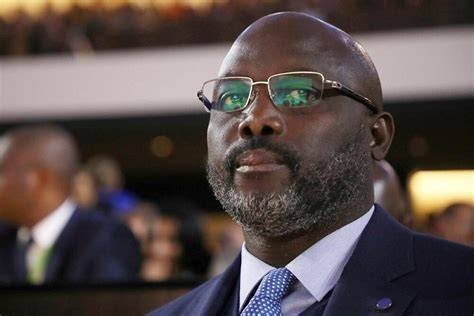
Monrovia-Is former President George Manneh Weah being monitored and considered for a possible arrest by the Liberian government?
That is the boggling question confronting Liberians, mainly his supporters, as unconfirmed and unproven reports about such plans have been swirling in the past few weeks, leaving many to wonder if truly the former President is on the radar for arrest.
The swelling question is whether the information has any iota of reality or mere political chicanery intended to stir tension and debate.
What is true is that there is no official government statement to the effect, neither has the government rebuffed such reports.
Recall that it is not the first time news about Weah’s arrest has emerged in the last few months, and the Liberian government had clarified they harbored no such plans to arrest the former president.
The government has maintained that no one or no office is above the law, an indication that Weah or any other official, current and former, can be arrested if there are justifiable reasons to do so in keeping with law.
More so, alleged plans to arrest Weah began filling the air in the immediate aftermath of former Vice President Jewel Howard-Taylor’s arrest back in August in connection to her alleged involvement in a major drug case.
However, the current information about Weah’s arrest is fast spreading and reaching the nooks and corners of the political and social landscape, causing nervousness and provoking sharp reactions from his supporters, some of whom are warning the Unity Party administration to desist from pursuing actions that could plunge the country into any mess of confusion, possibly war.
The information is not just growing and spreading, it is creating more tension to the already hazed atmosphere amid the rising economic strangulation already being faced by Liberians as the government is struggling to remedy the situation.
A recent World Bank report showed a scaring picture of the government’s ‘economic challenges. The exchange rate is reaching its most downward trend, as it is at US$1 to $820 Liberian dollars, a dramatic drop from $190 to $1 US dollar.
But the drop of rate is not affecting prices of goods, thereby exerting additional pressure on the household economy and more hardship on citizens.
The alleged plan of Weah’s arrest is said to be tied to the ongoing fight against drugs initiated by the government to rid the country of illegal narcotics and other substances.
Liberian blogger “LAW LAW” in one of his latest podcasts alleged the government has hatched plans, quoting alleged information he received, to arrest the former President.
He claimed the plan is to provoke a situation where Weah supporters, the opposition community and the Congress for Democratic Change (CDC) will come out to resist the arrest, and a potential chaos ensues.
In the wake of that, he claimed the government’s plan is to portray the CDC as the one that has created the mayhem. He urged the CDC and Liberians not to fall the government’s plan or allow it to manipulate the process, adding “the international community is aware of the plan that the government is the one masterminding the plan to create a false narrative about the CDC.”
Adding fuel to the fire was a widely shared post by Philipbert Semogar Jargba-Wleh Browne in his “Justice or survival: what should the National Security Council do when the evidence points to a popular president?”
He wrote, “Assume, for the sake of argument only, that President Weah was involved in cocaine trafficking, that the Government of Liberia holds overwhelming evidence sufficient to convict him before a court of competent jurisdiction, and that he is so popular that any attempt to arrest him would plunge the Republic into another round of civil war: if you were the National Security Council, would you arrest him in the name of justice and accountability and damn the consequences, or would you pretend the investigation never took place and the evidence was never found in order to preserve the stability and longevity of the Republic?”
He framed it as ‘HYPOTHETICAL’ and not real, and meant for illustration purpose only.
Browne who claimed to be knowledgeable of national security issues further stated: “No emotional outbursts, no political sentiments, just plain honesty and truth. If you were the head of the National Security Council, what would be your approach? I will start the ball rolling in the first comment.”
The post, though clearly marked hypothetical, was shared and misinterpreted in many quarters as evidence that an arrest was imminent.
The controversy intensified in August, when former Vice President Jewel Howard-Taylor was arrested at the Roberts International Airport on August 19, 2026, in connection with an investigation into the seizure of about four tons of cocaine in Duazon, Margibi County, in July.
The drugs were reportedly valued at US$317 million.Howard-Taylor was later charged with drug trafficking, money laundering, criminal conspiracy, and related offenses.
On August 25, she was remanded at the Monrovia Central Prison after the court rejected her lawyers’ request for compassionate detention.
Her arrest became a major political flashpoint, particularly within the CDC, where concerns arose that the investigation might expand to include other prominent figures linked to the Weah administration.
Former President Weah later threatened to mobilize CDC supporters and other Liberians to oppose what he characterized as efforts by the Boakai administration to target and intimidate opposition politicians and former officials under the pretext of combating illicit drugs.
Other Liberians are now having their say in the alleged Weah arrest plan. One of them is the political leader of the Economic Freedom Fighters of Liberia (EFFL), Emmanuel Gonquoi.
Weighing in on the issue, he repeated the highly popularized phrase “no one is above the law,” calling for equal justice and warning against political protection for former leaders.
His remarks come as a cocaine-trafficking controversy and allegations of a possible government action against former President Weah continue to heighten political tensions.
The controversy surrounding Weah has taken a new turn, as Gonquoi publicly challenged the idea that the former Liberian president should be exempt from criminal investigation or potential arrest because he once held the presidency.
In a strongly worded Facebook post published Saturday, November 14, Gonquoi questioned whether Weah has special standing that puts him beyond the reach of Liberia’s justice system.
He maintained that no one, regardless of political status or past service to the country, should be above the law.
Titled “The Difficult Truth,” the post addressed supporters of the former ruling Coalition for Democratic Change (CDC), the government of President Joseph Boakai, and Liberians involved in the increasingly heated debate over Weah’s potential legal exposure.
“So, Former President Weah is above the Laws in Liberia? Is he above our Country values?” Gonquoi asked, before urging the government to investigate the former president if credible information links him to criminal activity.
“If he is link[ed] to any crime, he should be investigated and if possible arrested,” he wrote. Although Gonquoi did not identify a specific criminal accusation against Weah or provide evidence connecting him to an offense, his remarks have placed the former president at the heart of an increasingly sensitive national debate, regarding whether Liberia’s commitment to equal justice can withstand the political influence and loyalty surrounding its former leaders.
Gonquoi, however, publicly rejected any attempt to use political mobilization to obstruct the government’s anti-drug investigation.
In August, Gonquoi warned that he would mobilize against protests aimed at disrupting the investigation, arguing that the drug crisis was too serious to be turned into a partisan political contest.
His latest remarks appear to broaden that stance beyond the investigation itself, prompting questions about whether Weah should be treated differently from other citizens if investigators establish a legitimate basis to question him.
At the center of Gonquoi’s argument is a constitutional issue that has become increasingly prominent in Liberia’s political debate: the scope of presidential immunity and whether it can protect a former president from criminal accountability.
Article 61 of Liberia’s 1986 Constitution grants the President immunity from suits, proceedings, arrest, and detention for acts carried out in the exercise of presidential authority in accordance with the Constitution and other laws.
However, the same provision states that the President is not immune from prosecution after leaving office for a criminal act committed while in office.
On the other side, Wantoe Teah Wantoe, a member of the CDC, warned the UP government against what he called reckless statements.
“I know the Unity Party government and its supporters are intelligent people, and I expect them to understand the difference between political intelligence and outright recklessness. Do not mistake President Weah’s silence, patriotism, and commitment to peace for weakness,” Wantoe wrote.
“This is a former president who received nearly 50 percent of the votes in the 2023 presidential runoff and peacefully transferred power in the interest of our democracy. It is deeply disrespectful to even think that you can use political power to intimidate, threaten, or manufacture a case against former President George Manneh Weah.”
According to Wantoe, the presidency of Liberia is not an ordinary political position, and a former president must not be treated as a target for political games.
“There is a difference between lawful accountability and the reckless belief that controlling the government gives anyone the right to use state institutions against political opponents,” he wrote on social media at the weekend.
“President Weah is protected by the Constitution of Liberia. Article 61 provides presidential immunity for official acts, while Articles 20 and 21 guarantee due process and the rights of accused persons. These constitutional protections cannot be ignored for political convenience.”
Even putting immunity aside, Watoe said President Weah’s record of patriotism, respect for the law, and commitment to democracy deserves recognition.
He further stated, “If these reckless statements are intended to test public opinion about a possible arrest of President Weah, let there be no misunderstanding: Liberians have every right to respond firmly, peacefully, and constitutionally to any politically motivated action against him.”
“Fighting impunity must never become an excuse for selective justice. The government should focus on jobs, the economy, healthcare, and the challenges facing ordinary Liberians rather than allowing reckless political statements to dominate national debate,” he added.
He noted that former President Weah is not above the law, but he is certainly not beneath its protection, stressing “Let’s respect ourselves.”
“The most foolish and idiotic political strategy is to believe that reckless statements about President George Manneh Weah can somehow become evidence of wrongdoing.”
For now, there is no arrest warrant, no charge sheet, and no official statement linking former President Weah to the cocaine case.
What exists is a toxic mix that a real drug investigation, a hypothetical debate about justice vs. stability, social media podcasts, and a deeply polarized political environment where every rumor travels faster than fact.
Until the government speaks clearly, either to confirm an investigation or to debunk the rumour, the question “Is Weah For Arrest?” will continue to hang over Liberia, stoking fear, anger, and speculation in equal measure.
About The Author