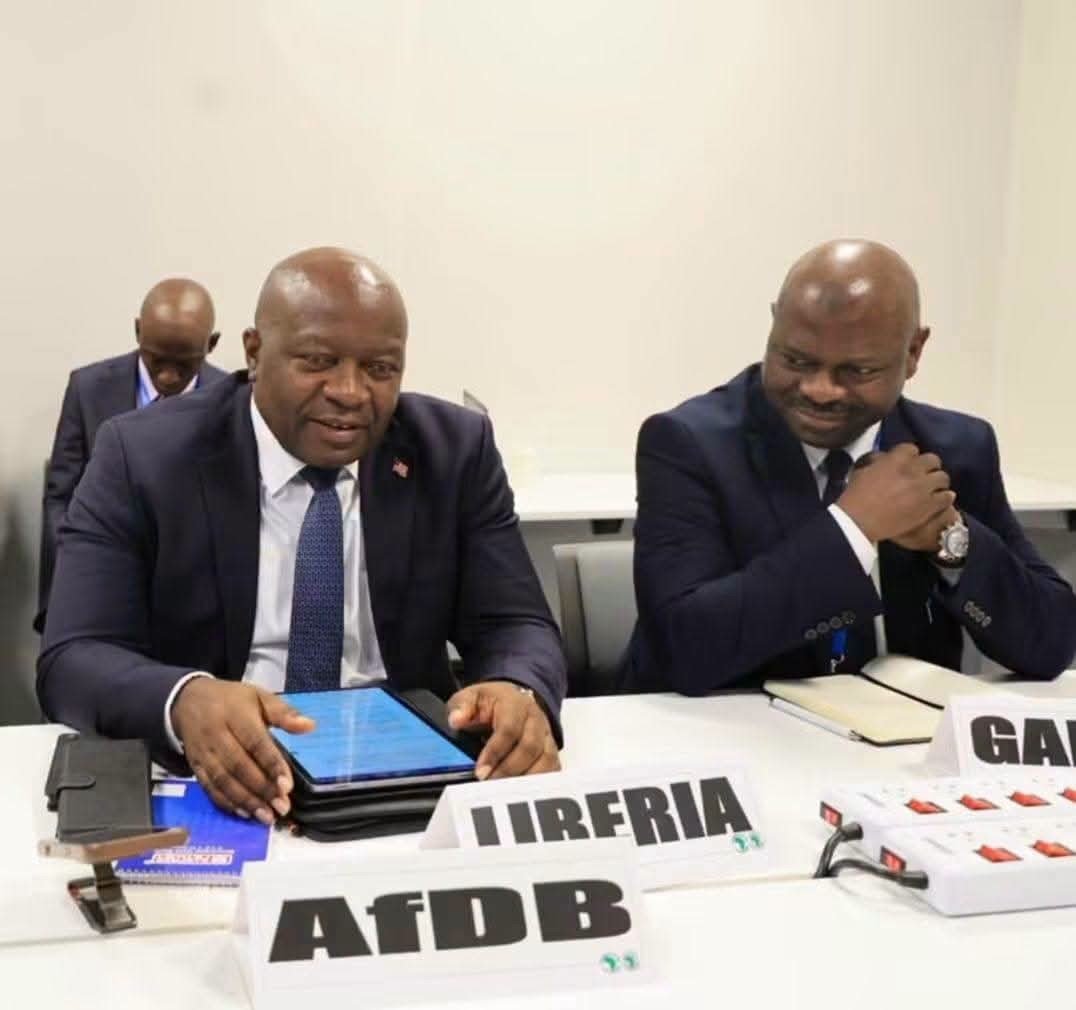
Monrovia-Finance and Development Planning Minister Augustine Ngafuan is among colleagues from the AfDB Constituency bloc Talks taking place in Bangkok, Thailand where he reported Liberia’s economic leap.
Minister Ngafuan is said to have led the talks which focused on strengthening economic cooperation, expanding development financing, improving institutional efficiency and accelerating investments in infrastructure and employment-generating sectors.
The discussions come as African economies confront persistent infrastructure financing gaps, pressure to mobilize domestic revenue, rising demands for youth employment and the need to sustain economic growth while managing public debt.
Constituency 15 comprises Liberia, The Gambia, Ghana, Sierra Leone and Sudan.
The delegation included Gambian Finance Minister Seedy K.M. Keita, Sierra Leonean Finance Minister Karefa Ansumana Francis Kargbo and Sudanese Finance Minister Dr. Jibril Ibrahim.
Speaking earlier, Minister Ngafuan commended Dr. Ould Tah’s first year of leadership, citing efforts to reduce bureaucratic delays, strengthen member-country representation and expand infrastructure investment.
Providing update on Liberia’s economic performance, he quoted figures as saying that Liberia’s economy expanded by 5.1% in 2025, up from 4.0% in 2024, while growth is projected to reach 5.5% in 2026.
The reported figures indicate an acceleration in economic growth, with the 2025 rate rising by 1.1 percentage points from the previous year. The 2026 projection would represent a further increase of 0.4 percentage points if achieved.
He told the august body now inflation, another major concern for households and businesses, reportedly declined from 12.5% in early 2025 to 4.3% at the end of September 2026.
He said the reduction would ease some of the pressure associated with rising consumer prices, although the actual cost of living would continue to depend on food prices, exchange-rate movements, transportation costs and other household expenditures.
The Finance Minister also reported how Liberia’s public debt-to-GDP ratio also reportedly improved, falling from 55.6% in 2024 to 54.1% in 2025, with a further decline to 49.6% projected for 2026.
He indicated that the projected 2026 ratio would represent a reduction of 6 percentage points from the 2024 level.
He has however clarified that the final outcome will depend on economic growth, government borrowing, revenue performance and other fiscal developments, adding that Liberia exceeded its IMF fiscal target in 2025, a development he presented as evidence of progress in fiscal management.
While these indicators point to improving macroeconomic conditions, Ngarfuan said the central policy challenge remains translating economic growth into better living standards, stronger public services, expanded employment opportunities and productive investment across the country.
He used the forum to highlight three AfDB-supported initiatives he said are central to sustaining Liberia’s economic momentum: domestic resource mobilization, youth entrepreneurship financing and the Cavalla River Bridge project.
For the Domestic Resource Mobilization (DRM) project, which is the first initiative, he said is designed to strengthen Liberia’s capacity to collect public revenue and finance national development priorities.
“The project is particularly relevant to the mining sector, one of Liberia’s major sources of economic activity and export earnings,” he said. “Improving revenue administration and strengthening the government’s ability to capture taxes, royalties and other legally due payments could help the country derive greater public benefits from its natural resources.”
Minister Ngarfuan also informed the body how stronger domestic revenue collection could also reduce dependence on borrowing and external assistance, creating additional fiscal space for investments in roads, schools, healthcare, electricity and other essential services.
For Liberia, the long-term objective is to ensure that economic expansion in mining and other productive sectors translates into sustainable government revenue and broader development gains.
He also weighed in on the second initiative, which is the Youth Entrepreneurship Investment Bank (YEIB), launched in Liberia in July 2025.
Ngafuan said Liberia became the first African country to operationalize the AfDB’s youth investment bank model, positioning the initiative as a potential instrument for addressing youth unemployment and limited access to business financing.
The programme is intended to provide young entrepreneurs with access to finance, mentorship and skills development, helping them establish businesses, expand existing enterprises and participate more actively in the formal economy.
Its stated ambition to create up to 120,000 jobs represents a significant employment target. Achieving that objective, however, will depend on the availability of financing, the survival and growth of supported businesses, market demand and the programme’s capacity to reach young people across Liberia.
The initiative comes against the backdrop of a wider African challenge: expanding productive employment for a rapidly growing working-age population.
Across the continent, access to affordable credit, practical business training and reliable infrastructure remains a barrier for many young entrepreneurs.
If implemented effectively, the YEIB could help connect youth empowerment with private-sector development, while encouraging innovation and reducing some of the structural barriers facing young business owners.
He named the third project as the 288-metre Cavalla River Bridge, which is expected to strengthen road connectivity between Liberia and Côte d’Ivoire under the Mano River Union regional road programme.
The project is intended to replace unsafe and unreliable river crossings by ferry and canoe, improve the movement of people and goods, reduce transport costs and strengthen cross-border commerce.
The bridge is particularly significant for regional integration. Liberia, Côte d’Ivoire, Sierra Leone and Guinea share longstanding economic and transport links, but inadequate road connections and border infrastructure have often increased the cost and difficulty of moving agricultural produce, commercial goods and passengers across the region.
Improved connectivity could benefit traders, farmers, transport operators and border communities while supporting the development of more integrated regional markets.
The Mano River Union, established in 1973 by Liberia and Sierra Leone and subsequently joined by Guinea and Côte d’Ivoire, provides a regional framework for economic cooperation and integration.
Transport infrastructure is central to that mission because cross-border trade depends not only on tariff policies but also on reliable roads, bridges and border facilities.
Minister Ngafuan acknowledged delays in the Cavalla River Bridge project and urged the parties involved to maintain implementation momentum to meet the targeted March 2028 completion date.
He said meeting that deadline will be important to realizing the project’s anticipated economic and social benefits. Construction progress, project coordination, financing arrangements and compliance with implementation schedules will remain key considerations.
African Development Bank (AfDB) Group, one of Liberia’s development partners , providing millions of dollars to infrastrucptural projects in roads, energy, education and health, has said it would continue its support for infrastructure development, energy, agriculture and other strategic sectors across Africa..
AfDB President Dr. Sidi Ould Tah reaffirmed the commitment following high-level talks with finance ministers from AfDB Constituency 15 on the sidelines of the 2026 International Monetary Fund (IMF) and World Bank Annual Meetings.
AfDB President Commends Constituency 15, Highlights Liberia’s Contribution
Addressing the ministers, Dr. Ould Tah expressed appreciation for their support and commended their efforts to strengthen national economies, identifying Liberia among the constituency’s strong economic performers.
He disclosed that Constituency 15 was the first to contribute to the African Development Fund, with Liberia committing US$3 million, underscoring the country’s stated willingness to support the Bank’s concessional financing mechanism for eligible African economies.
Dr. Ould Tah also emphasized the need to expand the AfDB’s financial capacity by mobilizing additional resources from international capital markets.
The strategy is intended to increase the institution’s ability to finance development priorities across its regional member countries.
The AfDB, established in 1964, has a continent-wide mandate to promote sustainable economic development and social progress through investments in infrastructure, agriculture, energy, private-sector development and regional integration. Its concessional financing arm, the African Development Fund, supports eligible low-income countries through grants and highly concessional loans.
The meeting between Dr. Ould Tah and Constituency 15 ministers thus provided an opportunity to align national economic priorities with the AfDB’s broader development-financing agenda, at a time when African countries are seeking more resources to fund infrastructure and accelerate structural transformation.
About The Author