
Monrovia-When Joseph Nyuma Boakai, as presidential candidate, vowed that no car would get stuck in the mud under his watch if elected President, he was embraced as the guy Liberia needed in the Executive Mansion.
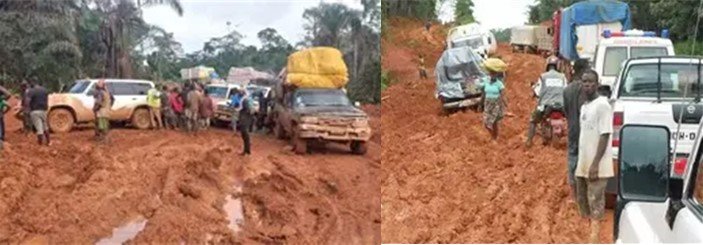
Nearly three years into his administration, that commitment is proving tetchy, ineffective and near-unrealizable, as reports of deplorable road conditions across the country swell, particularly in the southeast.
From Grand Gedeh to Sinoe, River Gee to Grand Kru, social media footages from different road corridors paint a grim picture of extreme difficulties travelers are experiencing in reaching their destinations in targeted time.
Videos and photos trending on Facebook and WhatsApp show motorbikes, private cars, commercial buses and heavy-duty trucks camping by roadsides, their wheels sunk deep in mud, passengers stranded for hours, sometimes days.
Drivers are seen digging, pushing, and offloading goods to lighten vehicles, while women and children sleep in the bush.
The situation has renewed scrutiny of President Boakai’s most publicized vows, with many Liberians asking whether the President is aware of the nightmare, or whether his mandate to the Ministry of Public Works has simply been defied by nature, neglect, and lack of funds.
During the 2023 campaign, Candidate Boakai, who branded himself as the rescue mission, made roads his signature promise.
At rallies across the country, he repeatedly said under his presidency, no car would get stuck in the mud.
For a country where 90% of transport depends on roads and where southeasterners spend up to three days to reach Monrovia in the rainy season, the promise resonated.
Upon taking office, he declared roads as a national emergency, deployed yellow machines to all 15 counties, and announced the creation of a Road Fund and an aggressive dry-season road rehabilitation program.
But as the rains have returned, and so has the old nightmare.
Two days ago, the Ministry of Public Works confirmed what travelers had been posting for weeks, the roads are in poor condition.
In a public advisory, the Ministry warned people traveling to Zwedru about a serious road problem at Duogee Town Swamp, about 20 kilometers from Tapita, Nimba County, along the critical Ganta-Tapita-Zwedru corridor that links Monrovia to the southeast.
“The bad section is about 100 meters long, and the ground is very soft and unstable. There is no other road to use at this time,” the Ministry said.
The Ministry said its team is already on the ground and working to make the road safe for travel, stating that “Light vehicles can still pass through the area. Heavy-duty vehicles should reduce their total load to 20 tons for now.”
This will help the Ministry work on the road and make it stable, the statement said, while apologizing for the trouble this situation may cause and says it is working to fix the problem as soon as possible.
According to reports, the Duogee Town is just one spot as travelers report similar or worse conditions between Pleebo-Barclayville, Greenville-Zwedru, Zwedru-Kanweaken, Tapita-Tchien, and Karloke-Fish Town.
In some places, trucks have been stuck for four days, causing prices of basic commodities to skyrocket in Zwedru, Fishtown and Barclayville.
“Road crisis is not just about inconvenience. It is an economic and social tax,” said one traveler. “Farmers cannot move cocoa, plantain and vegetables to market. Traders cannot move goods to rural markets. Prices in Monrovia stay low, but prices in the southeast double.”
This paper gathered that a bag of rice that costs $17 in Monrovia costs $30 in Zwedru because transporters add fuel, risk, and “stuck-in-the-mud” costs.
Senator Amara Konneh of Gbarpolu, in his Tuesday address to the Senate, linked the road crisis directly to fuel prices and poverty, saying “Bad roads raise fuel consumption by 30-40%.”
The Ministry of Public Works blames a combination of heavy rains, soft swampy soils, overloaded trucks, and years of underinvestment.
Critics blame slow disbursement of road funds, poor contracting, and lack of permanent pavement.
According to the Joint Public Accounts Committee, public revenues sit in commercial banks for days before hitting the Consolidated Account, while government borrows at high cost from the same banks, and PSIP execution for infrastructure remains low in the first three quarters.
Recall that the government deployed dozens of yellow machines nearly a year ago with fanfare, but residents in many counties say they see machines parked, not working.
In Kpayekorleh, Ngowolala District, Gbarpolu, where Senator Konneh visited during recess, farmers welcomed the yellow machines but fear delays in government financing will stall roadworks.
“Almost three years in, the worst has become the new embrace,” one commentator wrote.
On social media, the frustration is raw.”Mr. President, your cars are stuck,” one traveler posted from Duogee Town, showing a line of over 30 trucks.
“Rescue mission needs to rescue the roads first,” another wrote. Supporters of the President argue that fixing roads that have been bad for 20 years cannot happen in two rainy seasons, and that the administration needs more time and money to do permanent paving rather than grading.
The government says it is working on long-term solutions, including the African Development Bank-funded southeastern corridor and the World Bank-supported Liberia Road Connectivity Project.
But for the traveler stuck tonight in Duogee Town Swamp, with no food, no network, and no alternative road, long-term promises mean little.
As one stranded driver put it, “We voted for no car stuck in the mud. But today, we are sleeping in the mud.”
Until the road dries, or until heavy-duty pavements replace mud and swamp, President Boakai’s most famous campaign promise remains unfulfilled, and the bad roads continue to defy the presidential mandate.
About The Author