
By Benjamin Q. Z. Johnson
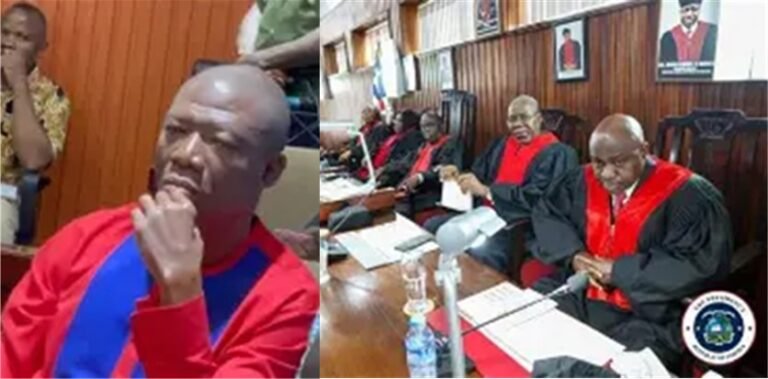
Monrovia-Criminal Court “E” at the Temple of Justice has reserved its verdict in the case against Peter Bon Jallah, who is accused of sexually assaulting a 16-year-old boy, following final arguments by the prosecution and defense on Thursday, October 22, 2026.
Assigned Circuit Judge Wesseh Alphonsus Wesseh Sr. announced that the court would deliver its verdict on Friday, October 23, at 11:00 a.m., leaving the outcome of the closely watched case to the court’s assessment of the evidence presented during the trial.
During Thursday’s proceedings, prosecution lawyer Cllr. Calvin H. Momolu urged the court to find Jallah guilty, arguing that the evidence presented by the state supported a conviction.
However, defense lawyer Cllr. G. Wiefueh Alfred Sayeh challenged the prosecution’s case, arguing that the state had failed to establish the allegations against his client beyond a reasonable doubt.
The competing arguments have placed the interpretation of medical findings, forensic evidence, police investigations and witness testimony at the center of the court’s pending decision.
In his final arguments, Cllr. Momolu urged Judge Wesseh to convict Jallah, relying on evidence presented during the proceedings, including medical findings reportedly referencing bruising, swelling and abrasions observed during the examination of the minor.
The prosecution maintained that the evidence should be considered collectively in determining whether the allegations had been established.
The state’s position places significant weight on the court’s assessment of the medical findings and other evidence introduced during the trial.
However, the prosecution must establish the essential elements of the charged offense beyond a reasonable doubt.
The court must therefore determine whether the evidence, considered as a whole, satisfies that legal standard.
In response, defense lawyer Cllr. Sayeh argued that the prosecution had failed to produce sufficient evidence to secure a conviction against his client.
He reportedly characterized the police investigation as inconclusive and challenged the prosecution’s reliance on the evidence presented during the trial.
The defense lawyer also referred to the medical report from the John F. Kennedy Medical Center, the forensic findings attributed to an expert witness from the Rwanda Forensic Institute, and testimony from witnesses who appeared during the proceedings.
According to the defense’s argument, the evidence did not sufficiently establish penetration, a central issue in the dispute over whether the prosecution had proved the alleged offense.
The defense maintained that the court should carefully evaluate the prosecution’s evidence rather than presume that the allegations had been established.
The precise wording of the defense lawyer’s final submissions could not be independently verified from the available account of the proceedings.
The medical and forensic evidence has emerged as a significant point of contention between the two sides.
Earlier reports concerning the case indicated that a John F. Kennedy Medical Center report dated March 4, 2026, found no visible signs of anal trauma. Separately, testimony attributed to the Rwanda Forensic Institute reportedly addressed pathology and DNA evidence.
The parties appear to differ over the significance of these findings and whether they support the prosecution’s allegations.
The absence of visible trauma does not, by itself, conclusively establish that sexual abuse did not occur. Likewise, injuries or other medical findings do not automatically establish the identity of an alleged perpetrator or prove every element of a criminal charge.
DNA evidence must also be interpreted in light of what was tested, the findings reported and the conclusions supported by the expert testimony.
Judge Wesseh will therefore have to evaluate the relevant evidence and determine the weight it deserves under Liberian law.
The complete medical and forensic reports were not independently available for review in preparing this report, preventing independent verification of their precise conclusions.
The pending verdict raises fundamental questions about the burden of proof and the evaluation of evidence in criminal proceedings.
Under the principles of criminal justice, Jallah is presumed innocent unless the prosecution proves his guilt beyond a reasonable doubt. The seriousness of the allegations does not relieve the state of that obligation.
At the same time, allegations involving a minor require careful judicial consideration, with the court expected to assess the evidence fairly and protect the rights of all parties.
The judge must determine whether the prosecution has established the elements of the offense charged, taking into account the police investigation, medical and forensic evidence, witness testimony and arguments advanced by both sides.
A verdict must ultimately rest on the evidence and applicable law, not public sentiment or assumptions about the allegations.
In its formal order, Criminal Court “E” stated that, having heard the legal arguments, it had reserved its verdict of guilty or not guilty for Friday, October 23, 2026, at 11:00 a.m.
The court also directed that the minutes of Thursday’s sitting would constitute regular notice of assignment because counsel for the prosecution, the defendant and the BCR were present.
The matter was subsequently suspended pending the delivery of the verdict.
As of Thursday’s adjournment, Judge Wesseh had not announced a decision.
The ruling is expected to determine whether the prosecution has met its burden of proof or whether the defense’s challenge to the evidence warrants an acquittal.
The decision will bring a critical stage of the proceedings to a close in a case involving allegations against a minor, disputed medical and forensic evidence, and competing interpretations of witness testimony.
About The Author