
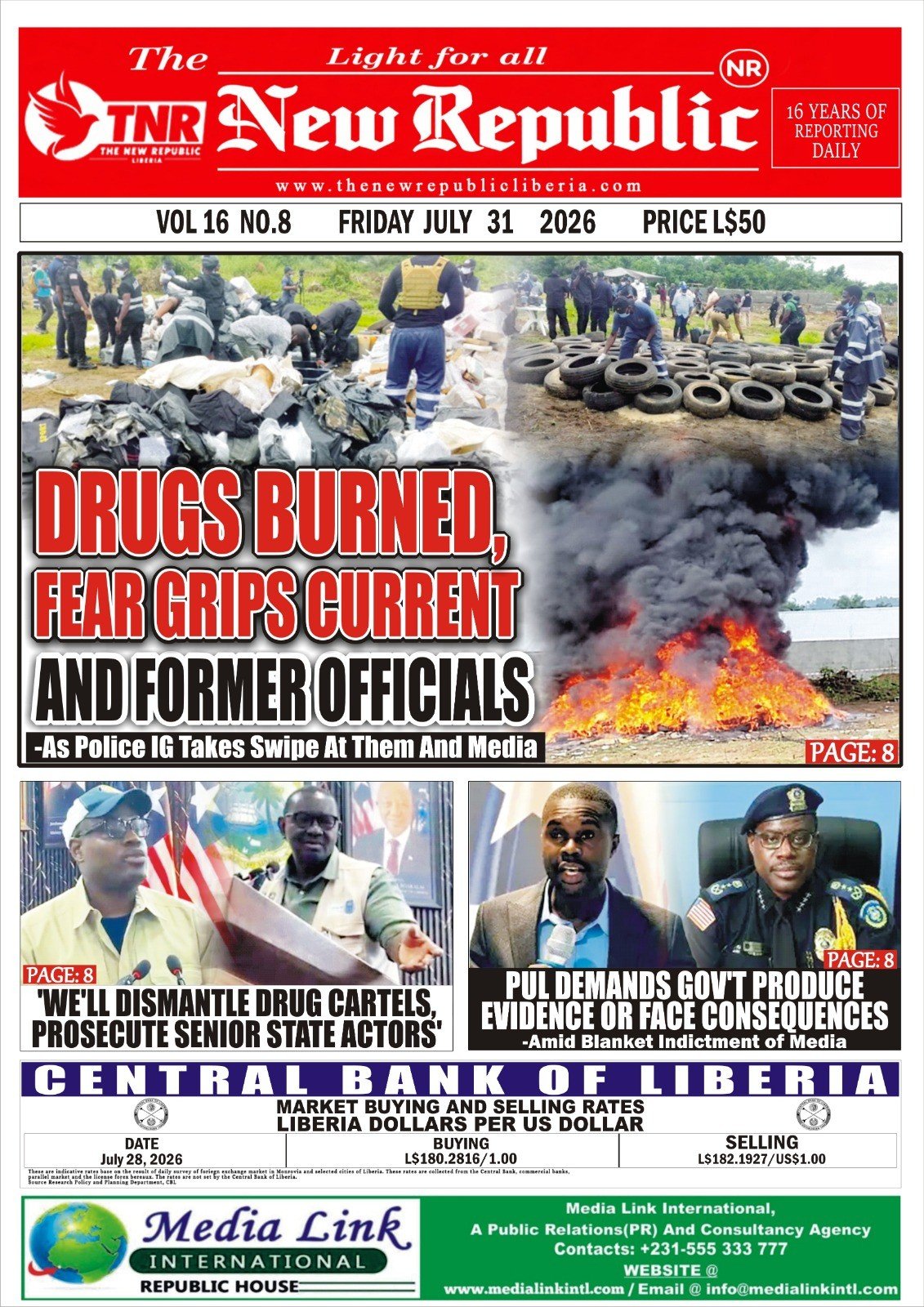
MONROVIA–Liberia’s debate over whether the country has become a “narco-state” or international drug transit hub has taken a sharper political turn after Liberia National Police Inspector General Gregory O.W. Coleman threw what is viewed “political bomb,” saying international drug cartels that were once dismantled “re-entered” the country in 2018.
The timing of that year has placed the spotlight directly on the administration of former President George Weah, which took office in January 2018, succeeding the 12-year administration of former President Ellen Johnson Sirleaf.
IG Coleman made the remarks Thursday during a Joint Security briefing at the Ministry of Information, ahead of the destruction of two massive cocaine consignments seized at Roberts International Airport and in Duazon.
The Police IG traced Liberia’s fight against narcotics back to 2008, when he said the Sirleaf government sought assistance from the United States to break up drug networks operating here.
“The partnership with U.S. authorities led to the dismantling of several drug trafficking networks, significantly weakening their operations in Liberia for a number of years,” Coleman told reporters.
“But,” he added, “the cartels resurfaced following the country’s 2018 political transition.”
Coleman served briefly as Police Inspector General under the Ellen administration, before returning to the post under President Joseph Boakai.
The statement immediately sparked political reaction, with observers interpreting it as a direct indictment of the Weah administration’s record on security and drug enforcement.
Going further, IG Coleman alleged that the current drug trafficking networks are not operating alone. Without naming individuals, he said the networks have “largely received support from both former and current senior government officials,” including members of the Joint Security, cabinet ministers, heads of public institutions, and other high-ranking state officials, adding the government will go after them all.
He said the government, with support from international partners, has launched an extensive investigation to “identify, investigate, and dismantle” the alleged network.
“The investigation is being conducted in collaboration with the U.S. Drug Enforcement Administration (DEA), Morocco’s anti-drug authorities, and Rwandan law enforcement agencies,” Coleman disclosed.
“Efforts continue to disrupt drug trafficking operations in Liberia.”US$336M In Seizures Puts Pressure on Government
The briefing comes as Liberia prepares to destroy two of its largest-ever drug seizures of 3,971 kilograms of cocaine valued at approximately US$317.68 million in Duazon, and 237.6 kilograms valued at over US$19 million at the RIA.
Both consignments are at the center of ongoing prosecutions and have intensified calls for transparency, forensic testing, and due process before destruction.
In a separate and controversial claim, the Police IG alleged that the cartels behind the seized cocaine have paid money to elements in the Liberian media.
According to Coleman, the goal is to “undermine the ongoing investigations and divert attention” from the suspects.
“The Cartels are allegedly using the media to divert attention and provide misinformation to undermine the ongoing investigations and ensure they are set free,” he said.
He described the alleged media interference as “not only hurting and detrimental to the Investigations, but it is also meant to damage the image of the country.”
The accusation has drawn concern from press freedom advocates, who are calling for evidence to back the claim while also urging journalists to avoid being used to obstruct justice.
Coleman’s linkage of the cartels’ return to “the 2018 political transition” has already fueled debate on talk shows and social media.
Supporters of the former Weah administration are demanding specifics and proof, while government officials under President Boakai say the investigation will follow the evidence “wherever it leads.”
The Boakai administration has declared drug trafficking and abuse a national emergency and has pledged closer work with the DEA and other partners.
With billions of Liberian dollars’ worth of cocaine now destroyed, the IG’s statements have widened the crisis from a law enforcement matter to a political one.
The key questions now are who within and outside government enabled the cartels’ return in 2018, and how can the ongoing DEA-backed investigation produce prosecutions without interference?
As IG Coleman put it, the fight is not just against drugs, but against a network he says includes powerful people and, allegedly, paid voices in the media.
About The Author