
By Jamesetta D. Williams
Liberia’s Joint Security on Thursday destroyed cocaine valued at approximately US$336 million, seized in two separate anti-narcotics operations, while declaring an intensified campaign against drug trafficking networks that authorities say have infiltrated sections of the country’s security and government institutions.
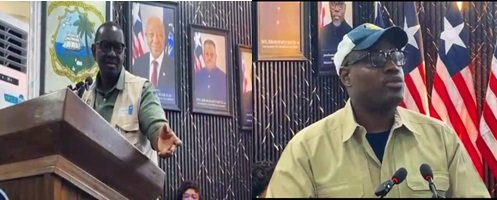
The destruction exercise, held in Zeewhorr, Margibi County, involved cocaine valued at US$19 million and US$317 million, confiscated during separate joint security operations. The exercise was witnessed by senior government officials, including Justice Minister and Attorney General Cllr. N. Oswald Natu Tweh, Information Minister Jerolinmek Matthew Piah, Executive Protection Service (EPS) Director Sam Gaye, heads of security institutions and other government officials.
Addressing journalists during a press briefing, Liberia National Police Inspector General Gregory O.W. Coleman, speaking on behalf of the National Security Investigative Team, described the country’s drug situation as a national security crisis that has become a top priority of the National Security Council under the leadership of President Joseph Nyuma Boakai.
Coleman said all security institutions have been directed to work collectively to dismantle drug trafficking organizations operating in Liberia and ensure that those responsible are brought before the courts.
He alleged that international Drug Trafficking Organizations (DTOs) have deployed substantial financial resources to frustrate ongoing investigations by attempting to influence public opinion and manipulate media narratives.
According to him, these criminal organizations are deliberately spreading misinformation to distract investigators, weaken public confidence and create confusion surrounding one of Liberia’s largest narcotics investigations.
The Inspector General appealed to journalists and the general public to rely on verified facts rather than speculation, warning that the spread of false information only benefits organized criminal networks.
Providing historical context, Coleman recalled that in 2008 former President Ellen Johnson Sirleaf requested assistance from the United States Drug Enforcement Administration (DEA) to combat transnational drug trafficking. He said the joint operation, which continued until 2013, resulted in the arrest and extradition of more than eleven cartel members who were later convicted in the United States and sentenced to prison terms ranging from five to thirty-three years.
Those operations, he said, effectively discouraged international drug traffickers from using Liberia as a transit point for narcotics.
However, he alleged that drug cartels gradually re-established operations in Liberia after being convinced they once again had protection from corrupt individuals occupying strategic positions within government institutions.
According to the investigation, traffickers initially attempted to move narcotics through Roberts International Airport before shifting to maritime routes and using Liberia’s waterways. Following more than one year of intelligence gathering led by the National Security Agency (NSA), investigators intercepted what authorities described as one of the country’s largest narcotics shipments.
Coleman alleged that investigations have uncovered evidence indicating that some security officers used official government vehicles to escort narcotics from their landing site to storage locations.
He announced that several security personnel have since been arrested and charged in connection with the investigation.
Among those identified are the Chief of Highway Patrol, Mr. Weibo, the Chief of Major Crimes, Mr. Blade, and the Deputy Commander of the Liberia Drug Enforcement Agency (LDEA) assigned at Roberts International Airport. He said the suspects remain in police custody and are expected to face prosecution.
He further disclosed that investigators have identified additional current and former government officials, including former presidential appointees who allegedly played roles in facilitating drug trafficking activities between 2021 and 2023.
Although declining to disclose further identities, Coleman assured the public that additional arrests would be made as investigations continue. “There is absolutely no one above the law,” he declared, stressing that the objective of the investigation is not merely to seize narcotics but to dismantle the entire criminal structure that finances, protects and facilitates drug trafficking operations in Liberia.
Coleman also revealed that Liberia has received international support following direct engagements by President Boakai with foreign governments.
According to him, agents and intelligence analysts from the United States Drug Enforcement Administration are already working alongside Liberian investigators, while Morocco and Rwanda have also agreed to provide technical and investigative assistance to strengthen the country’s anti-drug campaign.
He assured Liberians that investigators have shared all available evidence with international partners and pledged that every individual connected to the criminal network, regardless of rank or political affiliation, will be held accountable.
Meanwhile, Justice Minister and Attorney General Cllr. N. Oswald Natu Tweh defended the government’s decision to destroy the confiscated cocaine, stating that the exercise was conducted in full compliance with a court order.
He explained that investigators preserved representative samples of the narcotics as evidence before presenting them to the court, which subsequently authorized the destruction of the remaining quantities.
The Attorney General dismissed criticism suggesting that the drugs should have been retained, noting that Liberian law provides for the destruction of narcotics after sufficient evidence has been secured for prosecution.
“The court authorized the destruction after samples were preserved as evidence. Liberia will not serve as a safe haven or transit point for transnational criminal organizations,” he said.
Cllr. Tweh urged Liberians to support the government’s ongoing anti-drug efforts and encouraged citizens to allow the legal process to proceed without interference or misinformation.
During the briefing, he also appealed to Liberians to rally behind the national football team, emphasizing that national development requires collective support and that citizens should encourage institutions working to restore national pride.
Thursday’s destruction of the seized cocaine represents one of the largest public drug destruction exercises in Liberia’s history and underscores the government’s determination to confront organized narcotics trafficking through coordinated domestic and international cooperation.
Authorities maintain that investigations remain active and have warned that additional arrests and prosecutions are expected as security agencies continue working to dismantle every level of the criminal network responsible for trafficking narcotics into Liberia.
About The Author