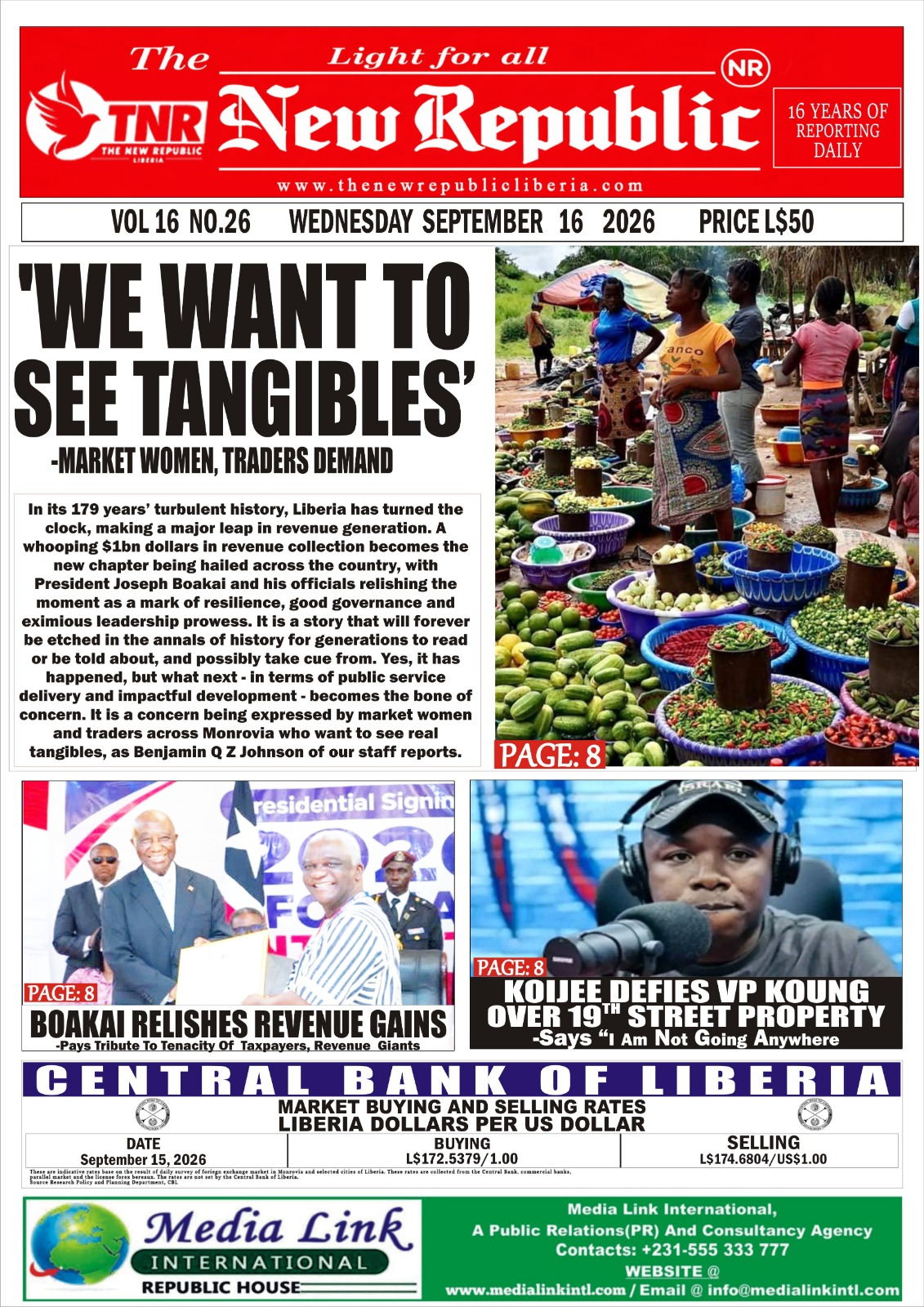
MONROVIA–In its 179 years’ turbulent history, Liberia has turned the clock, making a major leap in revenue generation. A whooping $1bn dollars in revenue collection becomes the new chapter being hailed across the country, with President Joseph Boakai and his officials relishing the moment as a mark of resilience, good governance and eximious leadership prowess. It is a story that will forever be etched in the annals of history for generations to read or be told about, and possibly take cue from. Yes, it has happened, but what next – in terms of public service delivery and impactful development – becomes the bone of concern. It is a concern being expressed by market women and traders across Monrovia who want to see real tangibles, as Benjamin Q Z Johnson of our staff reports.
Liberia celebrates a new chapter in its revenue generation regime as the country surpassed the US$1 billion domestic revenue collection target long set by the President Joseph Boakai administration.
Euphoria characterized the incredible milestone which has divided public opinion. As government supporters celebrate the development as a historic fiscal achievement, critics are demanding evidence that the increased revenue is improving the lives of ordinary Liberians.

Some market women also shared in the celebration with extreme caution, demanding real beneficial tangibles from the government.
President Boakai, addressing the nation Monday from the United States where he is currently ahead of the 81st Session of the United Nations General Assembly (UNGA), did not hold back his joy over the achievement.
“Liberia had, for the first time in its 179-year history, raised more than US$1 billion in domestic revenue in a single year,” the president declared, and said the development is evidence that Liberia is becoming increasingly capable of financing its own development.
“This is domestic revenue raised at home, earned, not borrowed, and not foreign aid,” President Boakai said.
He credited Liberia Revenue Authority Commissioner General Dorbor Jallah and his team, the Ministry of Finance and Development Planning, other government institutions and Liberian taxpayers for the achievement.
According to figures presented by President Boakai, domestic revenue increased from approximately US$612 million in 2023 to US$699 million in 2024, before rising to about US$848 million in 2025.
The administration says collections had exceeded US$1 billion by September 2026 and that the government remains on course to reach approximately US$1.3 billion by the end of December.
President Boakai said the increase had been achieved despite international economic uncertainty, disruptions in global trade and other external pressures.
He said government had also worked to maintain the availability of essential commodities, including rice and fuel, while seeking to contain price pressures.
But the announcement has quickly moved beyond government revenue statistics and into a debate over Liberia’s economic condition.
Speaking with our reporter following the President’s announcement, market women and traders in Monrovia expressed mixed reactions, welcoming the increase in government revenue while calling for tangible improvements in their businesses and communities.
At Red Light Market in Paynesville, fish seller Ma Sarah Kromah, 48, said the announcement was encouraging but argued that ordinary Liberians would ultimately judge the achievement by its impact on their daily lives.
“We are happy to hear that the country has made progress, but the important thing is for the government to help market women,” she said.
“Business is not easy. Transportation costs are high, prices continue to rise and many of us struggle to send our children to school. If the government has more money, we want to see support for small businesses.”
At Waterside Market, clothing trader Mary Gayeh said the President’s reference to market women had raised expectations.
“The President said market women should benefit, and we agree with that,” Gayeh said.
“Many women are doing business without access to loans. If government can provide affordable financing, reduce the cost of doing business and improve roads, that will help us grow.”
At Duala Market, rice retailer Moses Kamara said citizens were more interested in visible improvements than government financial figures.
“We hear big figures every year, but people are asking where the impact is,” Kamara said.
“When roads improve, electricity becomes available, medicines are in hospitals and jobs are created, then people will feel the difference.”
Petty trader Hawa Kolleh said small businesses were already contributing to the national economy through taxes and fees.
“We are paying taxes and fees, and we want government to use the money wisely,” she said.
“The market women are contributing to the country, so we expect better schools, better hospitals and more opportunities for our children.”
Electronics dealer Patrick Wilson, speaking at Gobachop Market, said increased domestic revenue could help Liberia reduce its dependence on foreign assistance.
“It is a good achievement for the country,” Wilson said.
“But accountability is important. People want to know how the money is being spent and how it will improve jobs and economic opportunities.”
President Boakai acknowledged that the revenue would ultimately be judged by the benefits it produces for citizens.
“We do not view this milestone as just a number on the government’s ledger,” he said.
“Behind every dollar stands a Liberian.”
The President said increased revenue should translate into improved services for market women, civil servants, students, teachers, health workers and communities.
He said government would continue to support public hospitals with medicines and ensure that doctors and nurses remain at their duty stations.
He also cited improvements in compensation for public servants, education and infrastructure as areas where increased government resources could have an impact.
Boakai said the government was considering establishing a Special Purpose Vehicle to provide affordable financing to Liberian-owned businesses and other critical sectors.
The proposal, he said, would be aligned with the administration’s ARREST Agenda for Inclusive Development.
“A billion dollars raised is a billion dollars entrusted,” the President declared.
“Every dollar must serve the public good and advance the ARREST Agenda.”
The opposition, however, has questioned whether the increase in revenue is translating into improved living conditions.
Emmanuel Mulbah Johnson, chairman of the CDC Youth League, called the development as a “paper victory”.
“The reality is that collecting money and improving lives are not the same thing,” Johnson argued.
He questioned the extent to which increased government revenue has addressed unemployment, poverty, poor infrastructure and weaknesses in public services.
Johnson referred to the economic concept known as the “Paradox of Plenty”, arguing that countries can generate substantial revenues without ensuring that ordinary citizens benefit from those resources.
He pointed to challenges in healthcare, education, sanitation, electricity, roads, food prices and employment.
“Budgets do not improve lives. Revenue collection does not reduce poverty. Announcements do not build roads,” Johnson said.
Augustine Boauzizi McGill similarly questioned the significance of the announcement for ordinary Liberians.
“What’s the significance of the USD 1 billion budget when the suffering masses can’t afford to send their children to school?” McGill asked.
Former Commerce Minister and former Unity Party chairman Amin Modad offered a more measured response.
“The government generated $1B, So What?” Modad asked.
But he said the achievement should not be dismissed, arguing that government had established a target, planned around it and succeeded in increasing domestic revenue.
For Modad, the importance of the development lies in the additional fiscal space it creates for government.
He said the increased resources could be directed toward healthcare, education, infrastructure, youth development, vocational training, entrepreneurship and support for small and medium-sized businesses.
At the same time, he called for transparency and accountability in the use of public resources.
Youth employment has emerged as one of the central issues in the debate.
Modad has called for greater investment in vocational education, digital skills, entrepreneurship and apprenticeships to help young Liberians enter productive employment.
Cllr. Kanio Bai Gbala, Assistant Professor of Law at the Louis Arthur Grimes School of Law at the University of Liberia and Executive Chairperson of the Centrism Movement, said Liberia should measure the success of increased government revenue by the number of jobs created and businesses expanded.
Gbala identified agriculture and agro-processing, employment-intensive infrastructure, technical and vocational education, apprenticeships, small businesses and light manufacturing as areas that could generate employment.
“Reaching the billion-dollar threshold is worth recognizing,” Gbala said.
“Converting that milestone into farms, factories, skills, businesses, roads, and sustainable jobs would be even more consequential.”
He also advocated greater investment in rice, cassava, vegetables, poultry, cocoa and oil palm, arguing that agriculture could generate employment across production, transportation, storage, processing, packaging and marketing.
Former Education Minister George Kronnisanyon Werner cautioned against interpreting the US$1 billion announcement as meaning that another US$1 billion is immediately available for government spending.
Under the heading “Money Finished, Go Home!”, Werner argued that government has been collecting revenue throughout the year while simultaneously spending it on salaries, programmes, goods and services and other obligations.
“The announcement does not mean a fresh billion dollars is sitting somewhere, available for new demands,” Werner wrote.
He summarised the process as follows: “LRA raises it. Finance releases it. Public institutions spend it.”
Werner called on government to clearly explain how much has been collected, how much has been spent, what remains available and what obligations are outstanding.
He warned that failing to explain the distinction could create unrealistic expectations among citizens.
“Celebrate the collection achievement. Explain it just as loudly,” he wrote.
CDC figure J. Jefferson Chesson took a more confrontational position, questioning the President’s announcement in a provocative statement.
“I listened to Boakai’s address last night about his $1 billion, but my question is this: IS THE $1 BILLION IN CASH OR IN COCAINE?” Chesson wrote.
The statement is a political allegation framed as a rhetorical question. No evidence supporting the insinuation was provided in the material reviewed for this report.
Representative Prince Aqueency Toles defended the administration’s revenue performance and called for an even higher fiscal target.
Toles compared Liberia’s present budget with previous administrations, arguing that the national budget increased substantially during the administration of former President Ellen Johnson Sirleaf and continued to expand under the previous government.
He said the current administration had taken the budget above US$1.2 billion in less than three years.
Toles said Liberia should aim for a US$2 billion budget before 2029, arguing that a larger fiscal envelope could improve the country’s ability to attract investors and secure financing for development projects.
The revenue increase has also prompted renewed demands from public-sector workers.
The Liberian Nurses Association is demanding a minimum salary of US$500 for nurses and other health workers beginning with the next budget year.
The Association said the increased revenue collection should now produce practical improvements in the conditions of health workers.
“Now that the government has raised $1 billion in revenue, it is time for nurses to feel the practical impact,” the Association said.
The demand presents an immediate test for the administration, particularly because President Boakai himself said increased revenue should help improve conditions for doctors, nurses, teachers and other public servants.
Liberia’s latest revenue increase comes after years of efforts to strengthen domestic resource mobilisation.
Following the civil war, the country faced weak institutions, limited tax collection capacity and heavy dependence on foreign assistance.
World Bank historical data show that total government revenue was equivalent to approximately 12.1 per cent of GDP in FY2005/06. By FY2011/12, that figure had increased to 26.1 per cent of GDP, reflecting significant improvements in revenue mobilisation during the post-war reconstruction period.
More recent IMF figures also show continued growth in government revenue, although the Fund distinguishes between revenue excluding grants and broader government revenue measures.
About The Author