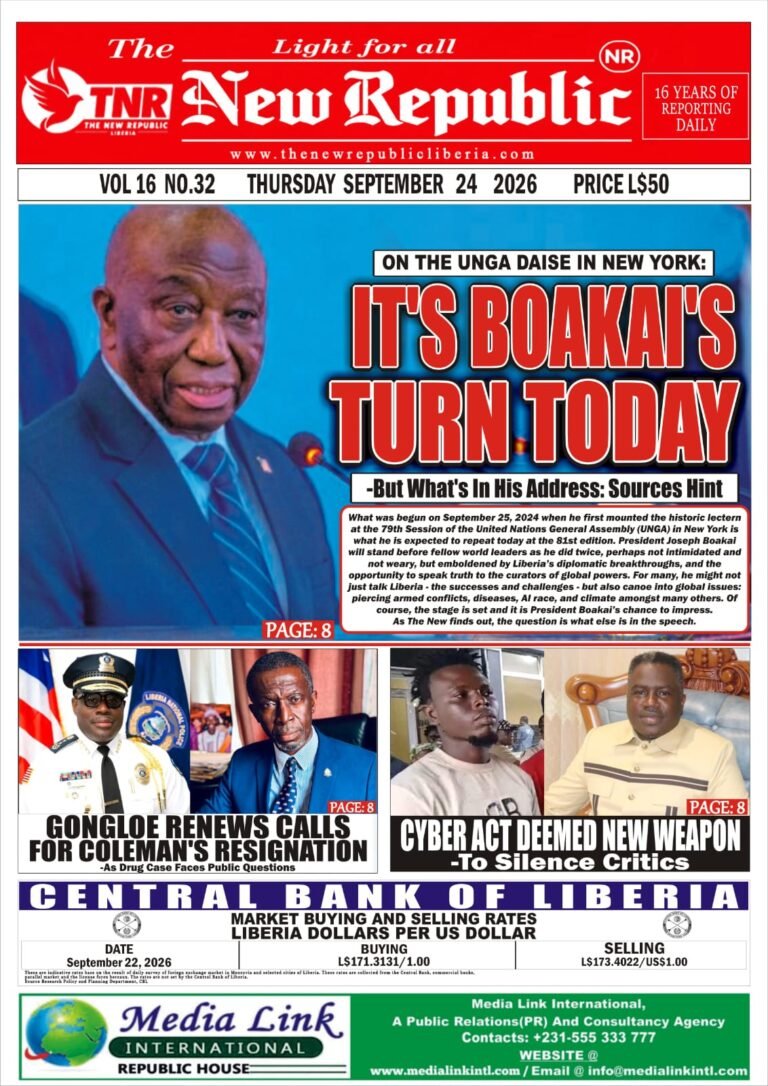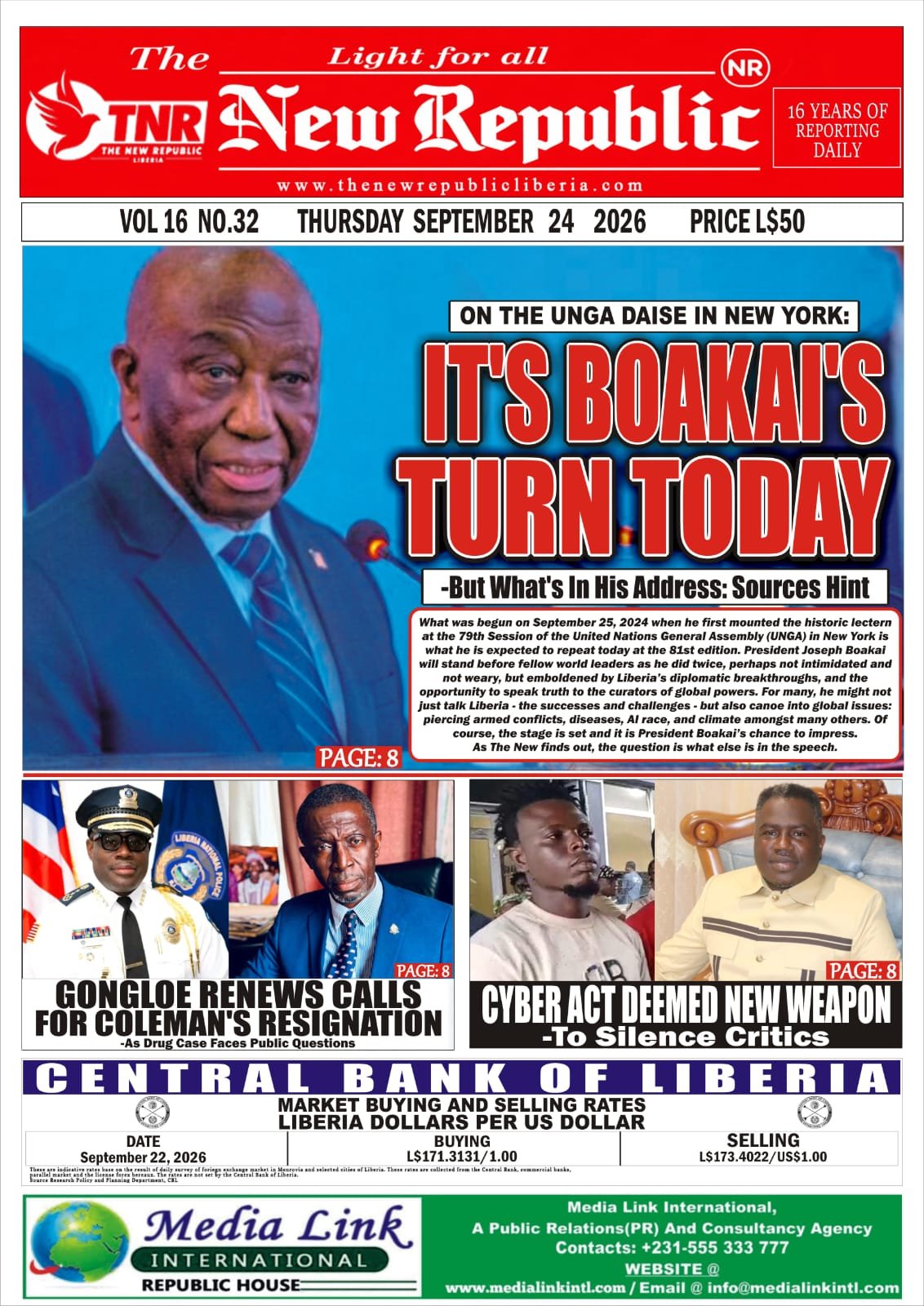
Monrovia-What was begun on September 25, 2024 when he first mounted the historic lectern at the 79th Session of the United Nations General Assembly (UNGA) in New York is what he is expected to repeat today at the 81st edition. President Joseph Boakai will stand before fellow world leaders as he did twice, perhaps not intimidated and not weary, but emboldened by Liberia’s diplomatic breakthroughs, and the opportunity to speak truth to the curators of global powers. For many, he might not just talk Liberia – the successes and challenges – but also canoe into global issues: piercing armed conflicts, diseases, AI race, and climate amongst many others. Of course, the stage is set and it is President Boakai’s chance to impress. As The New finds out, the question is what else is in the speech.
As more than 150 world leaders line up to mount the famous green marble dais of the United Nations General Assembly, all eyes in Liberia are on one moment as to what is in President Joseph Nyuma Boakai address, what has he to tell the world when it is Liberia’s turn.
Today’s address will be Boakai’s 3rd since he became President in January 2024, but his first as a sitting member of the UN Security Council, and perhaps his most consequential.
In markets, radio stations and WhatsApp groups back home, the question inundating the social and political space is simple is what is in Boakai’s address that will draw the world’s attention and spur necessary action, beyond the usual laundry list of local problems.
To understand what to expect, you must understand what he has said before, and how much Liberia has changed between speeches.
On September 25, 2024, an 79-year-old Boakai mounted the dais for the first time as President, eight months after defeating George Weah, and declared to the world “Liberia is back”.
That speech was an introduction, and the theme was rescue, coming on the back of an election that many feared would end in violence, but Boakai told the world Liberia had chosen democracy again.
He unveiled his domestic blueprint, the ARREST Agenda for Inclusive Development, which encapsulates Agriculture, Roads, Rule of Law, Education, Sanitation, and Tourism.
The president used the medium to appeal for international assistance as Liberia fight drugs which he labeled a national emergency, to fight climate change while protecting 43% of West Africa’s rainforest, and to support Liberia’s bid for a non-permanent seat on the Security Council for 2026-2027, 55 years after its last term.
Many saw the speech to be humble, hopeful, and heavily domestic, considering that the president asked for forgiveness of climate debt and investment in youth.
The world listened politely. Liberia was still a country on the UN agenda, not at the UN table.
By September 2025, Boakai returned a different man, and his second address was about credibility.
In between the two UNGAs, he had signed Executive Order 131 establishing the Office for the War and Economic Crimes Court (OWECC-L), a move his predecessor refused. He had ordered audits of the Central Bank, passed a tougher LACC act, and stabilized the economy. His 2025 speech therefore focused outward, formally presented Liberia’s Security Council candidacy, campaigning on Liberia’s unique story: from Security Council agenda item to Security Council member.
He reported progress on transitional justice, telling victims that Liberia would no longer run from its past, and also pushed for Security Council reform, demanding a permanent African seat. He warned about AI, drug trafficking through West Africa, and democratic reversals in the region.
In response to the speech, in June 2026, Liberia won the Security Council seat with 181 votes.
Now comes 2026, with many asking what is in the power speech this time around.
As President Boakai prepares to mount the dais in 2026, it is clear he is no longer asking to join the table, but sitting at it, as Liberia readies to preside over the Council in December.
Sources close to the drafting committee at the Ministry of Foreign Affairs say this third address will be fundamentally different, less about Liberia needing the world, and more about what Liberia offers the world.
According to them, five themes are expected to dominate, including Liberia will do with its December presidency.
According to delegation sources, he will announce that Liberia will make women, peace and security (WPS) a signature event of its presidency, launching the Peace Hut model as a global toolkit for localization.
Having launched NAP III on September 21 and PATHWAYS youth framework on September 18 on the sidelines of UNGA, he now takes those ideas to the main dais.
The issue that might form part of the address is transitional Justice, with specific reference “from promise to action.”
In 2024 he promised the War and Economic Crimes Court. In 2025 he said he established the office. In 2026, he must show movement.
Those with the president said he should be expected to announce progress in the search for a court statute, staffing of the Office, and call for international support, and to tie it to global accountability for conflict-related sexual violence.
The other issue that could be in today’s address has to do with the US$1 Billion revenue milestone.
Recall that for the first time in history, Liberia collected over US$1 billion in domestic revenue in August 2026, and President Boakai is expected to flaunt that, not as a show-off, but as proof that his rescue is working and that Liberia is ready for trade, not aid.
Also is that he will likely call for direct foreign investment in agriculture, energy and infrastructure, rather than traditional donor aid.
The speech is expected to take international dimension, looking at the issues of drugs, democracy and regional crisis in West Africa and other parts of the world; coups in the Sahel, drug trafficking through the Gulf of Guinea, and contested borders.
He could reflect on gains made in the fight against drugs, reporting on how Liberia recently seized 4.2 tons of cocaine and arrested high-profile figures, including former VP Jewel Howard Taylor.
Sources said President Boakai is expected to speak as a regional voice on transnational drug trafficking as a threat to peace, an issue he raised in 2024 but now has credentials to address as a Council member.
Expected to be focused are issues of youth, AI and climate change and the future agenda.
With 60% of Liberia’s population under 25, and with global anxiety about AI, Boakai is expected to connect the two. His PATHWAYS framework, which is a 10-year plan for youth, peace and security, will be presented as Liberia’s answer to youth unemployment and radicalization. On climate, he will repeat the call that countries that protect forests must be paid, not pitied.
Past Boakai addresses were about seeking validation, such as “accept us, help us, and vote for us. “This one, insiders say, is about offering value; “We have survived war because of women and youth. We have built a model that works. We can help the Council understand how to prevent conflict, not just react to it.”
“That is why his famous line from Sunday’s WPS launch is being whispered as the anchor for Thursday’s speech: “A seat is an opportunity, not an achievement.
“Whether that line moves from a side-event in Conference Room 5 to the main General Assembly Hall and captures the world’s attention in an era UN Secretary-General Guterres calls “an era of profound uncertainty” will depend on delivery.
But one thing is clear is that Boakai no longer mounts the dais as the old man rescuing a small country. He mounts it as the President of a country that now holds the gavel of global peace and security, at least for one month in December.
Liberians back home, tired of show-offs and empty talks at UNGA, will be listening not just for applause in New York, but for what returns to Monrovia.
About The Author