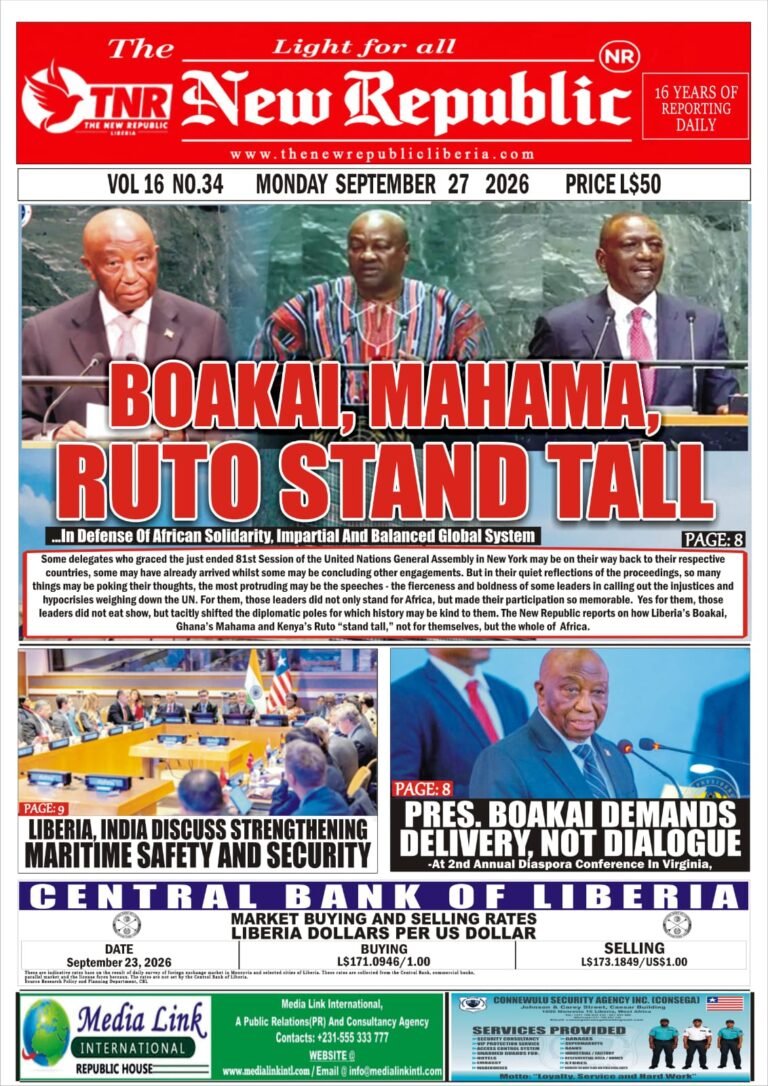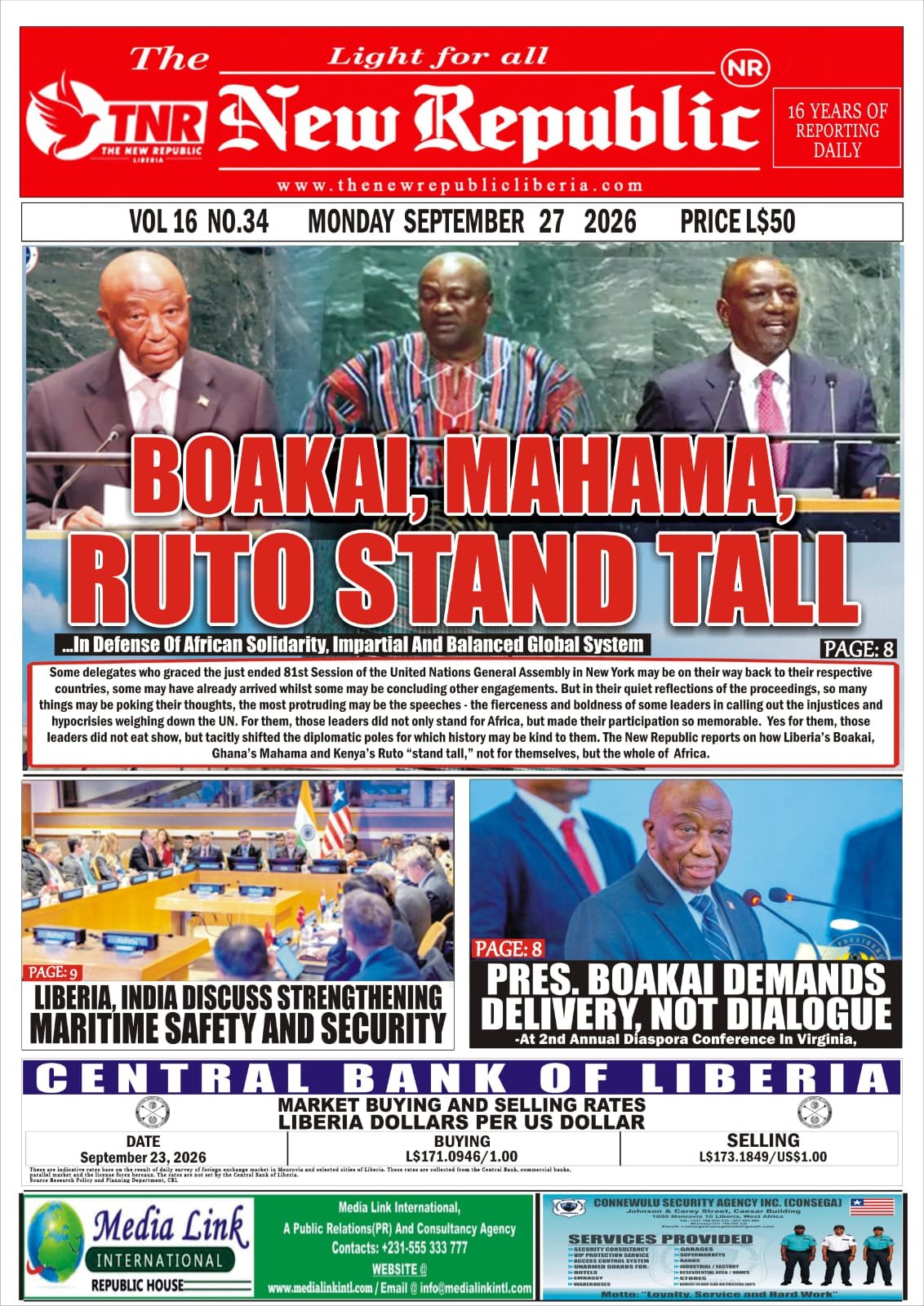
Monrovia-Some delegates who graced the just ended 81st Session of the United Nations General Assembly in New York may be on their way back to their respective countries, some may have already arrived whilst some may be concluding other engagements. But in their quiet reflections of the proceedings, so many things may be poking their thoughts, the most protruding may be the speeches – the fierceness and boldness of some leaders in calling out the injustices and hypocrisies weighing down the UN. For them, those leaders did not only stand for Africa, but made their participation so memorable. Yes for them, those leaders did not eat show, but tacitly shifted the diplomatic poles for which history may be kind to them. The New Republic reports on how Liberia’s Boakai, Ghana’s Mahama and Kenya’s Ruto “stand tall,” not for themselves, but the whole of Africa.

The 81st Session of the United Nations General Assembly may be over, but its impact, in terms of bold speeches delivered, will be recorded in history’s annals.
For once, African leaders did not come to New York to read diplomatic pleasantries, but stood tall, roared at the lopsided system, challenged the old order and the odds, and called out the injustices being meted out at the African Continent, the second largest continent after Asia.
Presidents Joseph Boakai of Liberia, John Dramani Mahama of Ghana, and William Ruto of Kenya did not elude or brush aside the most biting issues confronting Africa, and how the UN itself has lost its essence and place in the world.
From the green marble podium of the UN General Assembly Hall, the three leaders delivered what many delegates and analysts are calling the most fearless African interventions in years, speeches that unraveled global hypocrisy, demanded justice, and called for a complete overhaul of the international order.
First, President Joseph Nyuma Boakai set the tone for Africa’s moral argument. In a calm but piercing speech, the 81-year-old Liberian statesman defended multilateralism but warned that the UN Charter has become a document that member states praise but refuse to practice. “The charters of the UN are not irrelevant, but unaheld to,” Boakai said in a line that quickly went viral.
Boakai, who lived through Liberia’s two civil wars, used his country’s history as proof that the UN can work, but also as a warning of what happens when the world looks away.
His central message was simple and powerful: “Without peace, there is no development, and without development, peace is in danger.”
He called for an end to all conflicts, from Gaza to Sudan, from Ukraine to the Sahel, and demanded that big powers stop fueling proxy wars in Africa while preaching peace.
“Silence the guns, not with statements, but with sincerity,” he said.
If Boakai was the moral elder, Ghana’s President John Dramani Mahama was the firebrand economist. Returning to the UNGA stage after his re-election, Mahama delivered a blistering critique of the global financial architecture, calling it “a system designed to keep Africa poor.”
He blasted the IMF, World Bank, and credit rating agencies for what he called “economic injustice.”
“Africa does not need charity. Africa needs fairness. You cannot take $88 billion illegally from Africa every year through illicit financial flows and then come to give us $20 billion in aid and call yourself a donor,” Mahama said.
He demanded urgent debt cancellation and restructuring for African nations, noting that many African countries now spend more servicing debt than on health and education combined.
On democracy, Mahama was equally blunt. He condemned the wave of coups in West Africa but warned the West not to be selective.
“You cannot condemn coups in Africa when soldiers overthrow governments, but celebrate coups when constitutional order is overthrown through constitutional manipulation to stay in power forever,” he said.
His line — “Democracy must not be weaponized to serve foreign interests” — received a standing ovation from several African and Caribbean delegations.
Kenya’s President William Ruto, known for his outspoken reformist stance, went straight for the heart of the UN, the Security Council.
Ruto called the Security Council “broken, obsolete, undemocratic and unjust,” arguing that it no longer reflects the realities of a world of 8 billion people where Africa has 1.4 billion people but no permanent seat.
“How can a body tasked with maintaining world peace and security be so undemocratic? Africa, with 54 member states, has no veto, no permanent voice. This is apartheid in global governance,” Ruto thundered.
He renewed his call for Africa to have at least two permanent seats with veto power, and demanded serious climate justice.
Ruto reminded the world that Africa contributes less than 4% of global emissions but suffers the most from climate change, from devastating droughts in Kenya to floods in Libya and Liberia.
“You fly here in private jets to lecture us about climate change, while our people are dying from hunger caused by a crisis they did not create,” he said.
Ruto also defended Kenya’s peacekeeping mission in Haiti, saying Africa is ready to lead in global security if given equal respect.
Though different in style, the three leaders shared a common thread, demanded an immediate ceasefire in Gaza and Sudan, with Mahama describing the situation in Gaza as “a stain on humanity’s conscience.”
They also said the UN must reform or become irrelevant, particularly the Security Council, and rejected aid dependency and demanded fair trade, debt justice, and climate reparations.
Political analysts in New York said the 81st UNGA will be remembered as the session where Africa stopped asking politely and started demanding firmly.
“The days when African leaders came to read nice speeches written for donors are over. Boakai, Mahama and Ruto came to tell truth to power. They were bold, they were firm,” said a Liberian scholar at Columbia University who followed the debates.
As delegates left New York, the question now is whether the UN and powerful nations will listen, or whether these bold speeches will, like many before them, be filed away in the archives of the General Assembly, unaheld to.
About The Author