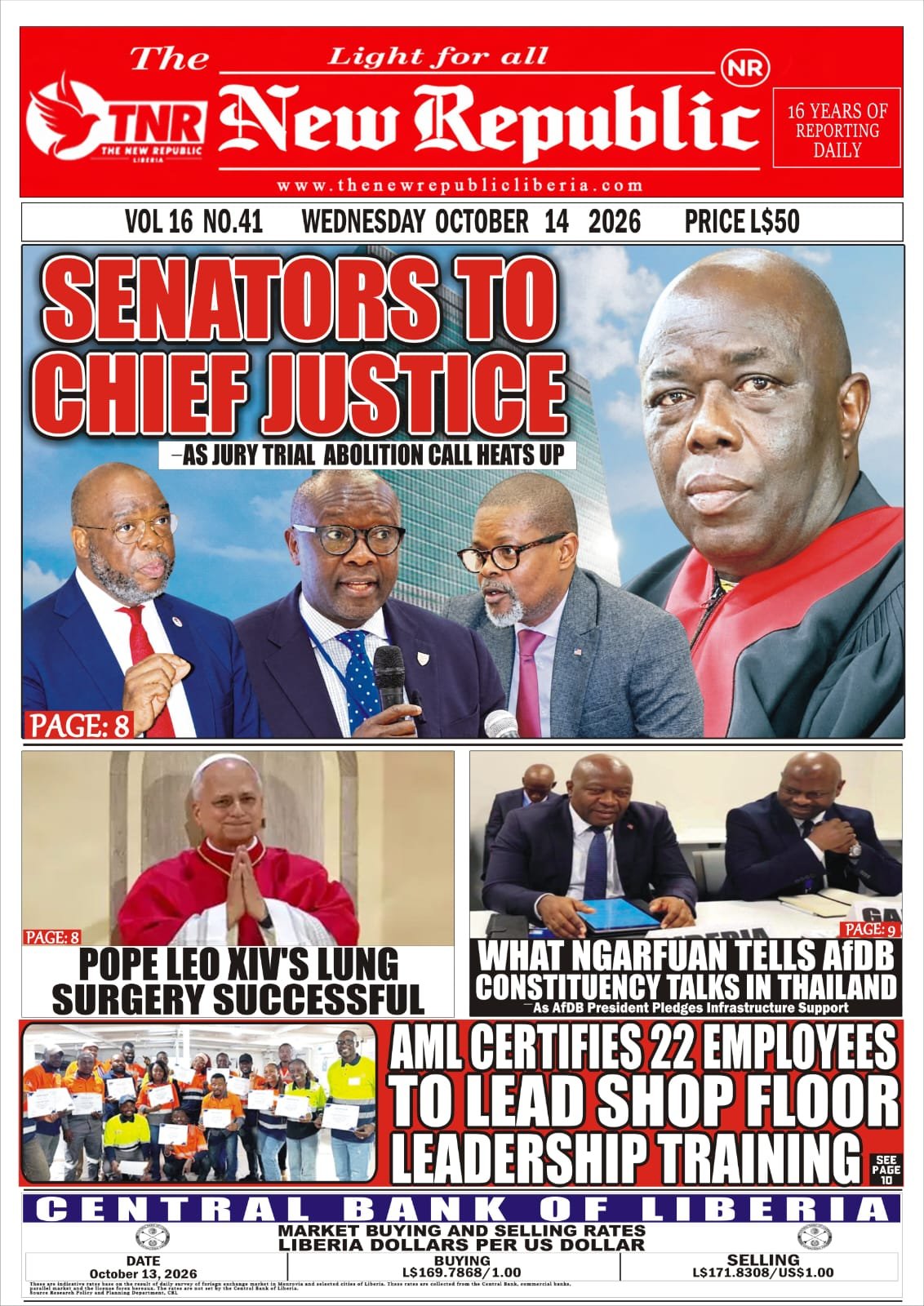
Monrovia-Several Senators have weighed in on the debate over the future of Liberia’s jury trial system, with Bomi County Senior Senator Edwin Melvin Snowe, Jr. adding his voice to a growing chorus of lawmakers responding to Chief Justice Yamie Quiqui Gbeisay, Sr.’s call to abolish jury trials.
In a detailed position statement issued Tuesday, Sen. Snowe referenced contributions from some of his colleagues, including Senators A. Darius Dillon, Sr., Amara Mohammed Konneh, and Nathaniel F. McGill on the matter that carries serious legal weight and implications.
“Let me state clearly for the record: I am not a lawyer. I am, however, one of the 103 members of the Legislature entrusted with the constitutional responsibility to make laws and sworn to uphold the Constitution,” Snowe said.
According to him, the Chief Justice’s proposal, made at the opening of the October Term of Court, was premised on allegations of widespread bribery, intimidation and misconduct that compromise jury verdicts and erode public confidence in the courts.
Snowe said he respects the Chief Justice’s determination to confront those challenges, but warned that Liberia must distinguish between the failure of individuals to discharge their duties honestly and the value of the constitutional right itself.
“My position is clear: Liberia should undertake comprehensive jury reform while preserving the protections guaranteed by our Constitution. Corruption demands investigation, accountability, and institutional repair. Its existence does not, by itself, justify withdrawing a fundamental right from the Liberian people,” Snowe declared.
The Senator anchored his argument in the Constitution, citing Article 20(a) which guarantees due process and the right to trial by jury, Article 21(h) which specifically protects the accused’s right to a speedy, public and impartial jury trial, and Article 2 which establishes constitutional supremacy over inconsistent laws and official actions.
Together, he argued, those provisions mean an ordinary statute or judicial directive cannot lawfully abolish constitutionally protected jury trials.
“There is an important distinction between an accused person voluntarily waiving a jury trial and the State removing that choice from everyone. An individual waiver exercises a constitutional option. General abolition would take away the underlying right,” he said.
Any removal of those guarantees, Snowe emphasized, must follow the amendment process under Article 91 approval by two-thirds of each House and ratification by two-thirds of registered voters in a referendum held no sooner than one year after legislative action, and Article 92 which requires publication and explanation of proposed amendments.
Snowe warned that abolition would not automatically end improper influence over verdicts. “If the problem is improper influence over verdicts, removing jurors does not automatically remove that influence. Judges, prosecutors, investigators, court personnel, and witnesses also require protection from bribery, intimidation, and political pressure. Transferring responsibility for determining the facts entirely to a judge could concentrate the efforts of those seeking to manipulate the outcome,” he said.
He cautioned against treating every acquittal as proof of jury corruption, citing as examples proceedings involving former Finance Minister Samuel Tweah and Abdullah Kamara, two completely different scenarios where verdicts must be distinguished from allegations of misconduct.
“An acquittal may reflect insufficient evidence, unreliable testimony, or a failure to establish guilt. Public frustration cannot become a substitute for proof, and political affiliation must never determine whose rights deserve protection,” he said.
Rather than scrapping the system, Snowe urged Liberia to strengthen what already exists, particularly the Office of Jury Management, established through 2013 legislation he said he proudly supported. Its responsibilities include jury selection, management of the central jury pool, and education of prospective and selected jurors.
“We should assess how effectively that institution is fulfilling its mandate, strengthen its capacity, and address weaknesses in its operations,” he said, adding that the Judiciary Law already prohibits jurors from accepting bribes and provides criminal penalties.
“Passing another law will achieve little unless the responsible institutions have the resources, independence, and commitment to enforce it.”
Sen. Snowe proposed that the Legislature, in consultation with the Judiciary and other relevant institutions, consider a comprehensive reform program, including auditable random selection and improved screening for conflicts and bias, while preserving fair challenge rights for both sides, timely payment of allowances, safe accommodation, transport and meals so citizens can serve without financial hardship, and clear reporting procedures for threats, sequestration arrangements, and controlled communications where justified.
Other points he considered also include investigating and prosecuting those who offer bribes or threaten jurors, as well as jurors who participate, with due process for all, practical orientation on evaluating evidence, confidentiality, and reporting misconduct, with clear judicial instructions, stronger evidence collection, witness protection and prosecution, and a costed implementation plan and periodic reporting to legislative committees on judiciary, appropriations and public accounts.
Snowe called for public hearings involving the Judiciary, Ministry of Justice, Liberian National Bar Association, jury administrators, civil society and citizens with jury experience to establish what is failing and what can be funded.
“The jury provides an important avenue for ordinary citizens to participate directly in the administration of justice. Preserving that role requires us to address its weaknesses and make it worthy of public confidence,” he said.
“The Legislature must also accept its own responsibility. We cannot demand stronger courts while overlooking the resources and laws needed to support them.”
He said he remains ready to work with the Chief Justice and colleagues on reforms that protect citizens, deter corruption and improve justice delivery.
“Liberia must demonstrate that it can enforce accountability while honoring its constitutional commitments. Let us protect the right, punish those who corrupt it, and give the system the support it needs to work,” Snowe concluded.
Earlier, Senator Dillon lashed at the Chief Justice proposal, arguing that the fundamental right to trial by jury is constitutionally instructive, as provided in the closing lines of Article 20 (a) of the 1986 Constitution of Liberia that “the parties SHALL have the RIGHT to TRIAL BY JURY”.
He noted that to “dissolve” or do away with this fundamental right guaranteed by the constitution will not require simply a “legislative action”; it will require a national referendum.
Dillon reminded the Chief Justice that his reason for suggesting “dissolution” of the fundamental right to “trial by jury” does not, in his view, present a strong case to even justify or warrant a referendum for said purpose.
“By suggesting that “jury-tampering” hurts the intent and purpose for “trial by jury”, for which you are seeking “dissolution” thereof, is simply exposing the weakness of our justice system and failure of the judiciary to decisively punish alleged doers of the act to serve as deterrent,” Dillion argued.
He added “We cannot simply seek to undo laws because of our failure to summon the courage to implement and enforce the laws. It is like deciding to burn an entire house down because a rat is annoyingly disturbing, instead of finding means to catch the rat and save the entire house.”
He made clear his disagreement with the Chief Justice suggestion to “dissolve” the fundamental right to “trial by jury”, as guaranteed by the 1986 Constitution.
Also responding to Chief Justice Yamie Quiqui Gbeisay, “Abolishing Jury Trial” call, Senator Amara Konneh of Gbarpolu theorizes the issue, saying “when the Chief Justice of the Republic speaks, the nation must listen carefully.
Konneh said he puts the crisis in the justice system at the center of the national conversation, where it belongs.
“Jury tampering and juror bribery undermine the justice system, lead to acquittals that defy the evidence, and erode public trust. The Chief Justice is right to demand a response. And, as a senator sworn to uphold the Constitution of this Republic, I must engage with this proposal honestly and with the seriousness it demands,” the Senator said.
But abolishing jury trials, he argued, is not the answer. “Before it is a policy question, it is a constitutional question,” he said. Citing Article 20(a) of Liberia’s 1986 Constitution, the Senator noted that every accused person is guaranteed the right to a speedy, public, and impartial trial by a jury of the vicinity.
Senator Konneh argued that “No legislative statute or judicial directive can remove that right. Doing so requires a constitutional amendment under Articles 91 and 92, a two-thirds vote of the Legislature, and ratification by the Liberian people through a national referendum. The people must consent to removing their own right. That is the point that the constitutional foundation must be respected.”
Beyond the constitutional hurdle, the Senator warned that abolition would treat the symptom while leaving the disease intact.”Removing juries from the courtroom would not remove corruption from the courtroom. It would not eliminate the possibility of a judge being bribed, intimidated, or politically pressured,” he argued.
“Concentrating all decision-making power in a single judicial officer creates a more efficient target for the very forces that now corrupt juries. Corruption follows power. Wherever verdicts are decided, corrupt actors will attempt to influence that process.”
The Senator is instead proposing comprehensive reform over outright abolition.
“The answer is reform, not abolition,” he said, outlining four key measures, including mandatory sequestration and anonymity for jurors in serious criminal cases, meaningful juror pay and protection so ordinary Liberians can serve without fear, prosecution of jury tampering as a standalone offense with mandatory custodial sentences, and a transparent, professionally managed jury selection system.
According to him, “These are not radical ideas. They are standard features of functioning justice systems that Liberia has not yet implemented.”
The Senator emphasized the democratic value of the jury system.”The jury is the only institution where ordinary Liberian citizens directly check the state’s power. In a country with a living memory of what unchecked power produces, we should strengthen that check, not eliminate it.”
The Senator said he has great respect for Chief Justice Gbeisay and understands his frustration, but invited the Chief Justice to work with the Legislature.
“I therefore invite him to bring a comprehensive Jury Reform Act to the Legislature. Let us hold public hearings. Let us fix the system together. If reform ultimately fails, the constitutional amendment process exists for exactly that reason. But abolition cannot be our first answer.”
Both Senators Edwin Melvin Snowe, Jr., Darius Dillon, Amara Konneh and Nathaniel McGill have all weighed in on the Chief Justice’s proposal, with a consensus emerging in the Senate that while jury corruption is real and must be confronted, any solution must respect the Constitution and strengthen, rather than eliminate, citizen participation in justice.
About The Author