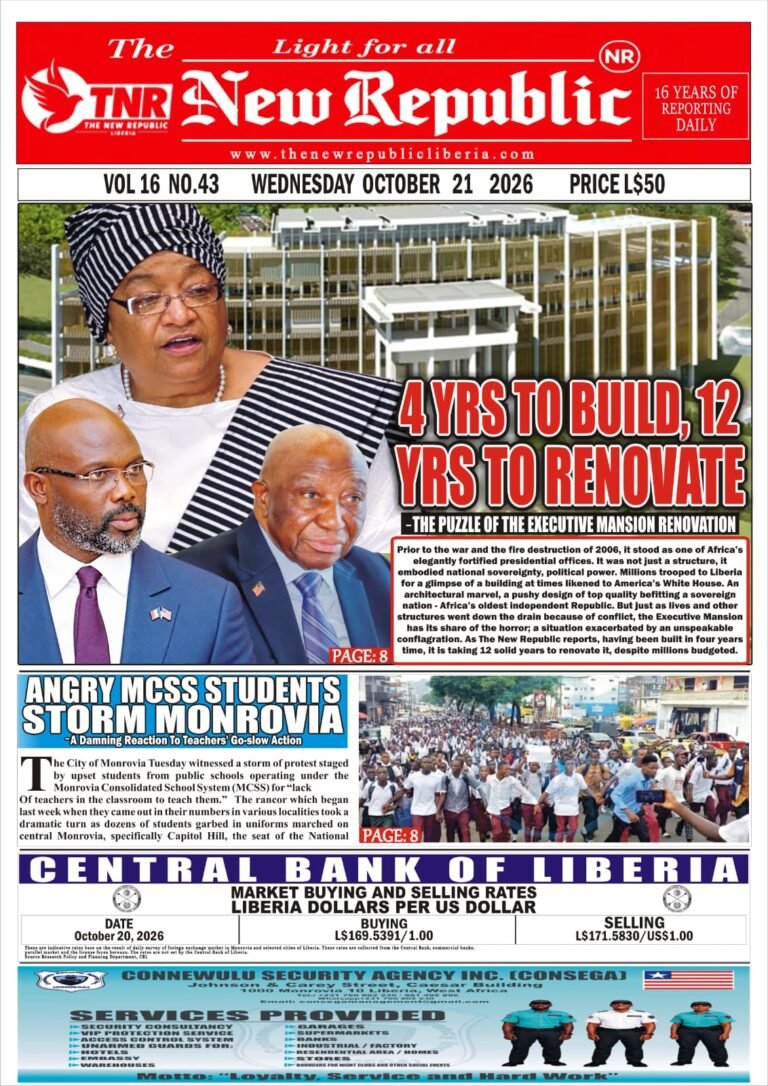

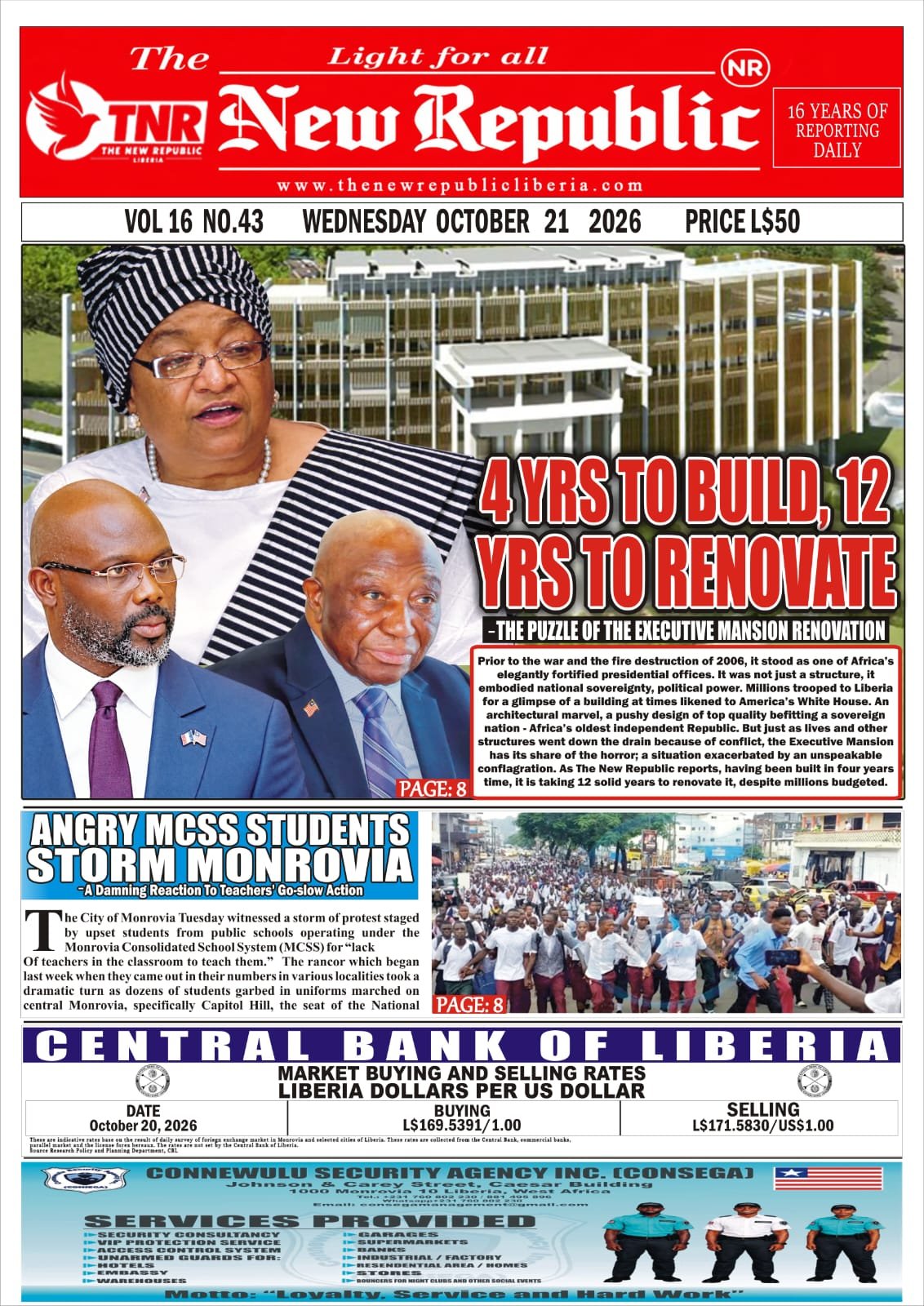
Monrovia-Prior to the war and the fire destruction of 2006, it stood as one of Africa’s elegantly fortified presidential offices. It was not just a structure, it embodied national sovereignty, political power. Millions trooped to Liberia for a glimpse of a building at times likened to America’s White House. An architectural marvel, a pushy design of top quality befitting a sovereign nation – Africa’s oldest independent Republic. But just as lives and other structures went down the drain because of conflict, the Executive Mansion has its share of the horror; a situation exacerbated by an unspeakable conflagration. As The New Republic reports, having been built in four years time, it is taking 12 solid years to renovate it, despite millions budgeted.

The status of the Executive Mansion, the official home and office of the President of the Republic of Liberia, remains a national puzzle, nearly two decades after fire gutted it, and after millions of dollars have been budgeted in successive fiscal budgets with little to show. The building constructed in the space of four years has gone more than 12 years to be where it was, and ought to be.
Under Presidents Ellen Johnson Sirleaf, George Manneh Weah, and now Joseph Nyuma Boakai, efforts to return the national seat of power to its antebellum glory have remained far-fetched.
The Mansion still stands largely as a symbol of unfulfilled promises, fenced, partially renovated, heavily guarded, but not fully up to standard.
Much more puzzling, if not overly concerning, is the fact that millions of dollars were appropriated in past budgets for its renovation but to no avail, though the appropriated amounts were reportedly exhausted, not for the intended purposes.
The Executive Mansion was gutted by fire on July 26, 2006, on the day of Liberia’s Independence Day, during the early months of President Ellen Johnson Sirleaf’s first term.
Then president Sirleaf and her guests, including then Ghanaian president John Kuffour, where whisked out emergency exits, putting the planned dinner on the 5th Floor in jeopardy.
The fire, which started on the fourth floor that houses the office of the President, ravaged key sections of the eight-storey structure.
Official investigations later singled out electrical fault as the cause, though the circumstances remain ambiguous to many Liberians who witnessed the chaotic afternoon when firefighters, EPS officers struggled to contain the blaze.
Those with historical knowledge told this paper, it was not the first time the Mansion had seen trouble. According to them, the building built in 1964 under President William V.S. Tubman, has survived coups, war, and looting.
But the 2006 fire was the most devastating in peacetime, forcing President Sirleaf to run the presidency from her Foreign Ministry office, a makeshift arrangement that continued up to 2022 under President Weah.
The Sirleaf government promised to restore the national structure and budgeted millions of dollars year after year. Between 2007 and 2017, appropriations for the Mansion’s renovation ran into more than US $10 million according to legislative budget reports, yet no comprehensive rehabilitation was completed.
According to reports from the Ministry of Public Works and the General Services Agency (GSA) at the time, the building, during those years of abandonment, suffered additional damages and the pillage of some of its security-proof materials, including copper wiring, bullet-proof fixtures, and elevator components.
Critics say the funds were diverted, reallocated, or simply unaccounted for through questionable contract arrangements and cost overruns.
Under former President George Manneh Weah, the story repeated itself. President Weah, upon taking office in 2018, vowed to return to the Mansion, declaring that “the President belongs in the Mansion.”
His government appropriated another US $6-8 million across multiple budgets, awarded new contracts to Chinese and Lebanese firms, and even held a few cabinet meetings in partially completed wings.
The full renovation never materialized, but Weah moved to the Executive Mansion in 2022, and conducted the affairs of state until the end of his six-year term in January 2024.
Appearing for confirmation sometimes ago, Minister of State for Presidential Affairs, Sam Stevequioh said complete renovation of the building would be his utmost priority.
He promised to ensure the building is restored to its original place as symbol of national dignity, a building befitting the presidency of the Republic.
Few months in the administration, Executive Mansion reporters were taken on a guarded tour of the building, from first floor to the eight floor with the aim of providing a clear picture of its physical outlook and the Weah’s administration’s work.
EPS officers and other employees with deep knowledge of the giant architecture took the curious reporters from floor to floor, showing them some remarkable offices and areas things happened before the war, where and what was renovated and what remains.
Analysts said taking journalists on the such mission was intended to expose the Weah government’s claim of full-fledged renovation of the building when, in fact, additional four floors had not been touched.
During the tour, those who made the tour reported that the renovation only covered first and fourth floors, while fifth and eight floors remained untouched and badly damaged.
But now under almost three years of the Boakai Presidency, the puzzle still continues, and the promises yet to be materialized.
The 2024 and 2025 national budgets again earmarked millions for “Executive Mansion Renovation and Security Upgrades,” yet construction pace remains sluggish, with scaffolding and unfinished interiors still visible.
The question every Liberian is asking is simple is where did the money go.
There are reports that under Madam Sirleaf, at least US $4.5 million was allegedly spent on architectural designs, feasibility studies, and emergency stabilization, but no main contractor ever finished the job.
The same under Weah where the government reported spending over US $5 million on electrical rewiring, interior furnishings, and the installation of a new elevator, but a 2022 General Auditing Commission (GAC) report flagged irregularities in procurement and lack of supporting vouchers.
And now under Boakai, the Ministry of State for Presidential Affairs says work is “95% complete,” a claim that has been made by three successive administrations.
Lawmakers in the House and Senate have repeatedly summoned Ministers of State and Public Works officials to account, but no comprehensive public audit of all Mansion expenditures from 2006 to date has ever been published.
Beyond the financial impropriety, the unrenovated Executive Mansion has become a symbol of state weakness.In every major country, the seat of the presidency is a symbol of sovereignty and continuity.
Now, the President runs the affairs of state from the uncompleted structure with limited protocol space, leaking roofs, and congested corridors.
The Executive Mansion, meant to embody the dignity of the Republic, only represents half of its purpose.
Security experts also warn that the continued abandonment exposes sensitive national security installations to decay and looting.
Today, Liberians drive past the Executive Mansion on Capitol Hill and see a building that lights up at night but remains empty of presidential presence because presidents only go to work and return to their respective homes.
For the ordinary citizen struggling to pay rent in Clara Town or find electricity in Barchue Town, the story of the Mansion is familiar, millions budgeted, millions spent, nothing to show, and no one held accountable.
Until there is a full, independent forensic audit of all funds allocated for the Executive Mansion since July 26, 2006, and until a government finally musters the political will to complete it, the Mansion will remain what it has been for 19 years, a national puzzle dangling on Capitol Hill, waiting for a President to truly come home.
About The Author