By Stephanie M. Duncan
ANJI COUNTY, Zhejiang Province, China — A delegation of 23 Liberian media practitioners is examining how China has integrated environmental protection, technological innovation, rural development and cultural preservation into its economic growth strategy during a series of field visits to Zhejiang Province.
The visits form part of the Seminar on Media Communication Capacity Building for Liberian Journalists, a 14-day training program sponsored by the Government of China and organized by the Research and Training Institute of the National Radio and Television Administration (NRTA).
The seminar, which opened in Beijing on October 14, 2026, will conclude on October 27, bringing together classroom instruction and practical field studies designed to expose Liberian journalists to China’s approaches to media development, digital governance, ecological sustainability and international communication.
In Anji County, the delegation visited several development projects illustrating how local authorities have sought to reconcile economic growth with environmental protection, while creating new opportunities for communities through tourism, agricultural branding, manufacturing and digital technology.
One of the most significant stops was Yucun Village, internationally recognized for its transformation from an industrial mining community into a destination for ecological tourism.
Between 2003 and 2005, local authorities shut down limestone mines and cement factories that had contributed to environmental degradation, choosing ecological restoration over continued dependence on polluting industries.
The decision marked a turning point in the village’s development, as authorities sought to rebuild the local economy around its natural environment rather than continue activities that threatened its long-term sustainability.
During the visit, the delegation learned how the village’s experience reflected a broader development philosophy: economic prosperity should not come at the expense of the environment.
The approach is closely associated with Chinese President Xi Jinping’s concept that “lucid waters and lush mountains are invaluable assets,” which he articulated during a visit to Yucun in August 2005 while serving as Zhejiang’s provincial Party secretary.
The concept emphasizes that environmental resources can serve as economic assets when properly protected and developed.
Yucun’s transformation demonstrates how ecological conservation can support tourism, create employment and improve residents’ quality of life. The village has since gained international recognition for its tourism development, including recognition under the United Nations World Tourism Organization’s Best Tourism Villages initiative.
For the visiting journalists, the experience offered an opportunity to examine how environmental policies can influence local economic planning and reshape communities previously dependent on extractive industries.
The delegation also visited the Anji Exhibition Center, where local manufacturers are developing bamboo-based products as alternatives to conventional plastics and other materials.
Bamboo, a rapidly renewable natural resource, is being used to manufacture products that can replace selected single-use plastic items, as well as materials traditionally made from wood and textiles derived from other sources.
The initiative reflects China’s efforts to reduce plastic pollution while creating commercial opportunities through sustainable manufacturing.
Conventional plastics can persist in the environment for decades or centuries, depending on their composition and disposal conditions. Bamboo products, particularly those designed to be biodegradable, offer an alternative in applications where their properties and disposal requirements make them suitable replacements.
However, the environmental benefits depend on how the products are manufactured, treated and disposed of, as not every bamboo-based product is automatically biodegradable.
The delegation’s visit highlighted how the development of bamboo industries can connect environmental protection with industrial innovation, agricultural production and employment.
Anji County is also associated with the development of Anji white tea, a regional agricultural product whose branding and cultural identity have helped strengthen the area’s economic profile.
Through agricultural branding, creative industries and tourism, the county has sought to build an economy that derives value not only from raw materials but also from the quality, identity and market appeal of local products.
The journalists further visited Dazhuyuan Village, known for its bamboo forests, to observe the role of bamboo resources in rural development and the promotion of environmentally conscious industries.
The visits illustrated how natural resources, when managed sustainably, can become part of a broader strategy to improve livelihoods and support rural revitalization.
Another major stop was the Anji Smart Governance Center, a digital command facility established in 2020 following an investment reported at approximately 2.2 billion yuan.
The center uses digital systems to support the coordination of municipal services, including urban parking, public transportation, healthcare, elderly care and agricultural information management.
By bringing information from different service areas into a centralized platform, the system is designed to help authorities monitor public needs, coordinate responses and improve administrative efficiency.
The visit offered the Liberian journalists an opportunity to observe how digital technology is being applied beyond traditional communication platforms to the management of public services.
For countries seeking to strengthen public administration, such systems also raise important questions about infrastructure costs, data management, digital inclusion and the capacity of public institutions to maintain and effectively use technology.
The delegation’s program also included visits to the Anji White Tea Cultural and Creative Complex and the Creative and Design Center, where rural development intersects with contemporary design, entrepreneurship and cultural branding.
The modern facility has received international design recognition, including a Red Dot award, and illustrates efforts to position rural communities as places for innovation and creative enterprise rather than limiting their economic role to agriculture.
By combining local identity with modern design, the initiative seeks to attract creative professionals, encourage entrepreneurship and expand economic opportunities beyond major urban centers.
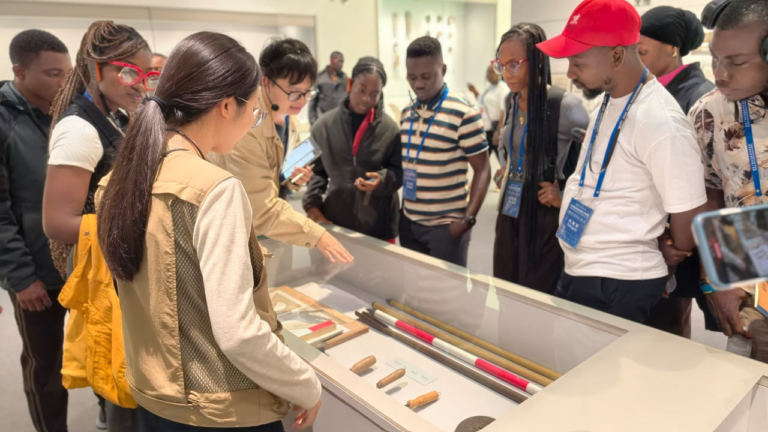
The journalists also explored the region’s historical foundations during a visit to the Ancient Yue Cultural Site, an archaeological area that provides insight into the development of early settlements and administrative institutions in Zhejiang.
The site features a burial complex covering approximately 30,000 square meters, with 571 excavated artifacts, offering evidence of the area’s historical significance.
Exhibitions trace human settlement in the wider Tianmu Lake and Taihu Lake basins to prehistoric times, while archaeological discoveries provide evidence of communities that developed along the Tiaoxi River valley over thousands of years.
Among the sites highlighted in the exhibitions is Shangmakan, recognized for its significance in the study of early stone culture in Zhejiang. Other discoveries, including ancient tombs associated with the Shang and Western Zhou periods, provide evidence of the region’s historical settlement patterns and cultural development.
During the Spring and Autumn period, the area was connected to the political history of the Yue state. Subsequent changes in regional power and China’s unification under the Qin Dynasty contributed to the evolution of administrative structures across the region.
The site’s historical interpretation also examines the origins of the name Anji, which is associated with a phrase from the Chinese classic Book of Songs conveying the idea of peace and good fortune.
The archaeological displays emphasize the importance of material evidence in reconstructing history, particularly periods for which written records are limited or unavailable.
Through the examination of artifacts, burial sites and ancient settlements, archaeology provides additional evidence of how communities lived, interacted with their environment and developed social and political institutions.
For the visiting journalists, the experience demonstrated how historical preservation can contribute to education, cultural identity and tourism while strengthening public understanding of a region’s past.
The Zhejiang field visits are part of a broader training program that began with classroom sessions in Beijing, where Chinese academics and media professionals introduced participants to China’s media landscape, communication strategies and approaches to digital transformation.
Gao Xi, Chief Editor of the NRTA’s Research and Training Institute, officially opened the seminar during a ceremony in Beijing.
The academic sessions included a presentation by Chang Jin, Second-Level Counselor in the NRTA’s Department of International Cooperation, who discussed China’s broadcasting system, the regulatory responsibilities of the NRTA and developments in the country’s political and administrative structures.
Other lecturers included Professor Zhang Yanqiu of the Communication University of China, Professor Ran Jijun of China Foreign Affairs University, and Associate Professor Zhang Weiwei of the University of Chinese Academy of Social Sciences.
Their sessions addressed China’s modernization, international communication, news reporting, constructive journalism, digital media literacy and strategies for countering misinformation.
The curriculum also featured contributions from Li Yu, Division Chief at China Media Group’s International Communication Planning Bureau, and former Chinese Ambassador to Gabon Sun Jiwen.
Beyond classroom discussions, the program included visits to prominent sites in Beijing, including the National Stadium, popularly known as the Bird’s Nest, as part of efforts to expose participants to China’s infrastructure and development initiatives.
The delegation’s Zhejiang itinerary continued on Wednesday, October 21, with scheduled visits to the Former Residence of Wu Changshuo and the Huangpu River Source Resort in the morning, followed by a visit to Lenashigu International Stone Art Village in the afternoon.
The journalists are expected to return to Beijing on Thursday, October 22, for further activities, including case studies on media cooperation, ahead of the seminar’s closing ceremony on October 27.
The training builds on the NRTA Research and Training Institute’s record of conducting international programs for media professionals and government officials from developing countries. According to figures provided in the seminar background, the institute had organized 253 government-sponsored international training programs since 2005, with more than 6,740 participants from 163 developing countries completing training by late 2024.
For Liberia, the program provides an opportunity to examine international experiences in media communication, technological development and public information management that may inform future professional practices and national development discussions.
Liberia and China established diplomatic relations in 1977, and cooperation between the two countries has since extended across several sectors.
As the seminar progresses, the delegation’s field studies offer a practical perspective on how development policies are implemented at the local level, from the restoration of an environmentally damaged village to the application of digital technology in public administration and the preservation of cultural heritage.
The experiences also present questions relevant to Liberia’s own development priorities: how natural resources can be managed sustainably, how local products can gain greater economic value, and how technology and cultural preservation can contribute to improved livelihoods.
The central lesson emerging from the Zhejiang visits is that development involves choices about how resources are used, how communities grow and how economic progress is measured. China’s experience in Anji illustrates one approach in which environmental protection, innovation and local identity are treated as important elements of long-term prosperity.
About The Author