By Stephanie M. Duncan
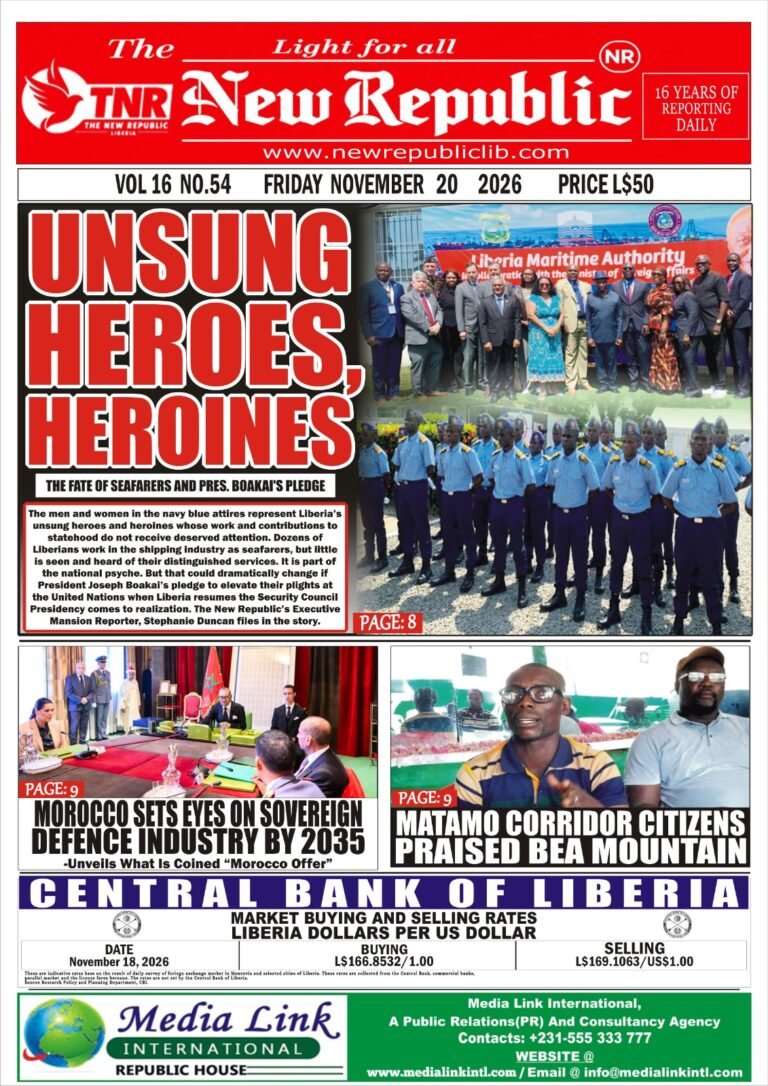
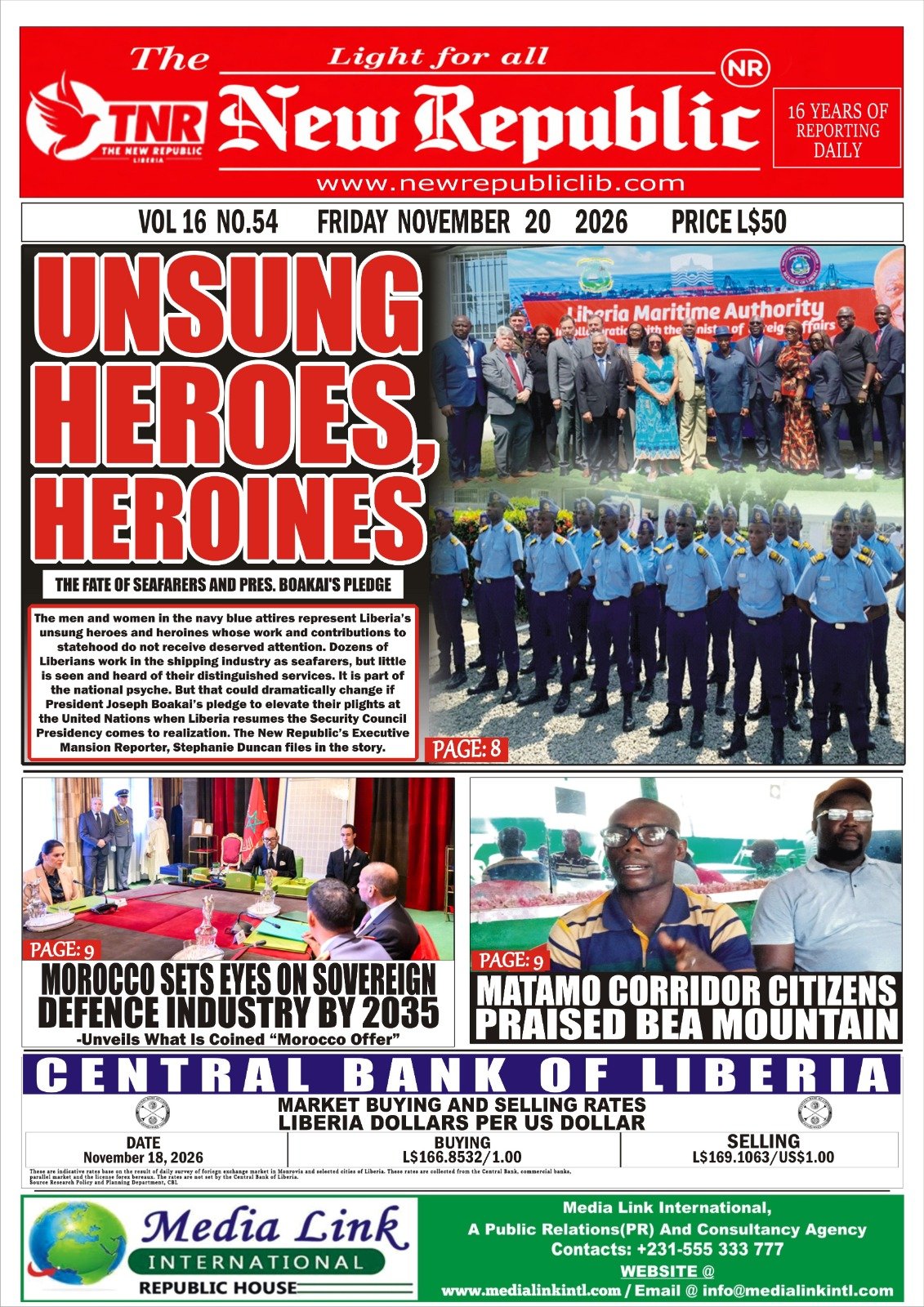
Monrovia-The men and women in the navy blue attires represent Liberia’s unsung heroes and heroines whose work and contributions to statehood do not receive deserved attention. Dozens of Liberians work in the shipping industry as seafarers, but little is seen and heard of their distinguished services. It is part of the national psyche. But that could dramatically change if President Joseph Boakai’s pledge to elevate their plights at the United Nations when Liberia resumes the Security Council Presidency comes to realization. The New Republic’s Executive Mansion Reporter, Stephanie Duncan files in the story.
The fate of Liberian seafarers depends on what happens in the ensuing months when Liberia takes over the Presidency of the United Nations Security Council, a monumental opportunity it intends to utilize to push for reordering and resetting lots of national and international issues.
Exactly, this is what President Joseph Nyuma Boakai pledge to use Liberia’s upcoming presidency of the United Nations Security Council in December to push for stronger international protection of civilian seafarers affected by armed conflicts portends.
The president warned that growing threats to commercial shipping pose serious risks to global peace, security and economic stability.
According to information available to this paper, Liberia is no longer second, but now the world’s largest ship registry. Liberia overtook Panama in 2023 after Panama had held the top spot for 30 years. By September 1, 2026, Liberia had extended its lead to 317.4 million gross tons, according to Clarksons Research data.
The latest top three by tonnage are Liberia, 317.4m gt, Marshall Islands, 212.7m gt and Panama, 196m gt.
Panama still has more ships by count, 7,516 vessels, versus 6,167 for Liberia, but Liberia carries far more tonnage, meaning its fleet is made up of larger ships like tankers, bulk carriers and container ships.
Despite its strategic placement, not much of Liberian seafarers are seen on board vessels plying international sea routes.
Perhaps this is why the Liberian government wants to place premium on issues affecting the wellbeing of seafarers.
On November 19, 2026, at the Marshall High-Level Dialogue on Global Maritime Safety, Security and the Welfare of Seafarers, held at the Liberia Maritime Training Institute in Marshall, Margibi County, President Boakai said Liberia would place the protection of civilian seafarers at the center of international discussions during its presidency of the Security Council.
The dialogue, organized by the Liberia Maritime Authority in collaboration with the Ministry of Foreign Affairs, also marked the official inauguration of Liberia Maritime Week, an annual national event intended to celebrate the country’s maritime heritage, promote investment and strengthen the maritime sector.
President Boakai emphasized that Liberia’s historical and economic relationship with the ocean places the country in a unique position to advocate for maritime safety and the protection of those working at sea.
He noted that Liberia has maintained a strong presence in the global maritime industry for decades and currently operates the world’s largest maritime registry by tonnage, with more than 300 million gross tons of shipping.
According to the President, this position comes with significant responsibility, particularly in ensuring that vessels flying the Liberian flag meet international safety and security standards and that the welfare of their crews is protected.
“Our flag is not just a business. With a ship that flies the Liberian flag, it carries our name, our pride. The people on board, in a real sense, they are under our care,” he said.
The Liberian leader expressed concern over increasing threats to maritime activities, including armed conflicts, piracy, transnational criminal networks, illegal fishing, drug trafficking and cyberattacks targeting ships and port infrastructure.
He warned that these threats extend beyond the maritime industry, affecting national security, international trade, food supplies and the livelihoods of people who depend on the ocean.
President Boakai particularly highlighted the dangers confronting civilian seafarers in conflict-affected regions, stressing that merchant ship crews are ordinary workers who should never become casualties of wars and conflicts in which they have no involvement.
He said cooks, engineers, deck officers and captains aboard commercial vessels should be able to perform their duties without the fear of missile attacks, piracy or other forms of violence.
“All parties to armed conflict must respect and protect civilian seafarers in accordance with applicable international humanitarian laws,” President Boakai declared.
He maintained that the world’s oceans should serve as channels for peace, cooperation and prosperity rather than become theatres of conflict and insecurity.
The President further disclosed that Liberia would convene a high-level open debate at the United Nations Security Council on protecting civilian seafarers affected by armed conflict.
He said the initiative would seek stronger international cooperation to address the challenges confronting seafarers, including medical evacuation, crew changes and repatriation, while ensuring respect for existing international legal obligations.
President Boakai also underscored the importance of cooperation between the United Nations Security Council, the International Maritime Organization and the International Labour Organization in strengthening maritime safety and protecting the welfare of seafarers.
He recalled Liberia’s difficult history when the country was once on the Security Council’s agenda because of its internal crisis and benefited from international assistance and United Nations peacekeeping operations.
However, he said Liberia’s election to the Security Council for the 2026–2027 term, its first in more than six decades, represents an opportunity to contribute meaningfully to international peace and security.
The President assured that Liberia would approach its December presidency through constructive dialogue, unity and cooperation with other members of the Council.
Meanwhile, the head of the Liberia Maritime Authority, Neto Zarzar Lighe Sr., said the dialogue was organized to bring together diplomats, maritime regulators, security experts and international partners to address growing threats to global shipping and the welfare of seafarers.
Lighe described maritime transportation as a critical component of the global economic system, noting that nearly everything people use, including fuel, food and electronic devices, travels part of its journey by sea.
He said seafarers remain the unseen workforce behind international shipping but increasingly face dangerous conditions in some of the world’s most troubled maritime routes, including the Black Sea, Red Sea, Strait of Hormuz, Gulf of Guinea and Gulf of Aden.
Citing reports from the International Maritime Organization, Lighe disclosed that the escalation of hostilities in the Gulf region on February 28, 2026, had resulted in approximately 100 attacks or attempted attacks on commercial vessels, with at least 25 seafarers killed.
He added that the United Nations had estimated that approximately 6,000 seafarers remained trapped in conflict-affected areas.
Lighe stressed that behind the statistics are families, parents and young maritime professionals whose lives are placed at risk while carrying out legitimate commercial duties.
He called for stronger international cooperation and practical recommendations to safeguard shipping routes and ensure that seafarers are protected from attacks and other threats.
The maritime authority head also used the occasion to highlight Liberia’s efforts to strengthen its maritime workforce through education, professional training and international partnerships.
He disclosed that the Liberia Maritime Training Institute is expected to graduate newly trained cadets in January 2027, with the ceremony also expected to dedicate new buildings and a dormitory aimed at expanding the institution’s enrollment capacity.
He further revealed that the Liberia Maritime Authority had increased scholarship opportunities for young Liberians pursuing studies in nautical science, marine engineering, electrical engineering, international maritime law and sustainable ocean governance at maritime institutions around the world.
Additionally, he announced that a team of 20 Liberians was being sent to the People’s Republic of China to undergo training in port state control procedures and ship inspections at Shanghai Maritime University.
The participants are drawn from the Liberia Immigration Service, Liberia Revenue Authority, National Port Authority and Liberia National Coast Guard.
According to Lighe, the training is intended to strengthen Liberia’s capacity to identify and eliminate substandard vessels calling at its seaports.
He said the initiatives form part of the authority’s broader strategy to transform the country’s maritime sector and develop a skilled workforce capable of contributing to economic growth.
Also speaking at the event, Acting Minister of Justice Betty M. Lamin-Blamo called for stronger collaboration between maritime security institutions and the justice system to ensure that perpetrators of maritime crimes are investigated and prosecuted.
She argued that maritime security cannot be sustained through patrols and vessel interceptions alone, stressing that effective law enforcement requires the ability to preserve evidence, investigate offenses and ensure successful prosecution.
According to Lamin-Blamo, intercepting vessels involved in drug trafficking, illegal fishing or piracy represents only one stage in the fight against maritime crime.
She warned that criminal networks would continue operating if investigations were inadequate, evidence was improperly handled or cases failed to result in successful prosecution.
The Acting Justice Minister called for improvements across the justice chain, from detection and interdiction at sea to investigation, prosecution and adjudication in the courts.
She also emphasized that efforts to combat maritime crime must not undermine the fundamental rights and dignity of innocent seafarers.
Lamin-Blamo said seafarers must not be subjected to arbitrary detention, intimidation, discrimination or other forms of abuse during maritime law enforcement operations.
She urged stronger coordination among the Coast Guard, maritime regulators, law enforcement agencies, investigators, prosecutors and the judiciary, alongside improved intelligence sharing and standardized procedures for collecting and preserving evidence.
The Acting Minister identified drug trafficking, human trafficking, illegal fishing, piracy and other forms of transnational organized crime as major challenges requiring coordinated national, regional and international responses.
She maintained that the success of maritime security efforts should not be measured only by the number of vessels intercepted or patrols conducted, but by the ability to prevent maritime crimes, dismantle criminal networks and ensure accountability under the law.
The Marshall High-Level Dialogue brought together government officials, diplomatic representatives, maritime professionals, security experts and international partners to discuss strategies for strengthening global maritime safety, security and the welfare of seafarers.
The inauguration of Liberia Maritime Week is expected to establish an annual platform for promoting the country’s maritime heritage, attracting investment, encouraging innovation and building partnerships to advance the development of Liberia’s maritime industry
About The Author