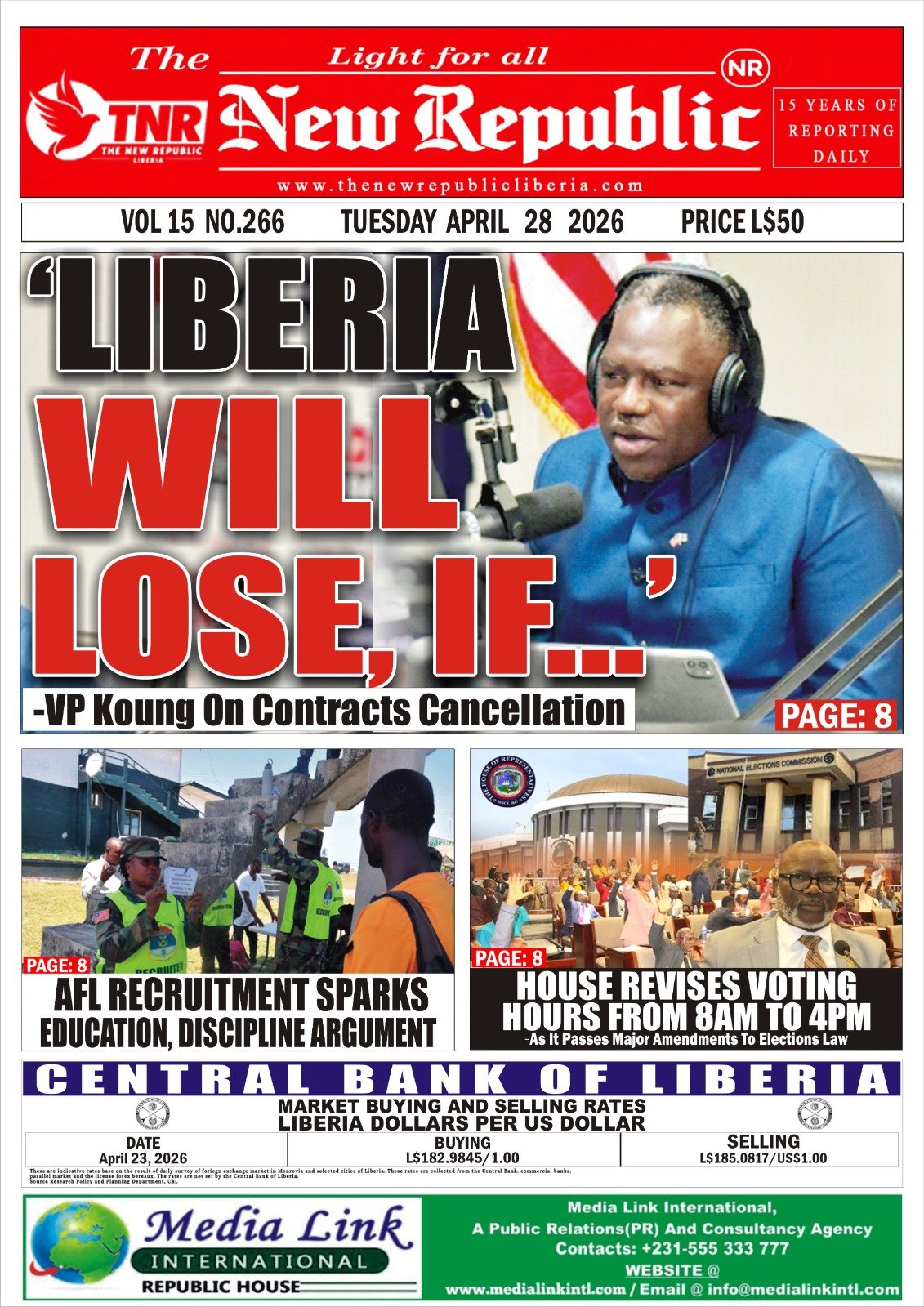
Vice President, Jeremiah Kpan-Koung has made it clear that Liberia stands to lose its integrity, and could be deemed unreliable if it were to cancel contractual agreements signed with foreign and local companies operating in the country.
Several companies with which government signed agreements are under the radar due to what officials considered “irregularities” in those agreements.
President Joseph Boakai last year issued an Executive Order, ordering the cancellation of the TIA/LTA deal. The President’s calls sparked debate and provoked legality concerns.
Despite a Joint Legislative Committee’s recommendation for renegotiation of the contract, the President does not seem settle on the matter.
There are reports that the government is considering hiring another company to take over the same role TIA supposed to play as per its contract.
However, during his first live radio appearance Monday, VP Koung did not mince words spelling out what could happen should the government backtrack on agreements.
Weighing in strongly on contractual agreements with companies, he said Liberia is obliged to have these deals in place because anything contrary will have negative impact, and will scare investors, as doing so would put the country in an awkward position of being unreliable.
However, addressing CTM and ‘Medtech Scientific’ Deals that have long engendered national debate, VP Koung said he’s moving “with the speed I am moving with” to fix problematic port and customs contracts because he knows the terrain — and because Liberia’s reputation with investors is at stake.
“That is my area; I told people I am an entrepreneur. God blessed me I am here; and as sooner it finishes, I will go right back because that somewhere I got passion for,” Koung said in remarks that have since circulated among policymakers and the business community.
“If I done fix it and I go back there, my friends will tell me ‘my man you were there you did not help us with the thing, and you come back here with the same thing again.’ Then, I will be taking to somebody else, and that is why I am moving with the speed I am moving with.”
He added: “With the President support and instruction, unless the president slows me because he is the only that can slow me down.”
The comments were made as Koung addressed mounting concerns over two controversial operations at Liberia’s ports: CTM, which handles the Cargo Tracking Note system, and Medtech Scientific, the firm contracted for destination inspection and scanning services.
There are reports that CTM has stopped all brokers from making payments to the country to paying overseas, but he said “this is news to me.”
The concern is seen as capital flight and loss of customs revenue at a time Liberia’s import cover is just 2.1 months.
Amid calls for the cancellation of the Medtetch Deal, VP Koung also disclosed that the LRA boss advised otherwise.
“The LRA boss has advised that look, METAR is building a center at the Port. They are having discussions to carry Liberia percentage up — or I think they have done that already because the percentage they were giving Liberia is low… After the construction, we will have discussions with them. But you can’t leave them in the middle and shut them down,” he quoted him as saying.
The GAC said Medtech did not consistently apply approved fees and key deliverables — including 3D scanners, CCTVs, forklifts, and IT infrastructure — “were either not provided or lacked any documented evidence of delivery,” in violation of the contract.
Senators have slammed the Medtech agreement as “unratified” and noncompliant with the PFM Act.
LRA Commissioner General Dorbor Jallah said the Boakai administration “has acknowledged the contract’s flaws and is committed to renegotiating its terms,” but legal proceedings at the Supreme Court have delayed the process.
Revealing the administration’s dilemma, he said “Some of the problem we face is the issue of the law… The first thing is that the President has instructed we cancel these things. But then, the lawyers will advise that this is a contract. You signed a contract.”
“For Liberia to be signing contracts and canceling them is sending a negative image out there that these people when you sign with a government, when the next government comes, they cancel it. Business people will be afraid to come in your country because you are not reliable.”
His instruction from President Boakai, he said, is different: “When you sign a contract with government, regardless of what government comes in, what you can do is to fix it. So, I was instructed to look at the CTM and METAR.”
That instruction puts Koung at the center of two of Liberia’s most sensitive revenue contracts.
On CTM, the National Port Authority in 2025 renegotiated the Cargo Tracking Note and marine services agreements, saying the revised CTN contract “represents a significant policy shift aimed at enhancing government revenue, increasing local participation, and strengthening financial transparency.” The new terms took effect April 1, 2025.
On Medtech, the LRA has been under pressure to establish the transitory account required by Section 9.1 of the contract and to account for US$1.3 million in undocumented expenditures.
LRA boss Dorbor Jallah said negotiations will “address all anomalies,” including revenue share and equipment delivery.
“I told people I am an entrepreneur,” Koung said, framing his role as technical, not political. His background is in business, and he served as Senator for Nimba before becoming Vice President.
Koung’s response is that speed matters because he intends to return to the private sector. “As sooner it finishes, I gone right back… that somewhere I got passion for.” He told potential Chinese suppliers of the earth-moving equipment: “We aim to get value for money… We don’t want cheap items but quality with affordable prices.”
Koung’s statement captures Liberia’s recurring bind – how to correct costly, opaque deals without branding the country as unreliable.
“The lawyers will tell you that you sign a contract by your government, despite it was not you in office or power,” he said. According to legal experts, that principle — pacta sunt servanda — protects investors.
“LRA advised… discussions to carry Liberia percentage up… or I think they have done that already.” Don’t “shut them down” mid-construction; fix the terms.
He said canceling deals scares business, adding “You can do is to fix it” — renegotiate, don’t repudiate, to protect Liberia’s reliability.
The Vice President’s “speed” is meant to reassure both Liberian entrepreneurs and foreign investors. His warning is blunt: if every new administration cancels old contracts, “business people will be afraid to come in your country because you are not reliable.”
For now, CTM is “still operating,” as Koung acknowledged. Medtech is “building a center at the Port.” The Vice President’s mandate is to raise Liberia’s percentage and make the deals work, not void them.
“With the President support and instruction,” Koung said, “unless the president slows me because he is the only that can slow me down.”
Koung is positioning himself as the fix-it entrepreneur in government, arguing that Liberia must honor contracts to keep investor confidence, but must also renegotiate them to keep its share.
The business climate, he says, depends on showing the world that Liberia can clean up deals without tearing them up.
Whether the public sees “fixing” or “repackaging” will depend on what the renegotiated CTM and Medtech contracts actually say, and whether, this time, Liberians get to read them.
About The Author