Monrovia-When former Vice President Jewel Howard Taylor was arrested at Roberts International Airport on August 19 and later remanded to Monrovia Central Prison on eight counts of drug trafficking, money laundering and criminal conspiracy, it was sold as the turning point in Liberia’s war on drugs.
A month later, many Liberians are asking whether the bus is stopped with her, as the anti-drug campaign appears to be losing steam after the high-profile seizure and arrest.
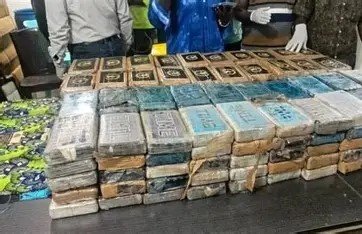
Since that dramatic arrest, linked by the Ministry of Justice to a transnational network and the seizure of 4.2 metric tons of cocaine valued at US$317 million in July, the visible momentum that once characterized Liberia’s anti-drug cartel pursuit appears to have nosedived.
Though few new arrests are being announced, however, no major follow-up seizures have been publicized, while daily raids in ghettos that filled headlines in June and July have quieted.
Instead, government appears to have shifted to image-building and diplomatic trappings at the UN General Assembly.
The case against Madam Taylor, 63, Vice President from 2018 to 2024 and ex-wife of former President Charles Taylor, was unprecedented.
Recall that the Justice Ministry accused her of meeting at her Congo Town residence in 2022 with foreign nationals, Sheik Bashiru Kante, Taras Zadereiko and Mihovil Vrovac, and later in Dubai with Croatian national Nikola Ivancic, alleged head of the network, to facilitate movement of cocaine through Liberia to Europe.
The charges included unlicensed importation, sale and distribution of controlled drugs, criminal solicitation, facilitation, conspiracy, and abuse of office.
As part of the alleged connections, three foreign nationals were charged in absentia.
The court initially denied her request for humanitarian release on asthma grounds, but she was later released to house arrest on compassionate grounds, surrendering travel documents and under movement restrictions.
For a few weeks, it looked like Liberia was finally dismantling a cartel that had turned West Africa into a transit hub for South American cocaine to Europe.
The Liberia Drug Enforcement Agency (LDEA) has announced only minor arrests, mostly of street-level dealers and users, not kingpins.
Besides, there has been no update given on the two Croatian and one Ukrainian co-defendants, or on the senior police officials that Police Inspector General Gregory Coleman said were implicated in the July seizure.
The much-touted asset tracing and money laundering investigation linked to the network has not yielded public results, as there are reports that communities in Montserrado, Margibi and Nimba where kush and cocaine ghettos thrive report the trade is back to normal.
“Few persons are being charged though, yet not much has been heard or seen,” a civil society anti-drug campaigner said. “If Jewel was the big fish, who are the small fishes feeding the market? The ghettos are still full.”
One is that the arrest of a former Vice President, a member of the opposition National Patriotic Party, has achieved its political optics, and the government is now more focused on its UN Security Council debut, investment conferences, and image-building than the messy, dangerous work of sustained drug enforcement.
Besides is the issue of institutional fatigue, where the LDEA remains underfunded, undermanned and dogged by allegations of internal complicity.
At the same time, the Kakata Central Prison jailbreak last weekend, where convicted drug trafficker Tony Obina was among more than 100 escapees, exposed how weak the correctional chain is.
Despite, the government through the Ministry of Justice and other line entities insists the investigation is ongoing and that cases are being built carefully to avoid collapse in court, citing travel records, audio recordings and witness testimonies it says link Howard-Taylor to the network.
Her defense team calls the charges baseless and politically motivated, but for families losing sons to kush, and for communities who celebrated the July cocaine burning, justice cannot be a one-stop bus.
If the campaign was truly about breaking cartels, they argue, the bus should not have stopped when Jewel got off. It should have kept moving into the ports, the checkpoints, the barracks, and the political financing that sustains the trade.
Until then, the question lingers in Monrovia’s streets hangs on whether Liberia arrests a cartel, or did it just arrest a moment.
About The Author