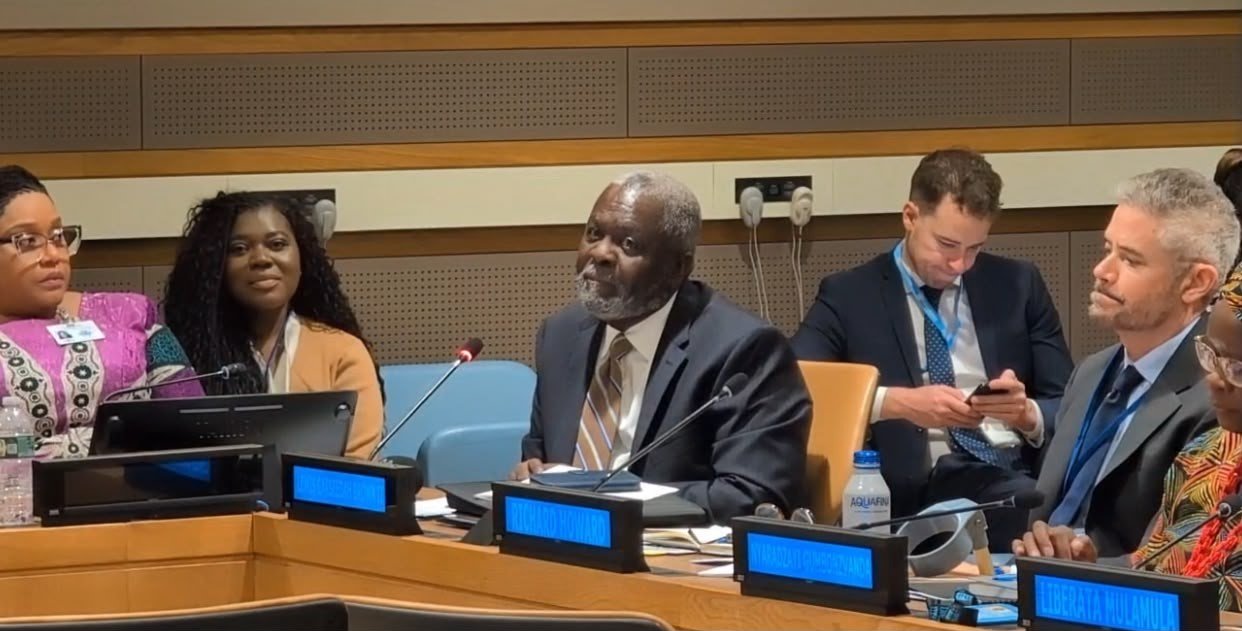
Monrovia-For more than two decades, Liberia has spoken about its youth bulge as both a promise and a peril, but last week in New York, it stopped speaking and started charting a path.
On September 18, 2026, on the sidelines of the 81st UN General Assembly, the countrh unveiled the PATHWAYS Framework, which is a 10-year vision that for the first time consolidates all youth, peace, security and development interventions into a single, measurable roadmap to 2035.
More than a document, the PATHWAYS is Liberia’s attempt to answer its most urgent demographic question about what happens to a nation where over 70 percent of its population is under 35, but most of them lack pathways to work, voice, and belonging.
Those in youth development undertakings contend that for years, youth programs in Liberia have been fragmented; a project here by the Ministry of Youth and Sports, a policy there by the Ministry of Education, a donor pilot by an NGO, a sports initiative in Montserrado that never reaches River Gee.
It is the fragmentation that PATHWAYS seeks to end that.
According to Foreign Minister Sara Beysolow Nyanti and Youth and Sports Minister Cornelia Kruah, who jointly launched it at the African Union Observer Mission in New York, the Framework merges the Ministry of Youth and Sports Five-Year Strategic Plan and the National Youth Policy under one mandate, aligned with Liberia’s ARREST Agenda and its first National Action Plan on Youth, Peace and Security (YPS).
Its essence is simple, is to create sustainable pathways, not one-off projects.
The Framework is built on six interconnected pillars, each addressing a long-standing gap of governance and how youth decisions are made.
This refers to youth desks that actually function, county youth structures that are elected not appointed, and inclusion of young women and rural youth in policy design.
It moves youth from being beneficiaries to co-designers. Liberia has long lacked credible, disaggregated youth data, how many young people are unemployed in Lofa, and how many have access to TVET in Grand Kru.
The Framework promises a national youth data system to track progress, with annual reviews, with the core promise being that every young Liberian, by 2035, should have a clear pathway to achieve their goals, whether through education, employment, entrepreneurship, or service.
This includes school-to-work transitions, apprenticeships, and second-chance education for war-affected youth.
Sports is also captured in the long-term arrangement, with focus being to reclaim sports as a development and peace tool, not just entertainment.
From the John S. S. Ball Park in Monrovia to community fields in Maryland, sports is positioned as a means for discipline, health, national unity and talent export.
Creative economy is also embedded in the framework document.
For the first time, Liberia is officially recognizing music, film, fashion, comedy, arts and digital content as an economy. With Liberian artists now filling shows in Accra and London, PATHWAYS proposes creative hubs, intellectual property protection, and financing for young creators who have been surviving on vibes and data.
There is also strategic investment, which focuses on money, considered as the hardest pillar.
The Framework does not just appeal for donor money; it challenges government to lead.
As Nobel Laureate Leymah Gbowee noted in New York, domestic financing must be at least 50 percent to prove ownership. The goal is to blend national budget allocations, private sector investment, diaspora capital and partner funding.
The timing is strategic. Liberia is a non-permanent member of the UN Security Council and will hold the Council Presidency in December 2026. Youth, Peace and Security will be a centerpiece of that presidency.UN officials have already endorsed the vision.
UNFPA Executive Director Diene Keita called it inclusive and growth-oriented. UN Assistant Secretary-General for Youth Affairs Felipe Paullier described Liberia’s leadership as a source of pride.
Sweden, which funded Liberia’s first YPS National Action Plan, and the UN Department of Political and Peacebuilding Affairs (DPPA) have pledged support to help Liberia present the framework to the Council and share it with ECOWAS and the Mano River Union.
The essence of PATHWAYS will not be tested in New York, but in Zorzor, Fishtown, Voinjama, and West Point.
The issue remains whether a young girl in Sinoe can see herself in this document, a motorcyclist in Ganta can access a loan because of it, a student in Pleebo can find a mentor.
But according to Minister Kruah, the framework is “transparent, accessible, backed by evidence and progress, not promises.”
Analysts say that transparency will require town hall meetings in all 15 counties, a public dashboard tracking targets, and genuine inclusion of youth voices, not just youth leaders close to government.
If implemented, PATHWAYS could transform Liberia’s greatest vulnerability, its youthful population, into its greatest dividend. A 25-year-old today will be 34 in 2035.
The question PATHWAYS asks is whether that 34-year-old be employed, peaceful, and invested in Liberia, or still waiting for a pathway.
Last week in New York, Liberia finally drew the map, and according to observers, the journey now must begin at home.
About The Author