
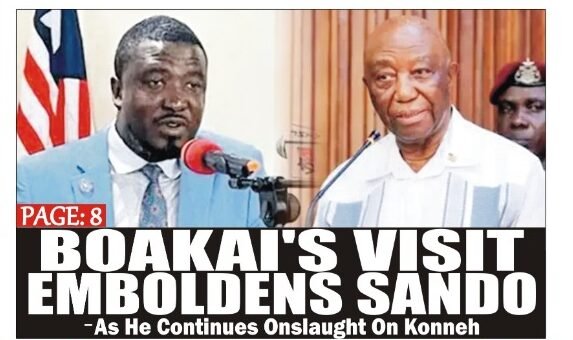
President Joseph Nyuma Boakai’s visit to the Ministry of Information last weekend has sparked fresh debate in political circles, with many asking whether it signals presidential backing for Deputy Information Minister Daniel O. Sando’s increasingly aggressive attacks on Gbarpolu County Senator Amara Konneh.
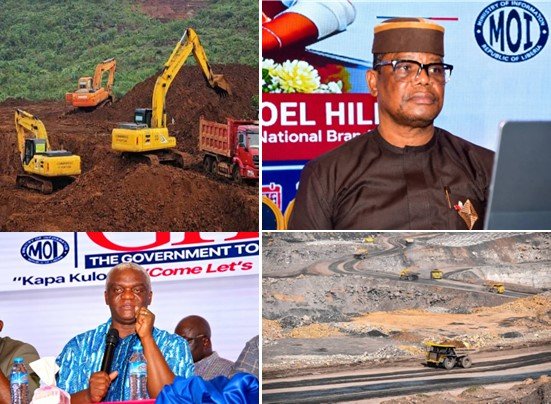
The President toured the newly upgraded facilities of the Ministry on, praising officials for the “structural upgrade” and for what he described as their “splendid work” in defending the government’s agenda.
According to our reporter, the President expressed appreciation for the work they are doing.
But the timing of the visit has not gone unnoticed, as Deputy Minister Sando, for the past two weeks, has been engaged in a public exchange of barbs with Senator Konneh, a former Finance Minister and one of the administration’s most vocal critics.
The back-and-forth has touched on issues ranging from the government’s handling of the drug crisis to economic management and transparency.
Sando has used radio interviews, social media posts, and press briefings to fire back at Konneh, often in sharp and personal terms, while Konneh has responded in kind, accusing the government of missteps and calling for greater accountability.
In the midst of that exchange, President Boakai walked into the Ministry, shook hands with staff, inspected renovations, and commended the communications team. But has the visit emboldened the Deputy Minister who was particularly seen in a lofty handshake with the President.
The ostentatious nature of the visit, which includes complete with press coverage, photo ops, and presidential praise, has led to questions about what message was sent to the Ministry’s communications team.
Beyond the public commendation, what the President communicated privately to his messaging team remains unknown. The Executive Mansion did not release a statement detailing any directives on tone or engagement with critics.
But Sando’s posture since the visit has done little to quell speculation.Rather than de-escalate, the Deputy Minister has continued his onslaught against Senator Konneh, doubling down on his criticism in multiple appearances.
In his latest move, Sando tried to lecture Senator Konneh about accountability, saying it cannot be built on speculation, selective disclosures, or the presumption that every allegation is already a proven fact.
“The Liberia National Police has neither ignored nor concealed allegations arising from the ongoing cocaine investigation,” he said in sharp response to the Senator’s latest push for an inclusive independent investigation into the cocaine busts.
Responding to the Senator, Sando disclosed that corrective and investigative measures have already been taken by the government, including the immediate removal of officers connected to the movement of the suspected narcotics vehicle from operational duties and subjected to administrative and criminal investigation, and that senior officer alleged to have received money was questioned, relieved of relevant responsibilities, and referred for further investigation.
According to him, these are not the actions of an institution shielding anyone. They demonstrate that allegations are being addressed through evidence, due process, and established law, irrespective of rank or position.
“The allegation concerning Starlink equipment is equally capable of straightforward verification. Equipment assigned to the LNP is subject to inventory, procurement, donation, and institutional accountability records,” he said in a social media post.
“If the Senator possesses evidence that any equipment was supplied by cartel actors, he should submit it immediately to the Ministry of Justice or the investigative team,” Sando challenged the Senator. “The burden of substantiating an accusation rests first with the person making it; public institutions cannot be required to disprove every unsupported claim circulated through leaks or social media.”
He added that “Legislative oversight is constitutionally legitimate and welcome. However, oversight does not convert unverified information into evidence, authorize the public declaration of guilt, or justify disclosures that may compromise witnesses, alert suspects, contaminate evidence, or prejudice future prosecutions.”
Sando said actions have been taken and that resignation based solely on accusation would substitute political pressure for evidence and weaken, rather than strengthen, institutional accountability.
“No officer is above the law, but no officer is beneath its protection either,” he argued. “Administrative action is not a criminal conviction, an allegation is not proof, and association is not culpability.”
However, “Many wondered if he is being emboldened by the President,” one government source said. “The visit came, and the attacks did not stop. If anything, they intensified.”
Sando himself has previously defended his approach, saying in a separate interview that President Boakai is aware of his public responses and would “call him to order” if there was a problem.
The Boakai administration has faced growing criticism over how it engages with opposition voices, particularly on sensitive issues like the recent cocaine busts at RIA and in VOA Community, Margibi County.
MPC Political Leader Simeon Freeman last week accused the government of using “zogoes,” a reference to street boys, to insult critics instead of addressing policy concerns.
He specifically pointed to officials at the Ministry of Information.With the President now publicly associating himself with the Ministry at the height of the Sando-Konneh feud, observers say the administration risks being perceived as endorsing a confrontational style over substantive policy debate.
The Ministry of Information is central to how the government explains its agenda on the economy, drugs, and governance. The structural upgrades praised by the President are intended to improve that capacity.
But as the 2029 political season begins to take shape, the tone of government communication is becoming a political issue itself.
Senator Konneh has not responded to Sando’s latest remarks. The Senator’s office said he “remains focused on legislative duties and issues affecting the Liberian people.”
About The Author