
By Jamesetta D Williams
MONROVIA–The Central Bank of Liberia (CBL) has said it is taking steps to strengthen the country’s credit system, improve loan recovery and expand access to financing as it prepares to convene a National Non-Performing Loans Resolution Conference from September 9–11.
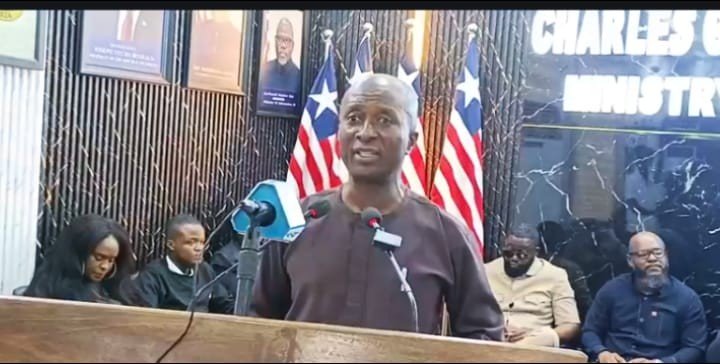
Musa Kamara, Senior Technical Advisor to the Executive Governor of the Central Bank of Liberia, outlined a series of financial-sector reforms being undertaken by the CBL when he addressed Ministry of Information press briefing last week.
Kamara said the upcoming three-day conference will bring together stakeholders from the Executive, Legislature and Judiciary, as well as commercial banks, private-sector representatives, credit unions, microfinance institutions, development partners, foreign embassies and other relevant institutions.
He said the conference is intended to identify practical solutions to the challenges surrounding non-performing loans and ultimately free up resources within the banking system for businesses and individuals seeking financing.
According to Kamara, non-performing loans have become a concern because when borrowers fail to repay loans, the funds remain tied up and cannot return to the financial system to be lent to other businesses and individuals.
He explained that commercial banks play a major role in providing credit to businesses to expand their operations, create jobs and contribute to economic growth.
Kamara disclosed that Liberia’s non-performing loan ratio has declined from approximately 10 percent of total loan portfolios to about 1.2 percent as a result of reforms implemented by the Central Bank.
Despite the reduction, he said the outstanding value remains significant at approximately US$71 million.
He said recovering the funds and returning them to the banking system could create additional financing opportunities for businesses and individuals capable of using the resources productively.
“The money is there,” Kamara said, emphasizing that the banking sector is not necessarily suffering from a shortage of liquidity.
He explained that banks have instead become more cautious about lending because of concerns about borrowers’ ability to repay and the difficulties associated with recovering outstanding loans.
Kamara said the situation can also affect legitimate borrowers seeking financing to expand their businesses and may contribute to concerns surrounding interest rates and other borrowing costs.
Kamara identified economic shocks, challenges within the legal and judicial system, lengthy court proceedings and the absence of a sufficiently developed loan-resolution market as some of the factors contributing to non-performing loans.
He said some loans end up in court because borrowers fail to comply with repayment agreements or disputes arise between lenders and borrowers.
According to Kamara, the experience of the Special Commercial Court also points to the need for additional reforms to make the resolution of commercial and financial cases more efficient.
He said the September conference will therefore examine how Liberia can strengthen its legal and enforcement framework while protecting the legitimate rights of both lenders and borrowers.
Another major component of the reform agenda is the enhancement of Liberia’s Collateral Registry System, according to Mohammed Fonsia Donzo, Senior Director for Regulatory Affairs at the CBL.
Donzo said the initiative is intended to improve access to financing, particularly for small businesses and individuals who often struggle to meet the traditional collateral requirements of commercial banks.
He noted that many small businesses do not own land or buildings that can be pledged as collateral, although they may possess vehicles, machinery, inventory, receivables and other valuable assets.
The Collateral Registry, which was established in 2010, allows financial institutions to register assets pledged by borrowers and determine whether those assets have already been pledged to another lender.
Donzo explained that the enhanced system will provide banks with better information before approving loans and help prevent borrowers from using the same asset to obtain multiple loans from different financial institutions.
For instance, a borrower who uses a vehicle valued at US$10,000 to secure a US$2,000 loan from one bank could attempt to use the same vehicle to obtain another loan from a second bank.
Under the registry system, the second bank would be able to search the asset and determine that it had already been pledged.
The first financial institution to register the collateral would have priority over the asset in the event of default.
Donzo said the enhanced registry will also cover immovable and fixed assets, including properties and machinery.
He explained that the reform is intended to address situations where individuals use the same property to secure loans from multiple financial institutions without lenders having adequate information about existing claims on the property.
The CBL is also working to strengthen the country’s credit-reference system to improve information-sharing among financial institutions.
Officials said limited access to information about borrowers has contributed to situations where individuals obtain loans from multiple institutions without lenders having access to their complete borrowing history.
Under an improved credit-reference system, a borrower who defaults on a loan would face greater difficulty obtaining additional financing without the new lender being aware of the existing debt and repayment history.
Officials emphasized that the objective is not to punish borrowers, but to promote responsible borrowing and repayment.
They said when borrowers repay their loans, the money can return to the financial system and become available to other businesses and individuals.
The CBL also disclosed during the briefing that commercial banks were required under Central Bank policy to write off more than US$40 million in non-performing loans last year.
Officials explained that loans can eventually be classified as losses when borrowers fail to make payments for an extended period.
The Central Bank stressed that the impact extends beyond commercial banks because much of the money being lent by financial institutions comes from deposits made by ordinary Liberians, businesses and other customers.
Consequently, when borrowers fail to repay, the impact can extend to the broader financial system.
The financial-sector reforms could also pave the way for the introduction of new financial products, including student loans.
Kamara said student financing is among the objectives being considered under the CBL’s five-year strategic plan.
Donzo, however, explained that financial institutions must be able to determine how borrowers will repay loans before extending credit.
He said reliable cash flow would remain an important consideration in developing possible student-loan products.
The broader reforms could also allow individuals and small businesses to access financing using assets other than traditional land and buildings, including vehicles, motorcycles and machinery.
CBL officials said the September conference is expected to go beyond discussions and produce specific commitments and a roadmap for reforms.
The Executive, Legislature and Judiciary are expected to participate, alongside financial institutions, private-sector actors, development partners and other stakeholders.
Relevant government institutions are expected to take responsibility for implementing reforms agreed upon during the conference.
The CBL also plans to include stakeholders from across Liberia, particularly those operating outside Monrovia, including credit unions, microfinance institutions and marketing associations.
Officials said their participation will help identify challenges faced by ordinary Liberians in accessing and repaying credit.
The Central Bank maintains that Liberia cannot achieve meaningful economic transformation if businesses and individuals are unable to access financing or if banks are unable to recover funds that have already been lent.
The planned reforms are therefore intended to improve access to credit, strengthen loan recovery, promote responsible borrowing, unlock capital for businesses, support private-sector growth and create jobs.
The National Non-Performing Loans Resolution Conference, scheduled for September 9–11, is expected to provide a platform for national dialogue and collective action aimed at strengthening Liberia’s financial system and creating a more accessible and reliable credit environment.
About The Author