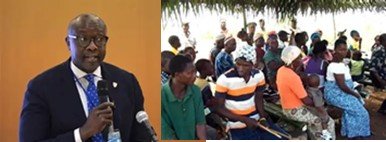
Flashback: citizens attentively listen to officials
Monrovia-Before and after the devastating civil war, the story of hardship, deception and corruption remains Liberia’s biggest dilemma, despite promises of trans-formative governance intended to improve the lives of the suffering masses.
This is what the Boakai-led government said it would do but almost three years into the administration that prides itself on leadership dexterity, the “worst” is said to have now become the new normal.
This is what citizens inquiries and concerns captured in the summary of Senator Amara Konneh’s perspectives delivered Tuesday, October 20, seem to point to, showing how citizens of the country, not just the people of Gbarpolu, are yearning for solutions to the hardship confronting them.
The growing concerns largely centered on reports from the government that the economy is performing, projected to grow at 5.5% in the next fiscal year, though there is a reported hovering plague of hardship across the country.
Senator Konneh, who represents Gbarpolu County, said he saw that contradiction firsthand during his recess break.
In spite of few deliverable citizens of the county welcome, they raised concerns about other issues affecting their lives.
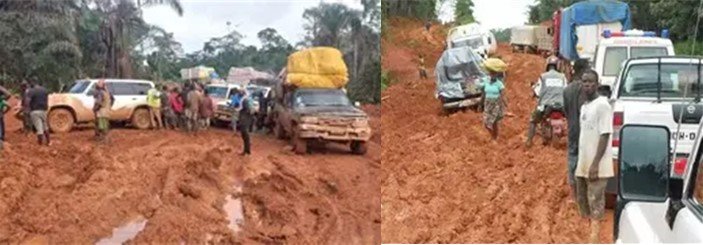
“They welcome the yellow machines but fear delays in government financing will stall roadworks,” Konneh told his colleagues.
He revealed how residents praised their two health centers and volunteer health workers, but asked that they be placed on government payroll.
According to him, residents also flagged poor school conditions and asked “When will government send a police officer for security”
In the Gbarma District, Konneh said he met with the PTA, elders, students and teachers of Gbarma and Vaye Town High Schools, the district’s most populated schools, indicating that both of the schools are in crisis with leaking roofs, no labs or libraries, and three students per desk.
“If we cannot keep rural high schools and regional universities like Western Region University in Tubmanburg open and functional, we are exporting poverty to Monrovia. Our people do not want handouts. They want security, roads, schools, and quality healthcare,” he said.
He also touched on more important issues affecting petroleum industry.
As Chair of the Petroleum Levies Task Force, Konneh said an audit of LPRC lifting versus LRA collections from October 2025 to June 2026 showed 107 million gallons lifted, with 21 of 25 importers underpaying.
He announced a new rule of “No Pay, No Lift,” requiring digital LRA confirmation before LPRC releases any product.
Senator Konneh said no company is above the law that funds the counties. He also raised concerns with the RIA Highway road project as Co-Chair of the Joint Public Accounts Committee.
According to him, the RIA Highway was not built to design and costs are climbing, while public revenues sit in commercial banks for days before hitting the Consolidated Account, even as government borrows from the same banks at high cost.
The project began during the administration of former President George Weah faced delays due to “technical, administrative and legal issues.” Its completion was projected for 2027 but there are possibilities it might go beyond the period.
On the issue of economic growth, Konneh contrasted the gains, quoting the people as asking “Government says the economy is growing and collected $1 billion – why are we still suffering?”
He explained that while growth rose from 4% in FY2024 to 5.1% in FY2025 and 5.5% in FY2026, and inflation is falling, three factors explain why people don’t feel it, noting how prices still rise faster than incomes.
The gap was -4.3 in FY24, -3.4 in FY25 and -0.4 in FY26, he said, explaining that growth is not inclusive.
“Mining grew 16.6% and accounts for 23.4% of GDP, but creates few jobs. Agriculture, which employs 70% of Liberians, slowed to 1.3%. Money doesn’t reach services,” Konneh said.
“PSIP execution in health and education is only about 4%. Schools are budgeted for but funds are not disbursed.”
Konneh said fuel is food, education and health in Liberia, which is 85% import-dependent and 90% road-dependent.
According to his statistics, from October 2024 to September 2026, gasoline rose from L$775 to L$985 and diesel from L$840 to L$1,235, a 47% increase.
Senator Konneh quoted a Senate probe which he said found consumers were overcharged L$131 million due to a wrong exchange rate, narrating how high fuel prices double transport costs, drive food inflation, and collapse small businesses, while bad roads increase fuel consumption by 30-40%.
The Gbarpolu Senator warned that FY2026’s $1.303 billion budget looks historic but includes a one-off $200 million concession bonus, stressing “Real revenue is $1.1 billion, and spending at $1.3 billion risks a $100-150 million deficit.”
He recommended six actions, including re-anchor spending to $1.1 billion, fix compensation and debt rigidity, fix PSIP procurement in Q1, fix farm and mining bottlenecks, publish petroleum prices weekly, and close $3.24 million in levy leakage to fund a $0.05 reduction for keke riders.
Also, Konneh warned that the drug crisis hurts more than bad roads, noting “In Gbarpolu, residents begged for help with Kush, Tramadol and marijuana more than for roads.”
He cited that Liberia is now a user country, LDEA seizures are up 300% in 2025, and 60% of admissions for young men 18-35 at JFK and Jackson F. Doe hospitals are drug-related psychosis.
The Senator proposed that the Senate fund rehabilitation centers outside Monrovia, make drug education compulsory in schools, empower communities to report ghettos with protection, and link farm programs to at-risk youth.
“A road without youth is empty. A school without clear minds is wasted. Let’s fund prevention, not just funerals,” he said.
About The Author