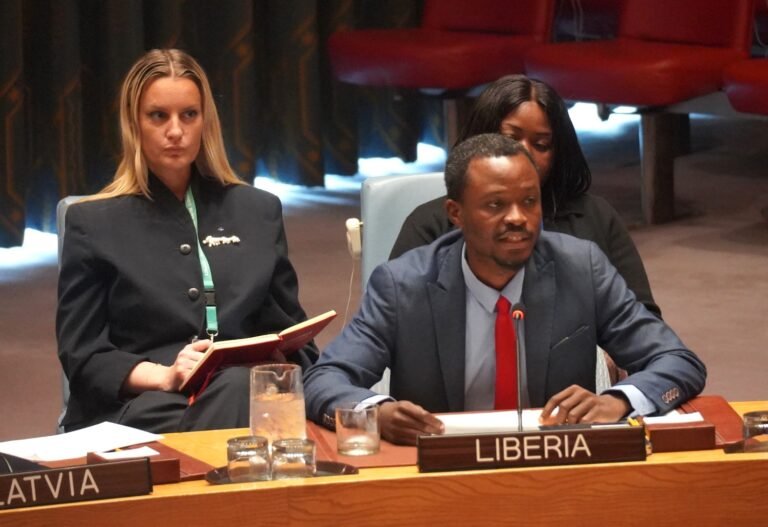
Monrovia-Liberian female lawyer, Cllr. Charlyne M. Brumskine took the oath of office Tuesday at the Community Court of Justice in Abuja, Nigeria at a glittering but enthralling ceremony graced by seasoned dignitary of lawyers and members of the court.
Amid thunderous applause, Cllr. Brumskine marched forward in front of the president of the Court for the administering of oath.
“I, Charlyne M. Brumskine, do solemnly swear that I will faithfully perform my duties and exercise my powers as a member of the Community Court of Justice, honorably, faithfully and impartially and conscientiously,” she read as part of the oath before appending her signature to the record book, fully confirming her membership of the court as one of the lawyers.
In July of this year, the Authority of Heads of State and Government approved statutory appointments for the 2026–2030 mandate, confirming Mrs. Charlyne M. Brumskine as a Judge of the ECOWAS Court of Justice and Mr. Dehpue Yenpea Zuo as Commissioner for Economic Affairs and Agriculture at the ECOWAS Commission.
Authorities said the appointments represented a significant diplomatic achievement for Liberia under President Joseph Nyuma Boakai’s administration, giving the country greater influence in two of ECOWAS’ most consequential institutions at a time when the regional bloc is pursuing ambitious reforms in economic integration, agriculture, food security, judicial cooperation and regional governance.
Brumskine joins a five-member panel of judges selected from across the region to serve on the ECOWAS Court of Justice during the 2026–2030 mandate. The Court serves as the Community’s highest judicial body, interpreting ECOWAS treaties and adjudicating disputes involving Member States, Community institutions and human rights matters.
She will serve alongside judges from The Gambia, Benin, Nigeria and Togo after receiving the endorsement of the regional leaders.
Cllr. Brumskine is widely regarded as one of Liberia’s leading female legal practitioners, with extensive experience in corporate law, governance, constitutional law, and public policy.
She serves as Principal and Managing Counselor of the CMB Law Group, one of Liberia’s prominent law firms, where she has represented multinational corporations, development agencies, businesses, non-governmental organizations, and government institutions.
In addition to private legal practice, she previously served as an Assistant Professor of Law at the Louis Arthur Grimes School of Law, where she mentored and trained aspiring Liberian lawyers.
Brumskine is also admitted to the Liberian National Bar and the New York State Bar, and has practiced before multiple United States District Courts. She earned a Juris Doctor degree from Howard University School of Law after graduating from Barnard College in New York.
The Community Court of Justice, ECOWAS, was established pursuant to Article 15 of the ECOWAS Revised Treaty, and listed in Article 6 thereof as one of the institutions of the Community.
It was designed as an inter-state Court and also as Court of first and last resort, to facilitate the economic integration process of the Community, with the primary mandate of interpreting and applying the Revised Treaty and the Community legal Acts.
The 1991 constitutive Protocol A/P1/7/91 on the Court provides that the Court is the principal legal organ of the Community. The Court commenced operations in 2001 following the swearing in of its seven pioneer Members on 30th January 2001.
However, in January 2005 the Community adopted Supplementary Protocol A/SP.1/01/05 which amended the initial Protocol on the Court and expanded the mandate of the Court.
The Supplementary Protocol granted direct access to the Court to individuals and corporate bodies in respect of certain causes of action. Consequently, the Court now has four distinct mandates: Mandate as a Community Court; Mandate as ECOWAS Public Service Administrative Tribunal; Mandate as a Human Rights Court; and Mandate as an Arbitration Tribunal. It is significant that the Protocol on the Court as amended granted the Court jurisdiction to determine cases of violation of human rights that occur in any Member State.
In the exercise of its human rights mandate, the Court has fashioned a unique and expansive human rights Mechanism with liberal access rules that do not require the exhaustion of local remedies.
Although the Mechanism does not have an associated catalogue of rights, the Court applies the African Charter and the basic United Nations Human Rights Instruments in the enforcement of the human rights mandate.
It is noteworthy that the protection of Human Rights is a cardinal and fundamental value of the Community, and the ECOWAS Court of Justice is ably holding Member States accountable for their Treaty obligations to respect, protect and fulfil human rights.
Although the primary responsibility of the Court relates to its oversight functions in respect of the economic integration of the Community, its human rights mandate is now the centrepiece of its judicial activities.
The ECOWAS Court of Justice is obviously the pacesetter amongst regional courts in Africa and has rendered hundreds of judgements since its establishment. We take pride in the fact that the Court was awarded the 2022 Columbia Global Freedom of Expression Prize for its judgment in Amnesty International, Togo v. Togo. We are delighted that the jurisprudence of the Court is a rich source of research materials for jurists, scholars and lawyers.
The Court remains committed to the robust implementation of all its mandates in the ECOWAS integration process and as an authoritative forum for the scrutiny of human rights violation complaints throughout the Community. As a key judicial institution of the Community, we will continue to promote the rule of law, democracy and good governance, while playing an active role in the provision of the enabling legal environment for the attainment of Community objectives.
The Court is also committed to deepening inter-institutional relations with other ECOWAS Institutions, and fostering cordial relations with ECOWAS Member States, particularly, the national courts of Member States, while maintaining the independence of the Court.
About The Author