
Monrovia-Liberia’s coffee farmers are working toward full cooperative status in an effort to strengthen their bargaining power, improve market access, and increase the economic benefits of coffee production.
The initiative is being spearheaded by the International Trade Centre (ITC) and the Farmers Union Network of Liberia (FUNL), in collaboration with the Cooperative Development Agency (CDA), through efforts to build farmers’ capacities and prepare them for formal recognition as cooperatives.
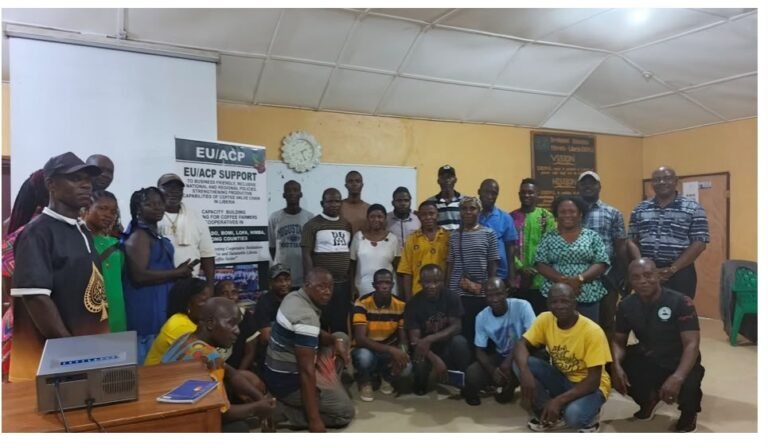
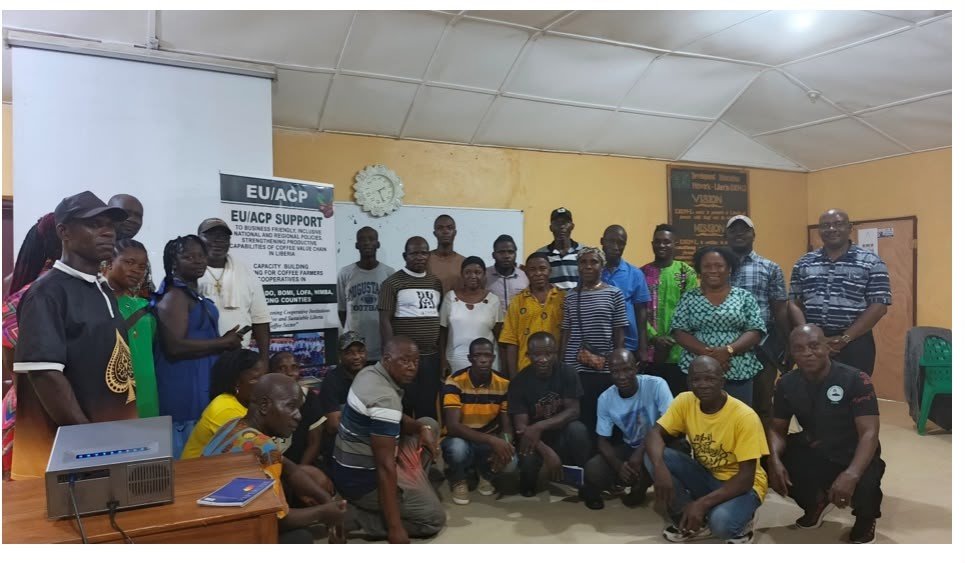
Funded by the European Union (EU), a weeklong workshop was held in Gbarnga, Bong County, from November 16 to 21, 2026, bringing together approximately 60 lead farmers from Bong, Nimba, Lofa, Bomi, and Montserrado counties.
The workshop brought together key stakeholders, including the CDA, Liberia Agriculture Regulatory Authority (LACRA), and International Institute for Tropical Agriculture (IITA), and an EU expert, alongside representatives of ITC and FUNL.
Discussions focused on the legal framework for cooperatives, governance and management, business development, and cooperative sustainability, particularly in relation to the EU’s regulations on forest governance.
Despite the economic potential of coffee production, many Liberian farmers continue to face challenges in maximizing the value of their produce due to limited market access, weak institutional structures, and inadequate bargaining power.
Since 2022, ITC and FUNL have worked with the government to support the formation of farmer cooperatives as a means of strengthening collective production and improving access to markets and other economic opportunities.
Several farmer groups have reportedly attained pre-cooperative status, while others remain at different stages of the formation process, awaiting formal recognition by the CDA.
FUNL President Josephine Francis reaffirmed the organization’s commitment to working with ITC and other partners to guide farmers through the cooperative formation process.
Francis challenged farmers to work collectively and meet the requirements necessary to obtain government recognition.
She said farmers who operate individually often sell their coffee cherries and beans at lower prices and under unfavorable conditions imposed by middlemen.
According to Francis, obtaining full cooperative recognition would allow farmers to pool their produce, negotiate collectively, improve market access, and secure better prices for their coffee.
Also speaking, LACRA Director for Research and Planning Wesseh Zoryou said the authority, which is responsible for tree crops, is supporting farmers through capacity-building initiatives, including the provision of seedlings and training.
He said the initiative is expected to create more jobs and increase coffee production, making Liberia’s coffee more attractive to international markets.
Under the EU-funded OACPS Business-Friendly Coffee Project, farmers in targeted counties have also begun establishing individual coffee farms after receiving training in climate-smart agricultural practices.
The project includes demonstration activities designed to improve coffee production, productivity, and quality.
As Liberia seeks to revive its coffee industry and restore its competitiveness in the international market, strengthening farmer organizations is increasingly becoming a key part of the effort.
The transition from pre-cooperative groups to fully recognized cooperatives is expected to give farmers a stronger institutional voice, improve their access to financing and markets, and help ensure that greater economic benefits remain within coffee-producing communities.
About The Author