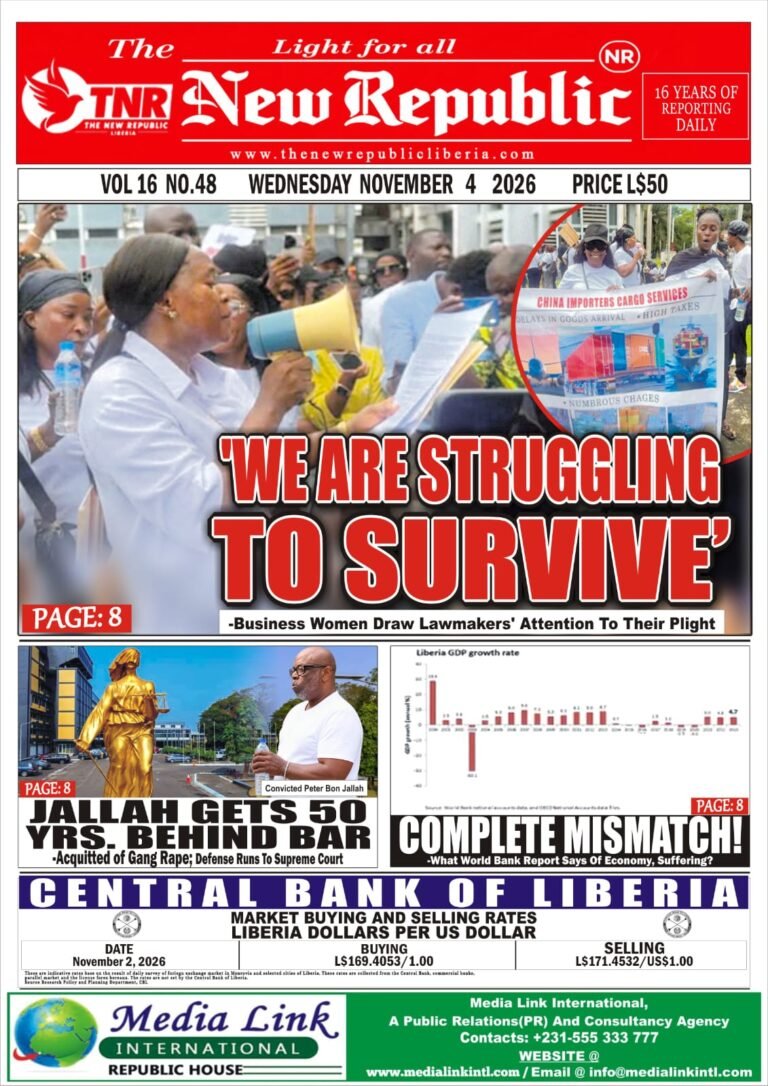

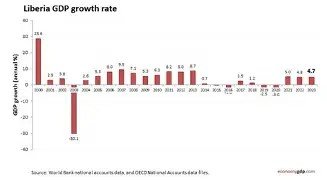
Monrovia-The World Bank recent report of ‘economy doing well’ against ‘sprawling hardship’ has shown what observers term “sharp mismatch” about government’s performance and wellbeing of citizens.
Recall that the WB reported Tuesday that Liberia’s economy grew by 5.1 percent in 2025, supported by a strong rebound in mining and continued expansion in services, but stronger and more inclusive job creation will be critical to translating growth into better living standards.
The finding is contained in the 7th edition of the World Bank Group Liberia Economic Update, LEU, launched today in Monrovia under the theme: “Beyond Growth: Addressing Structural Constraints to Job-Rich Growth in Liberia.”
According to the report, mining expanded by 17 percent in 2025, while services grew by 4.6 percent, supported by trade, electricity supply, and transport. Agricultural growth, which employs majority of Liberians, slowed to 2.6 percent.
“Liberia also made progress in strengthening its fiscal position, with the overall fiscal deficit narrowing to 2.1 percent of GDP from 2.5 percent in 2024,” the report said.
It also indicated that public debt declined from 56.4 percent to 55.1 percent of GDP, inflation remained contained, supported by tight monetary policy, a broadly stable exchange rate, and moderate global food and fuel prices.
It however warned that external buffers remain limited, with international reserves covering about 1.6 months of imports at the end of 2025, underscoring Liberia’s continued vulnerability to external shocks.
“Liberia’s recent economic gains are encouraging. The key challenge now is translating growth into opportunities and improvements in people’s lives,” said Georgia Wallen, World Bank Group Country Manager for Liberia.”
Achieving Liberia’s national development goals means sustaining macroeconomic stability while addressing the structural barriers that prevent businesses from expanding, workers from accessing productive opportunities, and communities from fully participating in the country’s growth.
“The report examines Liberia’s recent economic performance and the structural constraints affecting poverty reduction and job creation.It notes that despite 5.1% growth, hardship persists – a reality many Liberians feel in markets where rice, fuel and transport costs remain high.
The reason, according to the Bank, is that growth is concentrated in mining, which creates few jobs, while agriculture and manufacturing, which employ many, are growing slowly.
Part two of the report focuses on state-owned enterprises, SOEs, which provide important services and have implications for public finances. It highlights the importance of strengthening SOEs’ oversight, transparency, financial reporting, and performance as part of Liberia’s broader reform agenda.
The report calls for greater attention to the fiscal risks associated with SOEs and clearer accountability for their financial and operational performance.
“State-owned enterprises play an important role in delivering essential services, but strong oversight is critical to ensuring that they operate transparently and sustainably,” said Bonnie Ann Sirois, World Bank Group Senior Public Sector Specialist and co-author of the report.
“Improved financial reporting, accountability, and monitoring of fiscal risks can help protect public resources and strengthen their contribution to Liberia’s development.
“Liberia has over a dozen SOEs including LEC, LWSC, NPA, LPRC, and others that have historically been plagued by losses, political interference and poor financial reporting, requiring constant bailouts from the budget.
The report highlights four policy priorities to help Liberia translate economic growth into broader development gains, including preserving macroeconomic stability through prudent fiscal management, stronger domestic revenue mobilization, and rebuilding external buffers, enabling private sector growth and job creation by addressing constraints that limit productive investment and economic diversification.
Others are strengthening SOE governance and oversight, including financial reporting, transparency, accountability, and monitoring of fiscal risks, and promoting more inclusive growth by focusing policy and investment on expanding productive economic opportunities and improving livelihoods.
“Liberia needs to build on its macroeconomic progress by addressing the structural constraints that limit productive investment and job creation,” said Gweh Gaye Tarwo, World Bank Group Country Economist and lead author of the report.
“Stronger fiscal management, a more enabling environment for the private sector, and improved governance of state-owned enterprises can help put the economy on a more sustainable and job-rich growth path.”
The Liberia Economic Update is a World Bank Group publication that reviews recent economic developments and prospects.
The Seventh Edition focuses on translating economic growth into poverty reduction and job creation.
For Liberians, the message is familiar that GDP can grow by 5.1%, revenue can cross US$1 billion, debt can fall but if there are no jobs, no stable electricity, and no money in people’s pockets, growth does not feel like growth.
The Bank says the next phase is not just about growing more, but growing where it matters in farms, factories, and small businesses that create jobs Liberians can feel.
The report was made at the time of growing debate between critics and supporters of the government regarding its performance pitted against that of the former George Weah administration.
Weah handed power to Joseph Nyuma Boakai on January 22, 2024 in what is known as Liberia’s first democratic transfer from one elected president to another in decades.
Two years and nine months into Boakai’s term, Liberians are asking the same question in markets, keh keh stops and ataye shops which time was better, whether Weah time or Boakai time.
The answer is not simple, depending on whether you are asking about money in the pocket, price of rice, road you drive on, or hospital you go to.
The Weah administration (2018-2023) reported it inherited a fragile economy where inflation hit 27% in 2019, the Liberian dollar crashed to L$200 to US$1, and the government struggled to pay salaries.
His Finance Minister Samuel Tweah implemented an IMF program, harmonized salaries, and by 2022-2023, inflation dropped to single digits around 7-8%, and reserves improved. GDP growth averaged 4-5% in his last two years, driven by mining, especially gold and iron ore, and a construction boom.
But debt rose sharply.
Domestic debt, especially to commercial banks and contractors, ballooned. The economy grew on paper, but many Liberians did not feel it.
The Boakai administration (2024 to present) has also indicated it inherited debt. According to Finance Minister Augustine Ngafuah, the government met empty coffers and over US$700 million in domestic obligations.
Since coming to office, Boakai team is focused on discipline, ensuring revenue hit a record over US$1 billion in 2025 for the first time, with reports of Liberian dollar been relatively stable, L$190-L$195, and inflation remains around 8-10%. Above that, the IMF Extended Credit Facility was renewed.
But growth has slowed to around 4% and the cost of living is biting. The government has increased the budget from $750 million under Weah’s last budget to $1.3 billion, yet much of it goes to debt repayment, salaries, and recurrent costs.
Public Sector Investment Project execution in health and education is still only about 4% of what is budgeted, according to Senator Amara Konneh’s committee.
According to economic experts, Weah stabilized after a rough start and spent heavily, while Boakai is stabilizing debt and raising revenue, but spending is not yet translating to visible development.
The judgment is that under Weah, 25kg bag of rice: L$3,500 – L$4,500 in 2023, while Gasoline sold from L$750 – L$850.
Though transportation was relatively cheap, but bad roads increased cost in southeast
Under Boakai, 25kg bag of rice L$2,700 and above in late 2025-2026
At this point, gasoline is sold L$9,50 – L$1,250, with frequent shortages due to port and storage issues.
Most market women say hardship is worse now. “Under Weah, money was not much but we could manage. Now money is not there at all and things are expensive,” said a trader at Duala Market.
Weah injected cash through massive construction. Contractors, marketers, and youth got daily jobs on road projects, Invincible Park, PHP Park, Duala Market.
His administration was criticized for waste, but cash circulated. The “pro-poor” policy meant small cash transfers, loans to market women, and heavy political spending.
Boakai’s policy is more institutional, according to observers. The government says it is cleaning the payroll of ghost names, auditing, and saving. That means less political cash. Government is not giving out money to partisans like before. The private sector complains that contracts are slow, and payment to vendors is delayed.
Civil servants say salary is more regular, but traders, motorcyclists and casual workers say liquidity, actual cash moving hand to hand, is lower.
“Under Weah, you could hustle and see something. Under Boakai, everything is audit, audit. Audit doesn’t put food on table,” a Ganta businessman said.
About The Author