By Jamesetta D. Williams
Monrovia-Former President Ellen Johnson Sirleaf has initiated a political debate about Liberia’s political system being largely foreign tailored, insisting it is high time the country reversed such trend in the interest of national sovereignty.
Her suggestion comes about nine years after leaving office as Liberia’s first democratically elected female president who relied on foreign systems of governance to reposition Liberia after years of conflict.
As President, she worked with the international community, utilized their systems of governance and politics to canoe her agenda for the country.
Now reading political governance from an observer advantage, she is however suggesting a reset of Liberia’s political makeup, calling for greater focus on the country’s national interest.
Madam Sirleaf challenged Liberia’s long-standing tendency to look toward the United States for political and institutional models, calling for a u-turn
The comments have sparked a broader conversation about whether Liberia’s political system and institutions are sufficiently designed around the country’s own realities and national interests.
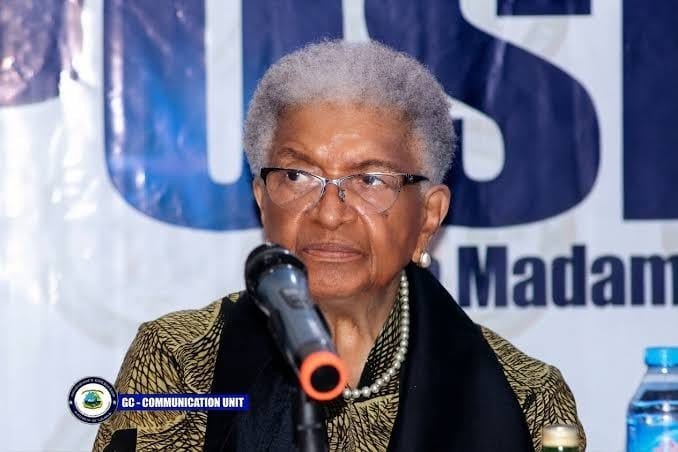
Madam Sirlead told journalists Tuesday, following her participation in a day-long Governance Commission symposium marking the Month of Good Governance, that Liberia should move away from simply copying foreign systems and begin developing solutions that respond to its own circumstances.
“We have to stop following the United States of America. Let’s join the new era of sovereignty, respectability,” Sirleaf said, arguing that Liberia has for decades operated with structures, policies and political thinking influenced by external models.
She said the changing political and social environment in Africa requires Liberia to reconsider some of the approaches it has traditionally followed and take greater ownership of its national development.
For Sirleaf, the issue goes beyond Liberia’s relationship with the United States. Her remarks point to a broader question of whether the country is developing institutions and policies based on its own needs or simply adapting systems created elsewhere.
She urged Liberians to take responsibility for building a system of governance that reflects the country’s history, challenges and aspirations.
Meanwhile, President Boakai has raised a different but related concern about the country’s political culture, particularly the relationship between those in government and those outside of government.
Speaking at the Rock International Church during an intercessory prayer service, President Boakai questioned the meaning of political opposition in Liberia.
“In the United States, they say the Democratic Party and the Republican Party. In Liberia, we say ‘Opposition.’ What are we opposing? We should all be working together for the benefit of this country,” Boakai said.
The President’s remarks suggest that political differences should not prevent Liberian leaders from cooperating on issues that affect the national interest.
His comments also raise a question about whether political opposition in Liberia should be defined primarily by resistance to government policies or by constructive engagement aimed at improving national governance.
Taken together, the statements from the two leaders highlight different aspects of Liberia’s political development.
Sirleaf is calling for Liberia to develop greater confidence in its own institutions and reduce its dependence on foreign political and governance models. Boakai, meanwhile, is calling for a political environment in which disagreement does not automatically translate into opposition to every government initiative.
The two positions ultimately place national interest at the center of the discussion, although they approach the issue from different directions.
For Sirleaf, Liberia’s challenge is partly about finding its own path as a sovereign nation. For Boakai, the challenge is about ensuring that political differences do not overshadow the collective responsibility to develop the country.
The statements come at a time when Liberia continues to debate the strength of its democratic institutions, the role of political opposition and the country’s ability to formulate policies that address its own development challenges.
As Liberia continues to strengthen its democratic system, the remarks from the former and current presidents leave a central question for political actors and citizens alike: How can Liberia maintain healthy political disagreement while ensuring that national interests remain above partisan and foreign influences?
About The Author