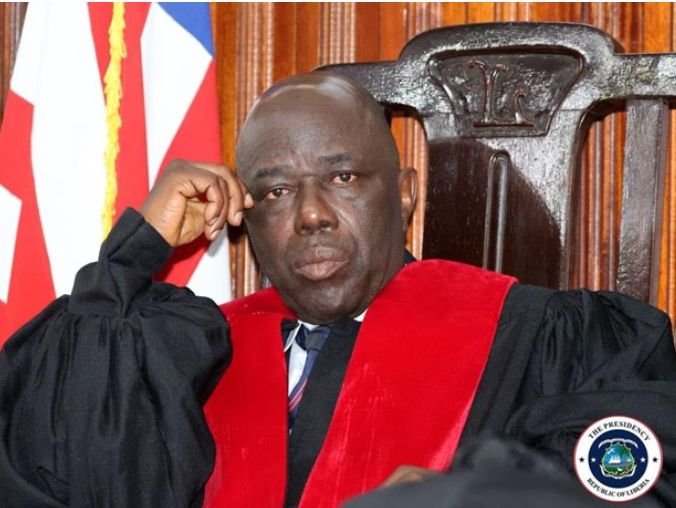
Monrovia-The suspension of Cllr. Dempster Brown, as Chairman of the Independent National Human Rights Commission (INHRC), has renewed focus on the rigmarole that has rocked the country’s tenure regime, legal framework designed to position certain entities to avoid too much of bureaucratic and executive control for a period of time, since the inception of the government.
The INHRC is one of several government entities that enjoys tenure privileges with its chairman serving for a period of time before being removed based on cause or reappointed, if deemed necessary.
Almost three years into the administration of President Joseph Nyuma Boakai, a startling fact has emerged that, except for Cllr. Alexandria Zoe of Liberia Anti-Corruption Commission (LACC), that no other single person appointed to a tenure-protected position by former President George Manneh Weah is still serving.
From the Central Bank of Liberia (CBL), to the Environmental Protection Agency (EPA), the National Fisheries and Aquaculture Authority (NaFAA), the Liberia Telecommunications Authority (LTA), the Liberia Electricity Corporation (LEC), the National Identification Registry (NIR), the Independent National Commission on Human Rights (INCHR), the Governance Commission, and the Liberia Extractive Industries Transparency Initiative (LEITI), all entities of government covered by law under tenure protection, almost every Weah appointee has been removed.
What began as a quiet administrative move is now being described by opposition figures, legal analysts, and civil society as the systematic dismantling of the tenure system in Liberia to pave the way for partisan employment.
Upon taking office on January 22, 2024, President Boakai announced that he would not be bound by what he called “illegally appointed tenure holders” and that he would fight corruption. Within weeks, his administration unveiled a three-step playbook that has now been used almost identically in every tenure agency.
Instead of directly firing tenure holders, which the law prohibits except for proven cause like gross misconduct, incapacity, or criminal conviction, the President would issue an Executive Order or a letter from the Executive Mansion suspending the official indefinitely for “alleged financial impropriety” and ordering an audit by the General Auditing Commission (GAC).
The Liberia Anti-Corruption Commission (LACC) and GAC were instructed to investigate entities protected by tenure, after which good number of them were removed from office through suspension, unpaid, and functionally out of office.
What is concerning about how people are removed from tenure positions is the appointment by the President of loyalist of the ruling Unity Party (UP) into acting capacity, Officer-In-Charge, or Interim head, all of whom would later be appointed on permanent basis.
Legal experts say this is a clever circumvention of Article 54 and other statutes that grant tenure.
“The law says you can only remove a tenure official for cause proven through due process. This government found a loophole: Don’t remove them, suspend them forever and appoint your person to act. It is removal by another name,” said a Monrovia-based constitutional lawyer.
At the Central Bank of Liberia (CBL), then Governor J. Aloysius Tarlue was suspended in July 2024 for alleged breach of compliance while Deputy Governor for Operations, Nyemade Pearson, was also forced out. Both were appointed by Weah and had years left on their tenure. In their respective places, President Boakai appointed UP aligned individuals.
The two former officials were not arraigned before court and convicted or acquitted, yet they remain out.
Executive Director Prof. Wilson Tarpeh, a Weah appointee with a fixed tenure, was suspended in May 2024 for alleged administrative irregularities. He was replaced by Dr. Emmanuel K. Urey Yarkpawolo, a staunch UP loyalist from Bong County.
The same is at the National Fisheries and Aquaculture Authority (NaFAA) where then Director General Emma Metieh Glassco, one of the most celebrated Weah tenure holders credited with cleaning up the fisheries sector and raising revenue, was suspended for alleged financial misconduct in early 2025. She was replaced by an acting leadership loyal to UP.
At the Liberia Telecommunications Authority (LTA), Chairperson Edwina Crump Zackpah and commissioners appointed by Weah were all forced out through similar suspension letters, the same with the INCHR and Governance Commission where Commissioners who had tenures running up to 2027 were asked to “take administrative leave” until further notice.
In 2024, some of the affected tenure officials, including Tarlue, went to the Supreme Court of Liberia, arguing that their removal violated the Tenure Law. The Court, in a landmark ruling, declared that the President cannot remove tenure officials at will and must respect tenure security.
But the Executive branch, according to critics, simply ignored the spirit of the ruling. It never reinstated them. It kept them on suspension, arguing that “suspension is not removal” and that the President has administrative discretion to suspend pending investigation, an investigation that has no timeline.
“They are using suspension for alleged corruption as a coverup to employ partisans of the Unity Party,” said a former official of the CDC who asked not to be named. “Show us one audit report that led to conviction. Not one. But show us the list of acting heads — all are UP partisans, campaigners, or relatives of UP bigwigs.”
An analysis of the new appointees who replaced Weah’s tenure holders shows a clear pattern, according to experts, that most served as campaign coordinators for the Rescue Mission in 2023, many are from Lofa County, the President’s home county, or are relatives of senior UP officials, and several had no technical background in the agencies they now head, raising questions about competence versus loyalty.
The Unity Party government defends its actions, saying it inherited a corrupt system where Weah had illegally extended tenure to reward his loyalists and that Boakai had to clean up.
Information Minister Jerolinmek Piah has repeatedly said “The President has the mandate to fight corruption. If you are under investigation, you cannot remain in office to tamper with evidence.”
But former opposition CDC lawmaker Acarous Moses Gray countered “If it’s corruption, charge them and take them to court. You cannot suspend a man for two years without a single indictment and then say you are fighting corruption. You are fighting tenure.”
Liberia’s tenure laws were created for a reason: to insulate critical regulatory and integrity institutions, CBL, LTA, EPA, LEITI, INCHR, from political interference, so that they can make decisions based on law, not loyalty to the President.
By effectively abolishing tenure through indefinite suspension, analysts warn, President Boakai has set a dangerous precedent, according to political critics, and according to them, “When the next President comes in 2029 or 2035, he too will repeat the same playbook, suspend all Boakai appointees for alleged corruption and bring his own people.”
“Today it is Weah’s appointees. Tomorrow it will be Boakai’s appointees. We have destroyed the very idea of institutional independence,” said a governance expert at the University of Liberia.
As of this October 2026, the scoreboard is clear that almost all Weah-appointed tenure holders are out of the picture , replaced with UP partisans.
For the CDC, it is a political purge. For the Unity Party, it is a necessary cleanup. For Liberia’s governance system, it may be the final nail in the coffin of tenure protection.
About The Author